Friday, 30 July 2021

4 Takeaways From Billie Eilish’s New Album Happier Than Ever


Last January, Billie Eilish and her brother Finneas responded with audible groans when their album, When We All Fall Asleep, Where Do We Go?, was awarded Album of the Year at the Grammys. “We didn’t make this album to win a Grammy… we didn’t think we would win anything ever,” Finneas, who produced the album, told the crowd in a sheepish acceptance speech. “We stand up here confused and grateful.”

Eighteen months later, the pair has returned to a much bigger audience and much higher expectations, as Eilish’s sophomore album, Happier Than Ever, arrives on all streaming platforms. Eilish, at just 19, is one of the most adored pop stars in the world, a seven-time Grammy winner and the subject of her own documentary (The World’s A Little Blurry on Apple TV). And in its first day, the 16-track Happier Than Ever (Interscope) immediately shot to the top of Apple Music’s albums chart in the U.S. and many other countries; the album sees her expanding her musical palette, exploring personal trauma and abuses of power, and tweaking her unique fashion sensibilities. Here are the main takeaways from Happier Than Ever.
[time-brightcove not-tgx=”true”]

Eilish’s expanding musical palette includes crooners-era pop, electronica and pop-punk

Eilish’s music has long been difficult to place into a neat genre box; she and Finneas have drawn from Soundcloud rap production, Laurel Canyon folk harmonies and techno. Happier Than Ever retains many of Eilish’s signature soundslanguid ballads, lingering, whispered syllables, dreamy synthesizer pads—while expanding outward into a disparate array of genres and eras. Eilish has talked about her love for jazz and pop torch ballad singers from the ‘50s and ‘60s like Julie London and Peggy Lee, and it’s not hard to hear their influence on songs like “Halley’s Comet” and “Everybody Dies.”

The album also swerves into sonic pockets more suitable for the dance floor: the outro of “I Didn’t Change My Number” is nearly overwhelmed by an abrasive sawtooth bass, while “Oxytocin” recalls the dark twitchiness of Britney Spears Blackout era. And on the second half of the title track, Eilish and Finneas switch to a punk-pop setup, turning up tom-tom drums and electric guitars until they seize with feedback, while Eilish unleashes several guttural howls reminiscent of Phoebe Bridgers’ “I Know the End.” “I screamed my lungs out when we recorded this song. I’ve wanted to get those screams out for a long time,” Eilish said in a Spotify interview accompanying the album.

Her lyrics address male toxicity and beauty standards

As the teenage Eilish has navigated the music industry over the last four years, she has become increasingly vocal about the way in which young women are preyed upon and taken advantage of. “I don’t know one girl or woman who hasn’t had a weird experience, or a really bad experience,” she told Vogue earlier this year. Many of the album’s lyrics touch on similar themes of vulnerability and abuse. “They’re gonna tell you what you wanna hear/ Then they’re gonna disappear/ Gonna claim you like a souvenir/ Just to sell you in a year,” she warns someone younger than herself on “Goldwing.” On “Your Power,” she addresses an abuser directly: “She said you were a hero/ You played the part/ But you ruined her in a year/ Don’t act like it was hard.”

The album also includes “Not My Responsibility,” a short monologue from 2020 that addresses toxic beauty standards, the male gaze, and the paparazzi. After she released the monologue, Eilish was the subject of a torrent of bodyshaming when a photo of her in a tank top went viral. Eilish addressed the sequence of events in the album commentary on Spotify, saying that the interlude was “some of my favorite words I’ve written, and I feel like nobody listened.”

“I put it out and everyone was like, ‘Yas queen! Body positivity!’ And like three months later, there was a picture of me in a tank top and the whole internet was like, ‘FAT!’” she said, laughing.

Eilish sings about her personal life with startling candor

Eilish has said that while much of her previous music was based on characters, Happier Than Ever is much more autobiographical; it deals with a breakup, abuse, identity crises, the perils of fame and losing any semblance of privacy. “I’ve had some trauma, did things I didn’t wanna/ Was too afraid to tell ya, but now, I think it’s time,” she sings on the opener, “Getting Older.” Eilish, as she is wont to do, laces these heavy topics with flippant humor: she laughs off needing therapy in “Male Fantasy” and recounts how legal documents have become a part of her love life on “NDA.”

The album also recounts a breakup with some startling specificity. In the documentary The World’s A Little Blurry, footage captures Eilish with her previously-secret boyfriend, Brandon Adams, as they fall in love and ultimately fall out. One scene shows Eilish unhappily confronting Adams about driving home drunkon the album’s title track, Eilish sings of an extremely similar situation: “You call me again, drunk in your Benz/ Drivin’ home under the influence/ You scared me to death but I’m wastin’ my breath/ ‘Cause you only listen to your f-ckin’ friends.”

The album marks a new era for Eilish’s fashion

When Eilish became a public figure a few years ago, her fashion sensibility was unmistakable: spiky chains; dichromatic green-black hair, oversized hoodies, homages to punk, goth and skateboarding styles. She has since tested many different looks, leaning into eccentric haute couture and pin-up throwbacks. For this album’s rollout, she has chosen an elegant, muted approach in which she sports voluminous blonde hair, plush fabrics and lies across Persian rugs. It’s a marked shift from a previous era in which her chains were always audible in interviewsin which she ate spiders and talked about her penchant for sucking on dirty jewelry. But while some may clamor for the old Billie, the look fits the album’s more refined sonic approach—and will likely be only one of many stylistic shifts by a young star in the process of building a durable and unpredictable career

The 5 Best New TV Shows Our Critic Watched in July 2021


July marks the high point of the summer season, and television has noticed. Along with the sparse, anticlimactic but occasionally transcendent Tokyo Olympics, the past month’s best programming has gone hard on sun and fun. Below, you’ll find a devilish dramedy that revolves around trouble in paradise, romances of the both the period-drama and the reality-competition variety, a journey into the sounds of pop music—as well as a surprisingly honest, artful documentary portrait of an Olympian among Olympians.

In need of additional suggestions? Here’s a list of my favorite shows from the first half of 2021, plus a few more highlights from June.
[time-brightcove not-tgx=”true”]

FBoy Island (HBO Max)

Here’s something I never thought I’d type: thank heavens for FBoy Island. Like Love Island, Temptation Island and, sure, 30 Rock‘s satirical MILF Island before it, FBoy transports a couple dozen hot people to the kind of luxury-beach-resort backdrop where even non-exhibitionists might plausibly wear swimsuits all day. At the center of the game are three gorgeous women, Sarah, Nakia and CJ, looking to get into serious relationships with men who really care about them. Of their 24 chiseled suitors, half are self-identified Nice Guys—guileless dudes who really have come to find love—and half are FBoys (a cleaned-up version of the obvious profane slang term) competing solely for a cash prize.

In the wrong hands, a premise like this could yield the same sexist schlock that is standard for this kind of dating show: look at these poor, stupid girls falling for all the old womanizer gambits. This is where FBoy’s smart execution makes all the difference. Crucially, the women not only come off as relatively intelligent and perceptive, but also generally have each other’s backs, collaboratively sleuthing to sniff out FBoys and saving each other from unpleasant dates. It’s a refreshing change from the catfights that The Bachelor and its clones are always serving up. With a few fun exceptions, the show also conceals from both viewers and the other men whether each contestant is a Nice Guy or an FBoy. This shatters the illusion that it’s easy to tell who’s who, while also maintaining suspense and allowing us to play along from home. [Read TIME’s full review of FBoy Island and Sexy Beasts.]

Naomi Osaka (Netflix)

I wasn’t expecting Netflix’s three-part documentary Naomi Osaka to remind me so much of Radiohead’s Meeting People Is Easy. Released at the height of the band’s mainstream popularity, in 1998, Grant Gee’s tour film captures some stunning musical performances—but what makes more of an impression is all the footage of exhausted musicians trudging their way through interviews, photo shoots and other media obligations that feel unnervingly similar no matter where on Earth they happen to be. The primary mood is disorientation. This is another way of saying that Naomi Osaka isn’t like any other sports doc I’ve ever seen.

Director Garrett Bradley, whose excellent feature Time was nominated for an Academy Award this year, spent two years following the Haitian-Japanese tennis superstar as she ascended to become the top-ranked player in the world. Although it contains no small amount of nail-biting tournament footage, and ends on a high note with Osaka’s Australian Open victory earlier this year, this is no simplistic inspirational narrative. In frank, patient interviews and candid vérité scenes, Bradley evokes a sense of what it must be like to actually be Osaka. And it certainly isn’t easy. The pressure heaped on her by the outside world is exceeded only by the pressure this thoughtful, determined, relentlessly self-critical athlete places on herself. Watching her smile politely through silly fashion shoots, endure rude questions at press conferences and, at one point, wonder aloud whether she’s failed to achieve all she should have by age 22 can be heartbreaking. To her great credit, Bradley captures her subject at some truly vulnerable moments—at one point we watch her immediate, emotional reaction to the death of her mentor Kobe Bryant—without ever coming off as exploitative. By the time the credits roll on episode 3, the series arrives at two very different but equally strong conclusions: Naomi Osaka is incredible, and talent is a curse.

The Pursuit of Love (Amazon)

The Pursuit of Love, a three-part miniseries adaptation of Nancy Mitford’s classic novel from writer-director-actor Emily Mortimer, comes to Amazon on July 30. An instant best-seller in the UK, the book, which TIME’s reviewer praised in 1946 for how it “plays on the surface of life so wittily and deftly,” cast a gimlet eye on an aristocracy—one that included the author’s family, who notoriously spanned the political spectrum of the time—struggling to acclimate to a new social order. Yet the story’s emotional urgency derives less from Mitford’s sharp satire than from the fiercely romantic temperament of its central character, Linda Radlett. Without sacrificing humor or social commentary, Mortimer thrillingly modernizes The Pursuit of Love by ratcheting up the romance in unexpected ways. [Read the full review.]

Watch the Sound With Mark Ronson (Apple TV+)

The first series of this crowded summer for music on TV that really jibes with the way people of all ages listen is Watch the Sound With Mark Ronson, an Apple TV+ original that debuts on July 30. Looking forward more often than he looks back, host Ronson—the producer behind meme magnet “Uptown Funk,” A Star Is Born mega-hit “Shallow” and Amy Winehouse’s Back to Black—takes on the difficult task of explaining various elements of sound without putting non-gearheads to sleep. An episode on reverb takes him to a disused underground oil tank in Scotland, home of what is probably the longest echo in the world. The show’s format can be playful, too. In a clever illustration of the topic at hand, an installment on sampling fills transitions between segments with collages of sounds and images from other parts of the episode. [Read an essay on the recent glut of post-MTV music television.]

The White Lotus (HBO)

Vacation, all we ever wanted—especially now that travel is starting to feel safe again. So great is the thrill of drawing up an itinerary for the first time in 16 months that it might plunge us into denial of what we know deep down: that vacation is no panacea. It’s a break from work, sure, for those who can actually log off. But our real troubles, the ones that infect our most precious relationships, can’t be checked at the front desk of any five-star hotel. They follow us to our destinations, reframing our every experience, like human remains in the cargo hold of a plane packed with tourists.

This grim metaphor constitutes the opening scene ofThe White Lotus, a darkly hilarious, existentially terrifying HBO miniseries from writer, director, actor and occasional reality-TV star Mike White. In a Hawaii airport, a tourist couple interrogates a somber-looking man (perennial rom-com boyfriend Jake Lacy in spoiled-frat-boy mode) about his honeymoon at a resort called the White Lotus. “Our guide told us someone was killed there!” the woman exclaims. Yes, says the groom; the body is, just now, being loaded onto the plane they’re about to board. Then it occurs to the couple to ask where his bride is. “No offense,” he replies. “Leave me the f-ck alone.” [Read the full review.]

‘The Ripple Effect Is a Major Concern.’ Chicagoans Worry Lollapalooza May Become a COVID-19 Hotspot


When music fan Noah Zelinsky bought tickets to the Chicago music festival Lollapalooza in May, he thought it might signal something of a return to normalcy after more than a year of isolation. “There’s so much pent up excitement, being the first major thing back,” he says. But a lot can change in two months. “Now, there’s a lot of fear countering that.”

As Lollapalooza arrives, along with its potentially hundreds of thousands of attendees, in Grant Park, worrying signs abound: the highly contagious Delta variant of the coronavirus has spread across the U.S., with Chicago’s COVID-19 daily case rate quintuple what it was a month ago, albeit nowhere near the heights of this spring. And recent music festivals, including the Verknipt festival in Utrecht, Netherlands, and Rolling Loud in Miami, have been connected to outbreaks among their attendees and surrounding communities. Whether or not Lollapalooza, which runs from July 29 through Aug. 1, succeeds in holding COVID-19 at bay could make the festival a tipping point in whether or not the country’s triumphant reopening continues as planned throughout the summer and fall.
[time-brightcove not-tgx=”true”]

“I think it has the makings [of a superspreader event],” Theresa Chapple-McGruder, a Chicago area maternal and child health epidemiologist, told TIME. “When we’re in a place where rates are rising, we need to put prevention strategies in place. I don’t see how a large festival like this could meet that criteria of slowing the spread.”

Relaxed safety requirements in the face of rising cases

Lollapalooza has been a Chicago institution for 15 years, regularly drawing 100,000 people each day of the typically four-day event. This year, the lineup includes Miley Cyrus, Tyler the Creator and the Foo Fighters, and marks the first major cross-genre festival to return to the U.S. since the pandemic’s start. Lollapalooza’s parent company, Live Nation, has been working closely with public officials, including Chicago Department of Public Health Commissioner Dr. Allison Arwady, to implement safety guidelines, including a system to check if attendees have valid COVID-19 vaccine cards, vaccine records or negative tests upon entering, and to advocate that everyone wear masks while on festival grounds.

“It’s outdoors. We’ve been having large-scale events all over the city since June without major problems or issues,” Chicago Mayor Lori Lightfoot said in a press conference this week. On Thursday, the first day of the festival, organizers said that 90% of attendees have showed proof of vaccination, with 600 people turned away for lack of paperwork.

However, in the two months since the festival was reannounced in May—when full weekend passes rapidly sold out, perhaps in part because the event was canceled last year—the Delta variant has spread rapidly throughout the U.S., accounting for 83% of new COVID-19 cases, the U.S. Centers for Disease Control and Prevention said last week, with most clustered in unvaccinated populations. The number of new cases reported daily in Chicago had dropped to as low as 34 in late June, but is now back up to 192 a day, although hospitalizations remain drastically lower than their peak this spring. (Hospitalizations typically lag behind increases in case rates.)

“We’ve seen data suggesting that vaccinated people are more likely to be breakthrough cases now than at other points in time with other variants, and that vaccinated people who are breakthrough cases may spread just as easily as unvaccinated people,” Chapple-McGruder says. “Those two pieces really lead to the concern about community transmission.”

Even as cases rise, Lollapalooza has relaxed its requirements for unvaccinated attendees. While Lightfoot had said in May that festivalgoers needed to show a negative COVID-19 test taken 24 hours or less before entering, that number has now been increased to 72 hours, allowing a much longer window to theoretically contract the virus before the festival. Earlier this month, the Verknipt festival in the Netherlands admitted unvaccinated attendees as long as they had a negative test taken within 40 hours of entering. The festival was later linked to 1,000 COVID-19 cases among its 20,000 attendees, and Lennart van Trigt, a representative of the Utrecht health board, admitted that the event’s policies were misguided. “In 40 hours people can do a lot of things, like visiting friends and going to bars and clubs,” Van Trigt said. COVID-19 tests also aren’t 100% accurate and can be easily faked—and there is a lag between when people contract the virus and when they might return a positive test.

Not all recent similar events have suffered from outbreaks. The Exit Festival, an electronic music festival in Serbia which welcomed some 45,000 people a day, recorded zero infections according to a study published a week afterward. Serbia has had relatively low COVID-19 rates, but festival organizers told Billboard that more than half of its attendees were foreign visitors; their monitored sample of festival guests was tested for COVID-19 both when entering the gates and a week later.

On the other hand, there have been reports of numerous COVID-19 cases connected to last weekend’s hip-hop festival Rolling Loud in Miami. Tens of thousands of people showed up daily to the festival, which did not require masks, vaccinations or negative tests. This week, the rapper Dess Dior and the actor Alexa Leighton, among others, announced on social media that they had tested positive for COVID-19. Their infections coincided with a larger spike in Florida at large, in which COVID-19 cases and hospitalizations have risen dramatically.

Potential for spread far beyond Chicago city limits

Critics of Lollapalooza are worried that the festival could spread COVID-19 in two dimensions: first in the Chicago area, and second, everywhere people travel back to after the weekend ends. Lollapalooza is a commuter festival—set in the middle of downtown Chicago, with many festivalgoers arriving by public transit from other parts of the metropolis. If that trend holds, it could make for buses and trains on the Chicago Transit Authority (CTA) jam-packed with a mix of unvaccinated festivalgoers and essential workers returning to in-person work, every day of the festival. “Many people who rely on using public transportation are essential workers who don’t have remote accommodationsand there’s going to be a domino effect, where they’re going to be on the same CTA car or [in the same] bars and restaurants as all these people coming in from outside the city,” says Elena Gormley, an organizer for Social Service Workers United-Chicago.

If the festival turns out to be a superspreading event, there could be significant trickle-down effects. Mayor Lightfoot told the New York Times’ Kara Swisher that if Chicago’s daily case rate jumps over 200, she would consider reimplementing a mask mandate as well as other measures. Jim DeRogatis, a longtime prominent Chicago music journalist, told the Washington Post that the impact of another shutdown on Chicago’s independent venues could be catastrophic. “If infections start again in a serious way and the city has to start shutting down again, I don’t see how they survive,” he said.

Others are more concerned about what happens when the festivalgoers return home to places with lower vaccination rates. (About 52% percent of Chicago’s population has been vaccinated, which is slightly higher than the national average.) Chicago health officials just added nine states to the city’s travel advisory—including nearby states like Missouri, Arkansas and Tennessee—which encourages unvaccinated travelers from those states to either obtain a negative test or quarantine. But it will be difficult for health officials to track those people if they arrive and leave by car. “We don’t even have to look as far as neighboring states: I think it’s going to be an issue with neighboring counties and cities to Chicago,” Dr. Chapple-McGruder says. “The ripple effect is a major concern for me.”

Putting faith in festival organizers and fellow attendees

On the subreddit r/Lollapalooza, a conversation emerged this week about COVID-19, with some expressing concerns and others readily dismissing them. “If I get it, I get it. I’m gonna enjoy this weekend. Been waiting a fat minute for a someone [sic] normal summer,” wrote one commenter.

Noah Zelinsky, who is 21 and from Chicago, is attending the festival with his friend Savanna Savoy, 18, who drove down from Minnesota to attend. They say they have friends flying into Chicago for the festival from across the east coast, and that they are both vaccinated and eager to return to live music—a once-essential aspect of their lives—despite the widespread consternation about the festival they are seeing online. “Now that there’s an opportunity to go out, it shouldn’t be an issue for those who are vaccinated, since we’re the ones who were staying home for so long,” Savoy says.

Savoy and Zelinsky say they plan to wear their masks for most of the outdoors festival, while acknowledging the organizers’ guidance to stay 6 feet away from people will likely be impossible. They also plan to go to some of the festival’s afterparty concerts, which take place indoors. “We’re putting a lot of hope in the other people around us,” Zelinsky says.

Dr. Chapple-McGruder recommends that festivalgoers wear their masks outside and particularly in crowded spaces, find less-crowded places to eat and take public transit during off-peak hours. “If you live with or can’t avoid contact with high-risk individuals, maybe reconsider your attendance,” she says.

Meanwhile, nearby businesses are contemplating the risk-reward ratio, with some taking the plunge into opening up to a wider, more maskless clientele for the potential economic benefits. Billy Dec, who owns the Underground nightclub less than a mile from the park, hosts all-night afterparties for Lollapalooza artists and attendees every year, and is looking forward to welcoming revelers back: “There are a lot of people that are really positive about what the festival is doing for the spirit of a city that this year has been really tough on,” he says. However, he says he will keep his club’s capacity much lower than in years past. “We’re going to be over-careful about capacity at the door,” he says. “We’re going to keep our numbers low.”

Table to Stix Ramen, in Evanston, will be part of the festival’s Chow Town area; it closed for a full week prior in order to prepare for the potentially huge and hungry crowds. While chef and owner Kenny Chou typically has five employees, he will be bringing 20 onsite and says he has discussed the risks with them. “Every one of my staff members is vaccinated and will be attending, with full knowledge of the risk of the delta variant,” Chou wrote in an email. “We know it will be difficult social distancing with this large of a crowd. I trust the coordinators and the Lollapalooza staff to keep everyone safe.”

Crypto Tax: How Congress Wants to Pay for Your New Roads


This article is part of the The DC Brief, TIME’s politics newsletter. Sign up here to get stories like this sent to your inbox every weekday.

The whole sexiness of cryptocurrency has been its potential to disrupt the status quo, to revolutionize Wall Street and create a new democratic ethos in a global economic system has largely been dictated by the U.S. dollar since the end of World War II. Well, that allure is starting to fade as even crypto’s strongest evangelists realize they may still have to play by Washington’s rules if they want to keep literally printing its own money.
[time-brightcove not-tgx=”true”]

A bipartisan framework on infrastructure spending—and how to fund that spending—cleared its first procedural hurdle in the Senate on Wednesday. A 2,500-page draft of the deal is now racing through Washington, though lawmakers today are saying it’s premature to treat it as gospel. Special interests are still trying to sneak in their own efforts as patience among negotiators is at a nadir. Much of the accounting behind how the $550 billion in new spending in the bill will be paid for is shaky at best (more on this below) but one piece is pretty solid: $28 billion is slated to come from tightening up taxation on cryptocurrencies. In other words, making sure people mining mints from their computers are paying the IRS what they’re due.

Companies that operate in the crypto ecosystem have been snapping up K Street lobbyists, but the outlays are still relatively small. Coinbase, essentially the New York Stock Exchange of crypto, has upped its spending on lobbying to $160,000 so far this year, up from the $100,000 at this point in 2019, the last full year uninterrupted by a pandemic that benched most of K Street and suspended in-person lobbying. Ripple, a major player in the cryptocurrency space that is facing a potentially devastating SEC lawsuit, has spent $550,000 lobbying in the first half of this year, more than twice what it spent in all of 2019. And an entirely new lobbying group, The Crypto Council for Innovation, is bringing together crypto leaders with the likes of Fidelity and Square to help crypto companies ward off the threat of regulation or, perhaps worse for them, taxes.

“If we don’t start planning and taking action soon, we have everything to risk,” Perianne Boring, the head of the Chamber of Digital Commerce, a cryptocurrency lobbying group, warned earlier this year.

These aren’t Washington neophytes unsure how to navigate the government’s choppy waters; the Chamber of Digital Commerce’s board is basically a roster of former regulators and insiders, including former White House chief of staff Mick Mulvaney. Which is why D.C. is now seeing a who’s who of power players in both parties line up with rising crypto firms.

But the crypto industry’s recent interest in D.C.’s political infrastructure may be coming too late.

Crypto’s highly unregulated currency has long had its critics in Washington, perhaps none more vocal than Sen. Elizabeth Warren of Massachusetts. Because of its anonymity and portability, it has the potential to fund underground economies, like human trafficking and drugs. And it’s all taking place on the Internet, a place most denizens of Washington don’t understand in much detail. To be blunt: if you’ve ever watched a hearing on tech issues, it becomes very clear very quickly that most lawmakers haven’t really expanded their understanding of the Internet much beyond that gem of a moment when Sen. Ted Stevens called it “a series of tubes” back in 2006.

That doesn’t mean Congress doesn’t sniff an opportunity around the overlooked crypto market, particularly when lawmakers are looking for cash. Enter the bipartisan ambitious infrastructure plan, whose own finances don’t actually add up. The nonpartisan Committee for a Responsible Federal Budget released its own quick assessment of the bipartisan plan, which lawmakers declared was paid for without any new spending. The so-called “pay-fors” in the bill probably will cover only half of the $550 billion in new spending, the group found.

The rest was coming from the bet that states would give back cash already allocated to them, the whole plan having a 33% return on investment and holidays from requiring companies to fully fund pensions in real time. A $6 billion draw-down of the Strategic Petroleum Reserve that is one of the pay-fors is money already spent. Even the whole “waste, fraud and abuse” cannard is back, saying it was a still-TBD pay-for. The proposal left out that there actually isn’t that much fraud to be caught and it barely covers the cost of the search. (Spending $5 billion anti-fraud saves only $6 billion, or a payoff of a net $1 billion.) And the writers of the outline are including in the pay-fors unemployment insurance costing less than anticipated, 5G spectrum sales that have already taken place and COVID-19 money that’s already been spent.

That leaves us with cryptocurrency taxes. By going for crypto’s keys, lawmakers spotted a relatively unorganized sector that most Americans cannot define and still has relatively few powerful friends in D.C. It’s telling that Republicans derailed plans to beef up the IRS’ chase of tax scofflaws and opted instead to use some budget gimmicks and crypto crackdowns to pay for this investment in roads, bridges and, in a twist of irony, $65 billion for high-speed Internet.

Legacy tech companies have learned—painfully—that disinterest in Washington doesn’t mean Washington will ignore an industry it sees growing, thriving and threatening long-standing systems. Failing to play the influence game comes with actual costs: in this case, $28 billion. It sure makes a couple million spent on K Street influence peddlers seem like a good ROI.

Make sense of what matters in Washington. Sign up for the daily D.C. Brief newsletter.

I Lived in My Car and Now I’m in Congress. We Need to Solve America’s Housing Crisis.


I had never realized St. Louis could get this cold in September. I reached into the back seat to take my 6-month-old daughter and 1-year-old son out of the playpen that was perched in front of trash bags filled with our clothes, and into my arms. The hot, late-summer sun had set, and the temperature plummeted with it. I fought sleep, my eyes watering from exhaustion. What if my babies got too cold and I didn’t wake up? I looked down at my watch. It was 3 AM ─ 4 hours until I had to be up for my shift.

[time-brightcove not-tgx=”true”]

Today, as a Congresswoman, I remember what it was like for us to live out of my car when I’m thinking about how to legislate on behalf of my district. I think about how society wanted me to believe that being unhoused was my fault. We have a deeply rooted misconception in our country that unhoused people have done something to deserve their conditions ─ when the reality is that unhoused people are living the consequences of our government’s failure to secure the basic necessities people need to survive. Many unhoused people work full time but earn starvation, unlivable wages. Some struggle to access mental health services or substance use treatment, making earning a consistent and stable wage nearly impossible.

When I was living out of my car, I did not know where we were going to eat, use the bathroom, rest or enjoy a quiet moment. I used McDonald’s bathrooms to mix baby formula and wash my body because I had no other options. I received food from food pantries, but I could not eat the items that had to be refrigerated or cooked. This never ending instability, combined with the constant fear of interacting with the police, losing custody of my children, having my car impounded — or even losing my life — left me stressed, traumatized and exhausted.

Being unhoused in America must no longer be viewed as an individual shortcoming, but rather as an unacceptable, life-threatening policy failure. Our government created the economic and social conditions under which I, and countless others, became unhoused — through unlivable wages, the absence of affordable housing and childcare, and an inaccessible health care system. Instead of comprehensively addressing this crisis, our government has approached it with patchwork solutions that disregard the humanity of people without housing and those who are living on the edge.

It shouldn’t be this way. It doesn’t have to be this way.

This week, I introduced a resolution that would put unhoused people in homes, address the compounding public health emergency, and eradicate the conditions that foster the unhoused crisis. The Unhoused Bill of Rights is the first-ever federal legislation to declare the civil and human rights of unhoused individuals, particularly the right to sit, stand, sleep, or eat in public without fear of harassment or criminalization. It describes in detail the multitude of complex issues faced by unhoused people on a daily basis, especially in relation to the disproportionately high levels of mental and physical trauma, substance use disorders, exposure to communicable diseases, and treatment on behalf of health care professionals.

The Unhoused Bill of Rights illustrates concrete actions the federal government is obligated to take to end the unhoused crisis by 2025, protect and enforce the human rights of unhoused people, and provide the highest levels of support for unhoused advocates, communities, and programs. Dramatically expanding the affordable housing stock, mandating universal housing vouchers, implementing universal health care, and guaranteeing livable wages are permanent solutions that will keep people sheltered and safe.

With the eviction moratorium set to expire on July 31st, millions of Americans face the imminent threat of becoming unhoused or housing insecure while the global pandemic continues to ravage our communities. The eviction moratorium must not only be extended, but strengthened to protect vulnerable renters and their families. But these monthly extensions are a temporary fix, not a solution. As elected lawmakers, we have a solemn duty and obligation to develop and enact policies that will permanently end the unhoused crisis. This will require bold, holistic action that addresses the root causes that lead to people becoming unhoused.

As I wake up every morning to a life that is so different from where it was 20 years ago, I think of the person who spends their nights struggling to stay awake out of the fear of what could happen to them or their loved ones if they let their heavy eyelids fall shut. It is for that person, and every person who went to bed without a roof over their head or not knowing whether there will be a roof over their head tomorrow, that we must right the societal wrongs that our failed policies have created. It is our duty to build a better future.

Can Biden Finish What Obama Started And Close Down Guantanamo?


Nineteen years after he was captured in Afghanistan, and five years after a review board ruled he posed no threat to the United States, Abdul Latif Nasser was finally released this month from the U.S. military prison complex at Guantanamo Bay, Cuba, and repatriated to his native Morocco. He became the first prisoner transferred from the notorious detention facility in more than three years.

The move became the first real sign that there’s an effort underway to close Guantanamo. Since President Joe Biden came into office, however, administration officials at the Pentagon, State Department and National Security Council have quietly been working on a strategy to shutter the facility, built after the al-Qaeda attacks of Sept. 11, 2001. Designed to detain individuals apprehended by the U.S. in its War on Terror, the prison has been become a costly and damaging quagmire for the U.S. government, once labeled by Amnesty International as the “gulag of our time.”
[time-brightcove not-tgx=”true”]

One of former President Barack Obama’s first orders in 2009 was to close the facility within a year; he failed. Now, twelve years later, his former Vice President is taking on the same arduous challenge that will require help from Congress and wholesale changes in the military commissions process.

After Nasser’s transfer, Guantanamo now houses just 39 inmates. Ten of them are already cleared for release, and 17 others are eligible for a periodic evaluation by a parole-like board about whether they, too, can be transferred. A dozen more high-value prisoners, including Khalid Shaikh Mohammed and other alleged plotters of the Sept. 11 attack, are set to remain at Guantanamo Bay until they are tried in military tribunals there. The Biden Administration wants to repatriate the detainees who have been cleared for release to foreign countries and work with Congress to lift current restrictions that block the remaining prisoners’ transfer to U.S. mainland facilities.

At the core of White House’s push to close Guantanamo is the desire to rein in the powers America wielded in the age of terrorism. It’s a chapter that Biden has indicated—at least outwardly—he would like to move beyond. The President has announced the U.S. military plans to withdraw all forces from Afghanistan by Aug. 31 and wrap up its combat mission in Iraq by year’s end. The Geneva Conventions and the international laws of war state that when a conflict is ended, prisoners detained pursuant to that conflict must be released and repatriated unless they’re charged with crimes.

Over the years, Guantanamo prisoners’ physical treatment and the U.S. government’s legal contortions to hold so many without charge have sparked international outcry from the United Nations, human rights organizations and the Cuban government, which complained that the territory was being used as a “concentration camp.” Of the roughly 780 people detained in Guantanamo since its establishment in 2002, many have been found to be non-combatants with no ties to either the Taliban or al-Qaeda, mistakenly apprehended or wrongfully turned over by anti-Taliban bounty hunters in Afghanistan. Just ten men at the prison today have cases dealing with war crimes, and only two have been tried, convicted and are now serving time.

The outcome of the Administration’s low-profile efforts to end this era is less than certain. Rather than delivering speeches or issuing mandates, Biden has worked behind-the-scenes to finish the work Obama started. The work of the Periodic Review Board, the parole-like board set up by the Obama Administration in 2011 to speed the process of transferring detainees out of Cuba, will continue under Biden to clear prisoners for release to foreign governments. The board helped Obama reduce the prisoner population from 245 to 41 detainees. Just one detainee was transferred out under former President Donald Trump, who issued an executive order to keep Guantanamo open indefinitely.

Biden has thus far rebuffed requests by Democratic senators to reestablish Obama-era offices at the State and Defense departments, which were dismantled by the Trump Administration, tasked with the singular mission to close Guantanamo. He’s also chosen not to name a Special Envoy to negotiate the transfer of prisoners to foreign countries. Instead diplomats in U.S. embassies across the globe, under the leadership of State’s Bureau of Counterterrorism, are working to repatriate the detainees cleared for release. “The Biden administration will apply all the necessary diplomatic resources to facilitate the transfer of detainees found eligible,” a senior administration told reporters on July 19.

After the detainees cleared for repatriation are transferred elsewhere, the White House will have to persuade Congress to bring the remaining prisoners on the U.S. mainland. That will be far more daunting task. Ten men are currently awaiting legal action through military commissions authorized by the Bush Administration, which is a costly and painfully slow process that—at its current pace—will keep Guantanamo open for years. But bringing the detainees to the U.S. is fraught with challenges on everything from where the detainees can be tried in court to where they can be imprisoned.

The biggest hurdle to moving those remaining detainees is legal. For a decade, Congress has included language in every Defense bill that forbids Guantanamo prisoners from coming stateside, citing the threat they might pose. The White House’s selling-point to the GOP, many of whom backed Trump’s order to keep the prison open, is that it currently costs about $140 million a year to keep the detention facility open along with assigning 1,500 personnel to run it. That breaks down to more than $3 million per prisoner per year—a price tag that will assuredly rise as more aging detainees require geriatric care.

Biden is now the fourth U.S. president that human rights groups have pushed to close Guantanamo. In January, as Biden prepared to take office, Amnesty International released a report documenting human rights violations perpetrated against those detained at the camp, including torture, inadequate medical care and the absence of fair trials. “These are detentions that are inescapably bound up with multiple layers of unlawful government conduct over the years – secret transfers, incommunicado interrogations, forced feeding of hunger strikers, torture, enforced disappearance, and a complete lack of due process,” said Daphne Eviatar, director of the nonprofit’s security with human rights program.

Mark Maher, a lawyer at Reprieve U.S., an international human rights organization that represents five detainees at Guantanamo, said he’s encouraged that the Biden Administration is revitalizing the processes to close the facility. “What is important for the Administration to do is to solve the easy cases—those people who aren’t charged and never will be charged with the crime and never will face trial,” he said.

Before his release, Nasser, 56, was among Guantanamo’s longest serving prisoners. Having been detained as an “enemy combatant” in 2002, he was taken to Guantanamo not long after it was established. And yet, despite two decades of incarceration, the U.S. government failed to demonstrate exactly why it upended Nasser’s life. He was never charged with a crime. He never had a trial.

“It sounds awful, but his case isn’t even that unique. There are many people who have been there for 14 to 19 years,” said Maher, who served as one of Nasser’s lawyers. “Do we as Americans really think that people should be held in prison—on an island thousands of miles away from their families—without any opportunity to stand up in a real trial and challenge the reasons for their detention, possibly for the rest of their life?”

Amazon’s Divine Period Romance The Pursuit of Love Gives Classic Social Satire a Modern Twist


Pity the British aristocracy. Oh, sure, they had a good run through the Victorian era. But by the time the Great War wrapped up, the country’s professional class was ascendant, progressive social movements were gaining steam and the aura of God-given superiority that surrounded people who could trace their lineage back to the Norman conquest was starting to dissipate. The monarchy faced threats from communism on the left and fascism on the right. Rich Europeans had infiltrated high society. Such newfangled ideas as careers for aristocratic men and formal education for their future wives scandalized the older generations.

This is the tumultuous, if still enviable, backdrop for the three-part miniseries The Pursuit of Love, an adaptation of Nancy Mitford’s classic novel from writer-director-actor Emily Mortimer that comes to Amazon on July 30. An instant best-seller in the UK, the book, which TIME’s reviewer praised in 1946 for how it “plays on the surface of life so wittily and deftly,” cast a gimlet eye on an aristocracy—one that included the author’s family, who notoriously spanned the political spectrum of the time—struggling to acclimate to a new social order. Yet the story’s emotional urgency derives less from Mitford’s sharp satire than from the fiercely romantic temperament of its central character, Linda Radlett. Without sacrificing humor or social commentary, Mortimer thrillingly modernizes The Pursuit of Love by ratcheting up the romance in unexpected ways.
[time-brightcove not-tgx=”true”]

We meet Linda—played as a beautiful mess of innocence, impulsivity and sensuality by Lily James—in a flash-forward that successfully distances the miniseries from any connotation of stiffness we might associate with British period dramas. World War II has reached London. One minute she’s sunbathing nude on her rooftop, hugely pregnant, with an adorable French bulldog by her side and The Who’s “Blue, Red and Grey” on the soundtrack; the next, she’s staggering away from the bombed-out rubble of her Chelsea townhouse. How’s that for a cold open?

Amazon StudiosLily James, left, and Emily Beecham in ‘The Pursuit of Love’

The story proper begins more than a decade earlier, when Linda is a starry-eyed teen mooning around her family’s shabby country estate at Alconleigh, desperate to embark on the epic romance she’s sure awaits her. Isolated from peers due to their father Matthew’s (Dominic West, in a hilarious red-faced performance) antisocial attitude and retrograde views on educating girls, the seven Radlett kids each find their own mode of escape. Dutiful eldest daughter Louisa (Beattie Edmondson) makes a bland marriage. Little Jassy (May Nivola) hoards cash in a vague plot to run away. And Linda spends idle hours in the linen-closet headquarters of her siblings’ makeshift secret society, the Hons, with her only conduit to the outside world: her cousin, best friend and the story’s narrator, Fanny Logan (an understated, sensitive Emily Beecham).

The Pursuit of Love traces Linda’s amorous misadventures in the interval between Alconleigh and Chelsea, as she chases what she believes is love with a crass banker, a crusading communist and a mysterious French duke. Mortimer hits all the sweaty, swooning highs and melancholic lows of this roller-coaster plot, with a particular eye for comedy. In one very funny scene, Linda weeps helplessly at a Paris train station as a suitor-to-be roars with laughter at her melodrama. He has her pegged as a posh, silly Englishwoman before they’ve even spoken.

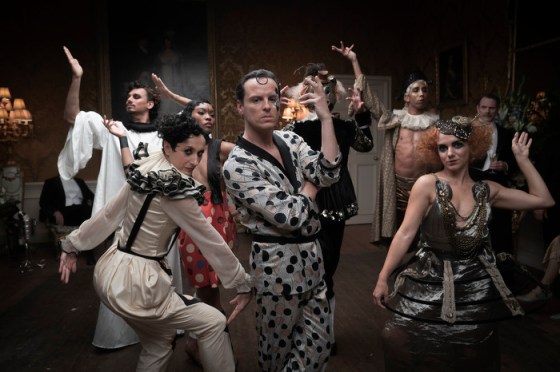
Mortimer also seems to understand that some of the book’s greatest pleasures lie in the quirky, richly detailed secondary characters, many of which were clearly drawn from life. (Uncle Matthew, or “Fa” to his offspring, is based largely on the Mitford clan’s own curmudgeonly patriarch.) She gives herself a small but juicy role as Fanny’s absent mother, who hops from man to man so often she’s nicknamed the Bolter; think AbFab’s Edina Monsoon as an aging 1920s ingenue. British-TV stalwart John Heffernan (Collateral, Jonathan Strange & Mr Norrell) is always good for a chuckle as Davey, the cheerfully hypocritical health-nut husband of Fanny’s guardian (Dolly Wells). Most delightful of all is Fleabag’s Hot Priest, Andrew Scott, perfectly cast as Linda’s haute-bohemian mentor Lord Merlin. Like everyone else in the story, Merlin thinks he knows what’s best for our heroine. Unlike them, he rolls with a crew of avant-garde revelers who seize her adolescent imagination. The apex of an electrifying, anachronistic pop soundtrack comes when he enters to T. Rex’s “Dandy in the Underworld.”

Robert Viglasky via Amazon StudiosAndrew Scott (center) in ‘The Pursuit of Love’

Where this Pursuit of Love departs most boldly—and effectively—from Mitford’s version is in drawing out Fanny. A fond but somewhat distant narrator, in the book she’s the calm in the center of the storm that is her “favorite human being,” Linda. Mortimer smartly repurposes Mitford’s droll prose as a voiceover without framing Fanny’s narration as the full picture. Taking advantage of the visual medium, the show probes areas of her psyche that Mitford left murky. The narrator, like Nick Carraway in The Great Gatsby, might be more infatuated with her subject than anyone. Well into adulthood, the cousins’ physical closeness can be uncomfortably intense; their full-body embraces tread the line between sisterly and homoerotic. Yet, as Mortimer shows rather than tell us, that affection means something devastatingly different to each woman. As she builds a suitable existence, marrying a fastidious Oxford don and having babies, Fanny’s yearning for her cousin’s outsize presence gnaws at what is supposed to be domestic bliss. Linda is the love of her life. But love is the love of Linda’s life.

There’s more going on here, though, than the excavation of lesbian subtext from a 76-year-old novel. (The show does, unfortunately, put a bit too fine a point on The Pursuit of Love’s feminist implications in a coda to the last episode that overstates what will be obvious to most viewers.) Thorny relationships between women are something of a specialty for Mortimer, who fictionalized the uneasy power dynamics that governed her friendship with Wells in HBO comedy Doll & Em. We come to understand that the alternating flashes of love, rage, longing and frustration Fanny experiences in the course of her obsession with Linda are echoes of what she feels for the mother who so remorselessly abandoned her. This new lens hardly detracts from Linda’s magnificent saga. In fact, viewing her through Fanny’s adoring eyes only enhances its colors.

Tunisia’s President Staged What Looks Like a Coup. But Democracy Isn’t Dead There Yet


In recent years, Tunisia has become a victim of its own reputation. In the decade since its landmark 2011 revolution, its characterization as “the only democratic success story of the Arab Spring” has hung around the country’s neck like an albatross.

While observers have routinely celebrated its “democratic transition” they overlooked a parliament that regularly descended into chaos and a flailing economy. Into this mix, factor in the worst of the COVID-19 pandemic and the government’s catastrophic response to it, and an event like the one that occurred Sunday—when President Kais Saied suspended the country’s legislature and dismissed unpopular Prime Minister Hichem Mechichi—becomes almost inevitable.
[time-brightcove not-tgx=”true”]

Few saw Saied’s intervention coming. Nevertheless, late on Sunday evening, following what had at times been violent demonstrations across the country, with protesters calling for the dissolution of parliament and early elections, among other things, the President acted.

Quoting Article 80 of the Constitution, he suspended the parliament for 30 days and removed its members’ immunity from prosecution. While the legality of this move remains the source of fierce debate, his seriousness was never open to doubt. “I warn any who think of resorting to weapons… and whoever shoots a bullet,” he said, “the armed forces will respond with bullets.”

Why the President felt he had to act

The desire for change in Tunisia has been brewing. Under the rule of the last ten governments to oversee Tunisia during the past decade, a political class has risen that is seen as entirely unmoored to the sometimes brutal reality of daily Tunisian life. Last year, as a government survey found that one-third of households feared they would run out of food, Tunisia’s politicians considered abolishing bread subsidies. Through riots over unemployment, economic desperation, hunger and police brutality, Tunisia’s politicians and government ignored the struggles of a desperate country and concentrated on political theatrics and positioning.

There was nothing contrived about the celebrations that greeted the news of the President’s intervention. In Tunis, excited crowds debated the news, while simultaneously trying to define exactly what it meant. Still, the enthusiasm has held in the days since. On the streets of Intilaka, a working class neighbourhood near Tunis that has frequently hosted clashes between the police and angry youths, residents on Tuesday applauded the President’s intervention. Some looked forward to the speedy reinstatement of a reformed institution, others were happy to be ruled by what they saw as the benevolent dictator of the presidential palace at Carthage.

Boubaker Guesmi, a 56-year-old local, shares this view. Unemployed for more than a decade, his only income was the 180 dinars ($64.50) he received from the state each month. From this and his wife’s part-time income, the couple have to feed and clothe themselves and their three daughters. He says he has few misgivings about the President’s intervention or fears of a return to the autocratic days of ousted President Zine El Abidine Ben Ali and his kleptocratic government, “I don’t think Kais Saied will be another Ben Ali. He’s clean, [not corrupt],” he said through a translator. As for a theoretical future free from parliament, Guesmi approves of the idea. “Now if I ask for something from the government, I know that they will answer,” he says. Saied has said that he would assume executive authority with the assistance of a new prime minister.

Concerns about corruption remain a source of frustration for many Tunisians in Intilaka. “All politicians are corrupt,” one young man said. That perception does not seem to extend to Saied, though, who remains extremely popular. According to a poll conducted by Emrhod Consulting, published on Wednesday night, 87% of the 900 Tunisians surveyed supported the President. Only 3% opposed him. His popularity isn’t newfound. In the second round run-offs of 2019’s presidential election, the former law professor and political novice registered a tally just shy of the total number of votes cast for parliament, in which the self-styled “Muslim Democrats” Ennahda emerged as the largest party. His star may have dimmed a little since then but, by contrast, the parliament’s star has plummeted.

A coup or ‘the will of the people’?

In the days since the President’s intervention, the online debate over what it signifies rages on. In the absence of firm evidence one way or another, his detractors call Saied’s move a coup and have branded his backers putschists and anti-democratic, accusing them of being on the payroll of France, the UAE and Egypt. Saied’s supporters claim their critics are Islamists, arguing instead that the President has acted upon the will of “the people.”

It’s true that the resistance to Saied’s intervention has been led by Ennahda, the Islamist party. However, not all critics of the President’s intervention are Islamists. Such accusations are also unlikely to endear the President and his supporters to Tunisia’s international backers, such as the E.U. and U.S., which he desperately needs to keep on side. Nevertheless, labelling all critics of the President as Islamists remains a useful tool.

For many in contemporary Tunisia, to call an opponent an Islamist is to question their integrity and malign their motives. For Ennahda, an exemplar of the Islamist philosophy in Tunisia, it has been a steep fall since the giddy peaks of 2011. Over the last ten years, Ennahda has maintained a presence in nearly all of Tunisia’s ten governments of various stripes. In doing so, it has found itself partnered with some unlikely bedfellows, profoundly undermining both Ennahda’s credibility and that of its political partners.

Perceptions that Ennahda is out of touch with the everyday struggles of many Tunisians helped fuel protests on Sunday and led to many of the party’s offices being vandalised. “They’re just out for themselves,” says 33-year-old Mohamed Ali from the border town of Ben Guerdane. “It’s not just about politics, it’s about jobs,” he says, referring to the perception that regional Ennahda officials distribute jobs to party members ahead of the local populace.

Public disenchantment with Ennahda has made it easy for rivals to scapegoat them, even when they themselves are as much to blame for disrupting the function of parliament. Abir Moussi, the leader of the Parti Destourien Libre (PDL), which was founded by members of the ruling party pre-revolution, is one lawmaker who has been quick to blame Ennahda and their more extreme Islamist allies, Al Karama, for disruptions they now deny having caused. Moussi herself was the victim of a horrific violent assault by an Islamist Deputy associated with Al Karama.

She has also arguably done more to disrupt parliamentary order than any other politician. In the past, her stunts have included turning up parliament in a bullet proof vest and crash helmet, calling out opposition deputies with a megaphone and staging numerous sit-ins to protest the Islamists’ presence in the chamber. She was quick to voice support for the President, posting a video 24 hours after Saied’s intervention wishing him the best in “realizing the aspirations of the citizens and restoring the foundations of the State.”

Democracy in Tunisia is still at risk

If Saied is to maintain the moral high ground in Tunisia, it will be important that he doesn’t circumvent the political process for too long. He has said parliament’s suspension is temporary. His own mandate is a democratic one and therefore no more or less legitimate than parliament’s—and no matter how problematic a parliament is, it’s best dismissed with ballots, not threats of bullets. An intervention like Saied’s puts Tunisia’s democracy at acute risk. But for now, Tunisia’s politically aware and hugely invested civil society groups have not raised the alarm, instead holding their counsel and watching events closely.

However, if Saied deviates from his constitutionally couched assurances on Sunday night, he risks jeopardizing not only the vital support he needs from the hugely influential Tunisian trade union, the UGTT, but also the country’s international backers.

Secretary of State Antony Blinken spoke with the President on Monday and “encouraged President Saied to adhere to the principles of democracy and human rights that are the basis of governance in Tunisia,” his office said in a statement. Other prominent voices in the U.S. were more critical. Writing in the Washington Post, Republican Senator Lindsey Graham called for the U.S. and its allies to go “all in” on Tunisia, including being “on the ground.” On social media, Connecticut Democratic senator Chris Murphy questioned the role that the United Arab Emirates and Saudi Arabia may be playing in Tunisia. Within Washington’s thinktanks, the response was no less furious. Shadi Hamid, a senior fellow at the nonpartisan Brookings Institution’s Center for Middle East Policy called for the suspension of all U.S. aid to Tunisia. To many within Tunisia, the response from the international community appears bizarre. On social media, accusations of colonialism dominated the discourse.

Despite the concerns among foreign onlookers, democracy isn’t dead in Tunisia. But it is at risk. The next 30 days will prove crucial to the path the country takes. If a roadmap out of the current mess isn’t drawn up by then, the country risks a parliament being restored that holds its citizens in contempt, setting the country up for a period of instability few wish to see again.

Bangkok Builds Another Field Hospital as Struggling Thailand Reports Record COVID-19 Cases and Fatalities


BANGKOK, Thailand — Health authorities in Thailand raced to set up a large field hospital in a cargo building at one of Bangkok’s airports on Thursday as the country reported record numbers of coronavirus cases and deaths.

Other field hospitals are already in use in the capital after it ran out of hospital facilities for thousands of infected residents.

Workers rushed to finish the 1,800-bed hospital at Don Mueang International Airport, where beds made from cardboard box materials were laid out with mattresses and pillows. It is to be ready for patients in two weeks.

[time-brightcove not-tgx=”true”]

The airport, a domestic and regional hub, has had little use because almost all domestic flights were canceled two weeks ago.

The quick spread of the delta variant also led neighboring Cambodia to seal its border with Thailand on Thursday and order a lockdown and movement restrictions in eight provinces.

Thailand reported 17,669 new cases and 165 deaths on Thursday, its highest number since the pandemic began in early 2020. Of those, 7,875 cases and 127 deaths were in metropolitan Bangkok, a region of nearly 15 million people.

Bangkok and its surrounding provinces have been in lockdown for more than two weeks, with overnight curfews and access only to supermarkets, pharmacies and essential services such as hospitals.

Authorities said about 6,100 patients in the Bangkok area are waiting for beds. Of those, 103 are in critical condition, 1,410 have moderate symptoms and 4,662 have mild symptoms. Nearly a quarter of a million people around the country are in medical facilities, some with symptoms and some without.

Thailand has recorded a total of 561,030 cases and 4,562 deaths. More than 90% have been reported during the surge that began in early April.

At a market near the airport, a few people were out shopping and many said they were concerned about the virus’s spread.

“I watched the news and I got so stressed and depressed about so many people needing help. I don’t leave the house very often anymore, only once in a while when it becomes necessary to buy some supplies,” said Chaninart Aimoat, a 32-year-old office worker.

Prime Minister Prayuth Chan-ocha’s government is facing harsh criticism over its handling of the virus surge and slow vaccination program, amid reports of people dying in the streets or in their homes while waiting for treatment.

Thailand hopes to provide 100 million doses of vaccines and inoculate 70% of its population within this year. So far it has administered 16.6 million doses nationwide. Around 18.5% of its 69 million people have received at least one dose while 5.5% are fully vaccinated.

On Wednesday, Swiss Humanitarian Aid dispatched 100 respirators and more than a million antigen tests to Bangkok to help fight the outbreak, while Britain is to send 415,000 doses of AstraZeneca vaccine within two weeks.

Meanwhile, 1.5 million doses of Pfizer vaccine donated by the U.S. government are to arrive Saturday morning.

“We will be sending no less than 1.5 million doses of COVID vaccine, in fact the goal is 2.5 (million). But the first shipment will be 1.5 (million),” said Thai-born U.S. Sen. Tammy Duckworth.

Neighboring Cambodia is to receive its first batch of 1 million vaccines donated by the U.S. on Friday, as it takes steps to slow a surge around the country thought to be caused by Cambodian workers fleeing Thailand.

Prime Minister Hun Sen said the border will be shut to everything except commercial traffic until Aug. 12.

Cambodia’s health ministry on Thursday reported 765 new cases and 11 deaths. It has confirmed a total of 75,152 cases and 1,339 deaths.

Unlike Thailand, more than 40% of its population has had at least one vaccine dose. Cambodia plans to vaccinate at least 12 million of its approximately 17 million people.

___

Associated Press journalists Patrick Quinn in Bangkok and Sopheng Cheang from Phnom Penh, Cambodia, contributed to this report.

President Rodrigo Duterte of the Philippines Has Changed His Mind About Scrapping a U.S. Security Pact


MANILA, Philippines — Philippine President Rodrigo Duterte has retracted a decision to end a key defense pact with the United States, allowing large-scale combat exercises between U.S. and Philippine forces that at times have alarmed China to proceed.

Duterte’s decision was announced Friday by Defense Secretary Delfin Lorenzana in a joint news conference with visiting U.S. counterpart Lloyd Austin in Manila. It was a step back from the Philippine leader’s stunning vow early in his term to distance himself from Washington as he tried to rebuild frayed ties with China over territorial rifts in the South China Sea.
[time-brightcove not-tgx=”true”]

“The president decided to recall or retract the termination letter for the VFA,” Lorenzana told reporters after an hour-long meeting with Austin, referring to the Visiting Forces Agreement. “There is no termination letter pending and we are back on track.”

Austin thanked Duterte for the decision, which he said would further bolster the two nations’ 70-year treaty alliance.

“Our countries face a range of challenges, from the climate crises to the pandemic and, as we do, a strong, resilient US-Philippine alliance will remain vital to the security, stability and prosperity of the Indo-Pacific,” Austin said. “A fully restored VFA will help us achieve that goal together.”

Terminating the pact would have been a major blow to America’s oldest alliance in Asia, as Washington squares with Beijing on a range of issues, including trade, human rights and China’s behavior in the South China Sea, which Beijing claims virtually in its entirety.

The U.S. military presence in the region is seen as a counterbalance to China, which has used force to assert claims to vast areas of the disputed South China Sea, including the construction of artificial islands equipped with airstrips and military installations. China has ignored a 2016 international arbitration ruling that invalidated its historic basis.

China, the Philippines, Vietnam and three other governments have been locked in the territorial standoff for decades. The U.S. doesn’t take sides and insists on freedom of navigation in international waters, and doesn’t recognize China’s claims.

In a speech in Singapore on Tuesday, Austin said that Beijing’s claim to the South China Sea “has no basis in international law” and “treads on the sovereignty of states in the region.” He said the U.S. supports the region’s coastal states in upholding their rights under international law, and is committed to its defense treaty obligations with Japan and the Philippines.

Duterte notified the U.S. government in February 2020 year that the Philippines intended to abrogate the 1998 agreement, which allows large numbers of American forces to join combat training with Philippine troops and sets legal terms for their temporary stay.

U.S. and Philippine forces engage in about 300 activities each year, including the Balikatan, or shoulder-to-shoulder, exercises, which involve thousands of troops in land, sea and air drills that often included live-fire exercises. They’ve often sparked China’s concerns when they were held on the periphery of the sea Beijing claims as its own.

The pact’s termination would have taken effect after 180 days, but Duterte has repeatedly delayed the decision. While it was pending, the U.S. and Philippine militaries proceeded with plans for combat and disaster-response exercises but canceled larger drills last year due to the coronavirus pandemic.

The Balikatan exercises resumed last April but were considerably scaled down due to continuing COVID-19 outbreaks and lockdowns.