To understand how President Joe Biden’s new $2 trillion infrastructure plan announced Wednesday will shape the fight against climate change, it’s tempting to look through the 25-page document and start tallying the dollars devoted to climate-specific programs. From investments in the electric grid to funding for research and development, the plan devotes hundreds of billions of dollars directly to tackling climate change.
But the White House officials charged with leading the Administration’s climate policy say the plan’s strategy to reduce emissions and prepare the country for the effects of a warming planet is more than the sum of the programs with climate in the name. Understanding how the Biden Administration plans to use the infrastructure bill to tackle climate change, they say, requires looking at how climate considerations are included in the details of a range of proposals in the plan, from manufacturing to housing.
“A misleading way to think about all this is to think that climate action can live on its own island and economic policy is part of the continent,” Ali Zaidi, the Deputy White House National Climate Advisor, told TIME in a March 23 interview. “The output of good economic policy is good climate outcomes.”
To that end, the vast majority of the economic programs included in the package—dubbed the American Jobs Plan—have a climate component. Take the proposal to rebuild the nation’s transportation infrastructure, which at $621 billion, is its biggest line item. The money would fund repairs and renovations to the country’s roads, bridges and airports. None of this inherently helps address climate change; in fact, roads, bridges and airports all facilitate high-carbon forms of transportation.
But the plan calls for renovating transportation infrastructure with “sustainable and innovative” materials, including“cleaner” steel and cement. The details of the cement and steel standard remain to be seen, but a federal push to cut emissions from those two carbon intensive products would have ripple effects across a wide array of industries.The plan also prioritizes modernizations that would reduce traffic and, in turn, wasteful energy consumption.
“There’s nothing like actual infrastructure to actually make jobs happen, and really good, well-paying union jobs, but [Biden] is also looking at, ‘what does it mean for climate change?'” says Gina McCarthy, the White House National Climate Advisor. “‘What are we building? What are we investing in?'”
The plan takes a similar approach with a slew of smaller items. The plan calls for an $18 billion investment in Veterans Affairs facilities, similarly stressing that thenew hospitals will be built with low-carbon materials and also powered by clean energy. Biden proposes spending $40 billion on training programs for out-of-work Americans with an emphasis on jobs in the clean energy sector. And the plan calls for $100 billion to improve public schools, including by building energy-efficient schools. “We need to build our physical infrastructure in a way that’s more climate resilient,” says Zaidi, “because that’s sound economic policy.”
None of that is to say the proposal is light on dedicated climate proposals. The Administration calls for $174 billion to help advance domestic production of electric vehicles and $35 billionfor climate-related research and development, for example. Those big ticket items sit alongside smaller but significant proposals like the creation ofa Civilian Climate Corps that would create jobs by employing people to conserve public lands and the start of a new program to hire people to plug oil and gas wells across the country. The value alone of these climate-focused programs—easily totaling in the hundreds of billions of dollars—would make the American Jobs Plan the biggest ever single U.S. investment in tackling climate change.
Beyond the spending measures, the plan also includes a proposal for a new clean electricity standard. A version of the policy, which would require a certain percentage of electricity to come from clean sources, has been implemented in some form in dozens of states and has become a favorite of environmental groups in the past year as political tides have turned against carbon taxes and other carbon pricing mechanisms. A senior administration official said on Thursday that Biden “intends to work with Congress” to figure out the details of how such a policy would work.
The Administration’s approach to the infrastructure package mirrors its “whole of government” strategy on climate more broadly. Instead of pursuing a landmark piece of climate legislation—like President Barack Obama did in his first term—Biden has sought to infuse climate considerations across the federal government, from the obvious players like the Environmental Protection Agency to the less obvious ones like the Department of Education.
“We can use the breadth of the agencies across the federal government, not just their ability to help us invest in the right strategies, establish the right standards,” says McCarthy. “But also we procure a lot of products and services. We can actually send the signal that climate change is important to us. We’re going to follow the science. And we’re going to help drive a continued investment in clean energy technology.”
The approach is in part an acknowledgment that climate change is a thorny issue that touches every part of the economy and society. It also reflects the political reality that implementing ambitious climate policies alone will almost certainly face roadblocks from Republicans and in federal court.Instead of relying on one bold measure that can be reversed by a future administration, Biden’s approach incorporates climate policy everywhere, making it harder to undo.
It remains to be seen how an infrastructure package with climate embedded in it will play inCongress. On the one hand,a bipartisan group of lawmakers say the country is long overdue for significant federal infrastructure investment. And, while many Republicans remain opposed to most things climate-tinged, there is widespread agreement that the country needs to invest in resilience to climate disasters and, to some degree, innovation. Just last December, for example, Congress passed $40 billion in spending on clean energy incentives as part of a COVID-19 relief package that Trump signed into law.
Still, the sheer scale of the proposal and its unambiguous climate messaging is certain to raise some objections, and some Republicans haven’t even begun to dust off their tried-and-true talking points used in the not-so-distant past to criticize calls for a Green New Deal.
Some have suggested that Senate Democrats might turn again to budget reconciliation, the procedural maneuver they used to push through the $1.9 trillion COVID-19 relief bill earlier this month. That would allow the bill to pass along party lines, with Vice President Kamala Harris casting the tie-breaking vote, but it would further undermine Biden’s campaign promise to seek greater bipartisan cooperation. (McCarthy told TIME that Biden is “going to want to engage every member of Congress on the legislation.”)
A senior Administration official on Tuesday declined to specify how the Administration’s planned to get the plan passed, but suggested an outreach effort has already begun. “This is the this is the beginning of a process,” the official said. But Biden “is uncompromising about is the urgency of the moment.”
This article is part of the The DC Brief, TIME’s politics newsletter. Sign uphereto get stories like this sent to your inbox every weekday.
Grievance is one of the most potent weapons in any political system. It nursed the Lost Cause theology that rationalized the Confederacy in the American South, continuing to this day for many. It had a corollary in post-World War II Germany as the occupying Allies tried, briefly, to pursue re-education programs. A fallen empire still haunts the United Kingdom. And few know how to throw a revolution better than the French.
New numbers out today from the Pew Research Center suggest grievance is still alive and well in those countries. The four-nation survey, conducted in November and December, shows the appetite for wholesale change is higher than previously suspected. Two-thirds of adults in the U.S. and France believe the political system needs overhauled, if not overthrown. Half of those in the U.K. think the same. Germany is less unstable, but calls for reform still ring true with roughly four in 10.
So what’s behind this distrust in democratic systems that, by and large, have led to national prosperity? The stench of corruption that hangs over them. In the U.S., two-thirds of adults think the statement “most politicians are corrupt” is true. About half of French and U.K. respondents say the same. Meanwhile, voters don’t think politicians care about the opinions of “ordinary people” in the U.S., U.K. and France about half of the time. The number falls to about a third in Germany, according to the data.
Years of suspicion — and, in some cases, evidence — have piled up, eroding trust in the system of government and undercutting the legitimacy of the democratic experiments. The numbers run highest among young people, meaning this sentiment is going to be with us a long while. In combination with the fact that these four countries face some rough terrain ahead, the lack of confidence in leaders and systems spells some pretty tricky politics for the folks looking to rise.
It’s an environment that incentivizes bad behavior among politicians. Populism has seen footholds in all four countries. Playing to the brewing rage may be smart access to frustrated voters’ power, but it’s tough to turn off once you get in the door. Just ask former President Donald Trump or current Prime Minister Boris Johnson. For leaders who try to stay above the fray, it’s equally tough to keep at bay, as President Emmanuel Macron has found. Germany’s Angela Merkel is on her way out the door, and it’s anyone’s guess what comes next in the zeitgeist there.
There are some reasons to be encouraged. When Pew asked these same questions in 2017, 20% of French respondents said they thought the government was doing the right thing. Now, the number is at 55%. It’s a similar, though less pronounced picture, in Germany and France.
The U.S., though, is a more complicated picture. The poll was taken in November and December, as then-President Trump was fighting his loss and Joe Biden, as President-elect, was stuck in an odd Trump-made fantasy limbo. Faith that the government would do the right thing has risen slightly overall among American respondents since 2017, but for the corresponding increase among Democrats in November and December, there was a matching fall among Republicans. Fewer than half of all Americans say democracy is working. And the data was collected before a mob tried to overthrow the elections when it stormed the Capitol on Jan. 6.
It’s easy for voters — especially Americans — to loathe the system but still harbor an affinity for their own piece of it. It takes very little imagination for constituents in The Bronx to say the whole of Washington smells like a garbage ferry, but to love their Congresswoman, Rep. Alexandria Ocasio-Cortez. Polls have shown voters for decades have harbored antipathy toward Congress as a body, but support their own representative.
But the system needs wide buy-in to work. Otherwise, the legitimacy falters. This country has had robust debates for centuries now about the validity of a strong federal system or sending the power back to the states. But when so many Americans say the system needs to change, is corrupt and ignores the rank-and-file voters, it’s a signal that the conversation is happening in a way that isn’t inspiring confidence. Grievances, after all, can last generations.
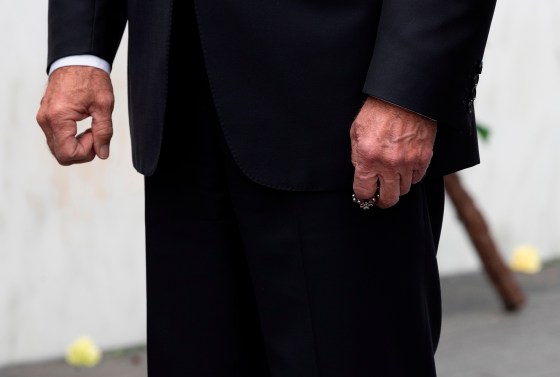
The hymns of the Catholic Church have been the soundtrack to Joe Biden’s life. He attends Mass on Sundays and holy days, and before major events. In Oval Office meetings, Biden sometimes pulls from his pocket a string of rosary beads that belonged to his late son Beau; in quieter moments, Biden will walk his fingers down the beads while saying the holy rosary, a series of meditative prayers. The day the 2020 election was called for Biden, just before he and his family greeted a cheering crowd in Wilmington, Del., a Catholic priest was asked to call in over Zoom to pray with the President-elect and his family. They bowed their heads to the prayer of St. Francis: “Lord, make me an instrument of your peace; where there is hatred, let me sow love.”
While Biden’s faith is deeply felt, his election has exposed divisions at the highest levels of the Catholic Church. Within days of his victory, 10 of the nation’s most powerful bishops took the extraordinary step of launching a “working group” on how to approach a Catholic President like Joe Biden. The panel met twice over Zoom, in December and January. Led by Archbishop Allen Vigneron of Detroit, it included New York’s Cardinal Timothy Dolan, who offered prayers at President Trump’s 2017 Inauguration, the 2020 Republican National Convention and both parties’ conventions in 2012, as well as San Francisco’s Archbishop Salvatore Cordileone and Archbishop Joseph Naumann of Kansas City, Kans., both of whom have suggested Biden should be denied the sacred rite of Communion for his stance on abortion. On the table in the discussions, according to three Catholic officials familiar with the group’s work, were the questions of how to respond to Biden’s policies that conflict with Catholic teaching and, according to one, “how to save Biden’s soul.”
Biden’s election comes at a complicated moment for the Catholic Church in America, which continues to reckon with a sexual-abuse scandal (and subsequent cover-up) that has caused widespread disenchantment with the institution. On one hand, Biden’s ascension is a capstone of the faith’s march to political acceptance. The nation’s second Catholic President oversees a government with unprecedented representation for the church. Six of nine Supreme Court Justices are Catholic, as well as the Speaker of the House, at least eight Cabinet secretaries and multiple other members of the Administration. One-fifth of all votes in the 2020 election were cast by Catholics, roughly half of them for Biden.
While Biden campaigned on some key policies the church favors—including advancing racial justice, ending the death penalty, addressing climate change and aiding refugees—he also advocates policies out of step with Catholic doctrine, such as expanding access to reproductive health care and increasing gay and transgender rights. For many top bishops and conservative voters, Biden embodies a more liberal version of the faith that poses a threat to the future of the church in America. His election “exposes a divide among American Catholics that’s been there for a long time,” says Maureen O’Connell, a religion professor at La Salle University. “There’s a big chasm, a growing chasm.”
The day Biden was inaugurated, L.A. Archbishop José Gomez, head of the U.S. Conference of Catholic Bishops, released a statement saying some of Biden’s positions “advance moral evils.” Other church leaders felt Gomez went too far. Cardinal Wilton Gregory, who oversees the churches Biden worships at in Washington, said Gomez’s comments were “ill-timed.” Chicago Cardinal Blase Cupich, who has close ties to Pope Francis, described the statement as “ill-considered.”
The schism affects all Americans. In a deeply divided country, the Catholic vote has been a key target for both major political parties. Democrats once relied on Catholics, while Republicans see making gains with the faithful—particularly Hispanic Catholics who are increasingly sustaining parishes across the U.S.—as part of a quest to reverse the slow decline of their core demographic: older white voters. That’s one reason Biden has set out to strengthen relationships with Catholic faith-based organizations, making the case that the Administration is doing important work to alleviate poverty, set a more humane immigration policy and stop executions.
All of which means that Joe Biden’s particular brand of Catholicism is not just a matter for bishops to debate. As Easter, the holiest day in Christianity, approaches on April 4, the questions of how Catholicism has framed Biden’s life, and how his life has framed his approach to his faith, have become matters of historic importance at a pivotal movement for the church—and for America.
Biden has described attending Mass as an occasion for solitary reflection. He does it even when he’s on the road. In late October 2019, while campaigning in South Carolina, he walked one Sunday into the sanctuary of St. Anthony Catholic Church in Florence, in the state’s northeast coastal plains. The next day, St. Anthony’s priest told news outlets that he had refused Biden the Holy Communion—the sacred act of taking bread and wine, as the body and blood of Jesus, at the end of the Mass—because Biden’s abortion policies conflicted with Catholic teaching.
Biden’s stance on abortion is among an increasingly liberal set of positions he has taken on matters of church doctrine. A few months earlier, as he prepared to roll out his plan to expand federal health care coverage, Biden dropped his long-standing support for the Hyde Amendment, the 1970s law that prohibits federal funds being used to subsidize abortion. Biden had supported the Hyde Amendment for decades. In the 1980s, he even voted for a constitutional amendment that would allow states to overturn Roe v. Wade. But as Vice President in May 2012, Biden unexpectedly announced his support for gay marriage—beating President Obama to the punch. (Obama expressed his support for same-sex marriage three days later.)
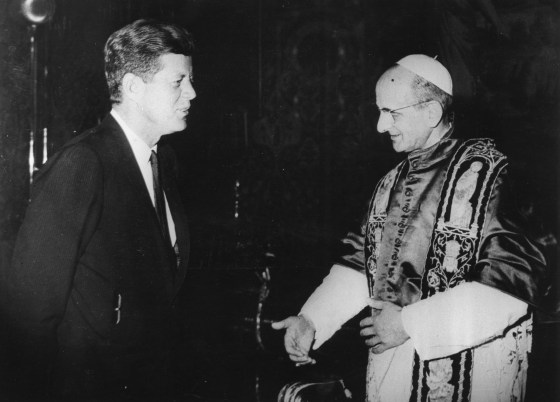
Like most things in Biden’s life, his approach to his faith was informed by his childhood in Scranton, Pa., and Wilmington, Del. Biden’s mother, Catherine Finnegan Biden, set the tone in the family, attending church every Sunday. As a young man, Biden considered joining the priesthood. He was 18 when John F. Kennedy became the country’s first Catholic President, breaking through decades of widespread hostility toward Catholics that was marked by false conspiracy theories that a U.S. President who was Catholic would be subordinate to the Pope in Rome. Kennedy’s election inspired a new generation of American Catholics, including Biden, to pursue public service.
Keystone/Getty ImagesJohn F. Kennedy, the nation’s first Roman Catholic President, greets the newly elected Pope Paul VI at the Vatican in July 1963
When Biden was in his twenties, 2,000 bishops met in Rome from 1962 to 1965 for the Second Vatican Council—the first reappraisal of church practices in nearly a century. A raft of liberalizing reforms emerged. The bishops decided church services should be more accessible to ordinary Catholics. Mass could be said in languages other than Latin, and priests could conduct Mass facing the congregation. Catholics were free to pray with other Christians and encouraged to work toward the common good with believers of non-Christian faiths.
Biden’s childhood preceded Vatican II, and his adulthood began after it, making him fluent in the signs and symbols of both eras. His childhood was filled with Latin Mass and saying the rosary. His favorite hymn, say two people close to him, is the late-1970s acoustic-guitar staple “On Eagle’s Wings.” But as with any major change, there came a backlash to the efforts to liberalize church doctrine. The 1980s were marked by a growing culture war—both inside the Catholic Church and across the country—over abortion and gay rights, which continues to split both the church and the nation.
Biden and other prominent Catholic Democrats have long sought to thread the needle. In 1984, New York Governor Mario Cuomo was one of the first major Catholic politicians to argue he could be personally against abortion while working politically to uphold the right to the procedure enshrined in Roe v. Wade. Like Cuomo, Biden says his personal beliefs are consistent with church teachings, but he can’t support policies that would force those beliefs on others.
Biden, who has described his personal interest in theology as his “avocation,” discussed this question when he met privately at the Vatican with Pope Benedict XVI in 2011. “He wasn’t judgmental,” Biden said of the conservative former Pontiff in a later interview with the Jesuit publication America. “It was like going to theology class. I came away enlivened from the discussion.”
Pope Francis has taken more liberal positions than his predecessor on issues ranging from openness to gay individuals to more roles for women in the church. Francis’ focus on mercy and tolerance over doctrine and tradition has brought these schisms to the fore. But the Pope has also shown there’s a limit to how far church doctrine can bend. Francis has upheld the primacy of the church’s teaching on preventing abortions, and on March 15 he released a Vatican decree affirming that priests cannot bless same-sex marriages.
That’s left Biden paraphrasing the late New York governor on supporting public policy that’s seemingly out of step with the Holy Father. “I’m a practicing Catholic,” Biden told MSNBC’s Andrea Mitchell in a 2019 interview, “but I’ve never let my religious beliefs, which I accept based on church doctrine—they call it de fide doctrine—to impose that view on other people.”
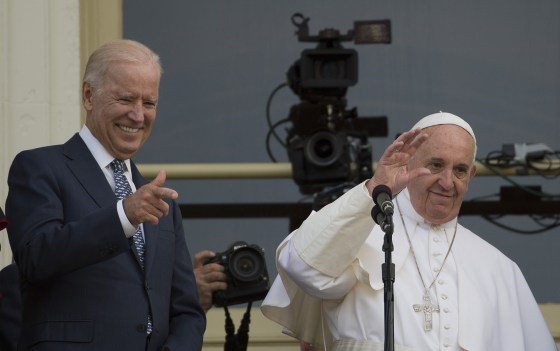
Andrew Caballero-Reynolds—AFP/Getty ImagesBiden with Pope Francis in Washington on Sept. 24, 2015, after the Pontiff’s address to a joint session of Congress
As President, Biden’s personal faith plays out in public ways. Rather than downplaying his religion, as Kennedy did, he has lived it publicly. A framed photo of Biden shaking hands with Pope Francis rests on the table over Biden’s left shoulder as he sits at the Resolute Desk in the Oval Office. In his speeches, he quotes from the Bible and invokes Catholic saints and philosophers. He made the sign of the cross at the Tomb of the Unknown Soldier when he visited after his Inauguration.
When Biden is home in Wilmington, his longtime aide and confidant, former Senator Ted Kaufman, often joins him for Mass at his home church, St. Joseph on the Brandywine. Biden’s faith, Kaufman says, has not only helped him through the tragedies of losing his first wife and daughter in a car crash and his son Beau to cancer. It has also steeled him against the criticism of his faith leveled by fellow Catholics. “The attacks on him that he’s not doing God’s will, they bounce off him. This has been going on for a long time,” says Kaufman. “He knows who he is. He knows what he believes.”
Justin Dillon, a 46-year-old lawyer in Washington, D.C., doesn’t doubt the sincerity of Biden’s Catholic faith. But he struggles with whether Biden should be allowed to take Communion given his strong support for policies that increase access to abortion. He is concerned about the example this sets for what it means to follow Catholic teachings on abortion and other controversial social issues. He worries liberals will ask conservative Catholics like him, “If Biden is Catholic and he can get with the program, why can’t you?”
Some church leaders are concerned that Biden may sow confusion over what it means to be devout. Conservative Catholics say Biden’s prominence legitimizes what is pejoratively referred to by some as “cafeteria Catholicism”—the idea that Catholics can choose which church teachings they adhere to. “We must pray and fast that the President will cease attempting to confuse people about Catholic teaching by trampling on the sanctity of human life while presenting himself as a devout Catholic,” said Kansas City Archbishop Naumann. “The presidency does not empower him to define Catholic doctrine and moral teaching.”
The contradiction between Biden’s outward faith and policies that appear to conflict with those teachings “creates confusion among the faithful about what the church actually teaches on these questions,” said Archbishop Gomez, who called for the working group of church leaders who discussed how to minister to the President. (After two long Zoom deliberations, the bishops agreed that Biden’s priests in Delaware and D.C. should be responsible.)
This isn’t just a matter of pastoral duty for the church; it’s a matter of power and reach. For all the influence that American Catholics now have at the top of government, the church in America is declining. It counts some 5 million fewer members than a decade ago, according to the Pew Research Center, and there’s little agreement on how to reverse the exodus.
If conservative Catholics blame a lack of clarity in church teachings, more liberal-minded Catholics believe the church isn’t evolving fast enough. Amid this debate, Biden’s approach to his faith has emerged as a sort of Rorschach test. “His Catholicism doesn’t match our caricature of what Catholics are supposed to be like, which is obsessed with the culture wars,” says Natalia Imperatori-Lee, professor of religious studies at Manhattan College. But Biden, she says, is in many ways an “ordinary” Catholic. “The majority aren’t out there screaming outside abortion clinics or rejecting their children for being gay,” says Imperatori-Lee. “The regular average Catholic is a lot like Joe Biden. Someone who has suffered in his life. Someone who has leaned on his faith during times of deep tragedy. Someone who continues to lean on his faith for strength and moral guidance.”
It is that broader view of the role of faith in one’s life that Pope Francis has embraced, believing that will make the church more relevant in a changing world. When Francis first donned his white papal cassock in 2013, he said the church must move beyond tensions over abortion and gay marriage and “heal wounds.” In January, he officially decreed that women could serve as lectors and distribute Communion at Mass, a practice already common in many churches. He’s preached that gay, lesbian and transgender Catholics should be welcomed into the church with love.
Whatever dissonance may exist between the Holy Father’s teachings and Biden’s policy agenda hasn’t gotten in the way of a warm relationship between the two. After Cardinal Cupich said Archbishop Gomez’s Inauguration Day critique of Biden’s policies was “ill-considered,” he was granted an audience with Francis, a move that Vatican watchers interpreted as support for a subtle handling of the President’s positions. Pope Francis reached out personally to Biden after he was elected, say two people close to Biden, sending Biden a signed copy of his book Let Us Dream.
Some top Catholics saw in Francis’ outreach a clear message. “Nuance is good,” says Sister Patricia McDermott, president of the Institute of the Sisters of Mercy of the Americas, who notes Biden is “not going to get all the issues right from some Catholic perspectives. But there is nuance within our Catholic community as well.”
Jim Watson—AFP/Getty ImagesBiden clutches a rosary after laying a wreath on Sept. 11, 2020, at the Flight 93 National Memorial, near Shanksville, Pa.
When Biden speaks to the country about the losses sustained in the pandemic, he’s using muscles honed by years of attending ceremonies and funerals, including those of his own son, daughter and first wife. “There’s a ritual to mourning that he’s very familiar with. He’s in a sense presiding at those memorials because he’s been part of that his whole life,” says Father Kevin O’Brien, a Jesuit priest who has often ministered to Biden and his family at important moments in their lives.
The President has said his approach to public service is guided by the first two commandments, “Love thy God” and “Love thy neighbor.” In his family, that meant performing acts of outreach and kindness based on the idea that everyone is entitled to dignity. This, he says, is how his faith has defined his approach to governing. “I can see his heart is led by the Catholic social teaching,” says Bishop Mario Dorsonville, who was part of a group of bishops discussing Biden’s presidency. A more open immigration policy is “one of his points of devotion,” says Dorsonville, who leads a committee on migration for the conference of bishops. Asked about Biden’s support for policies that run counter to Catholic teachings, Dorsonville says, “I don’t think it is a good thing for me to point fingers at anyone, because that’s the role of God.” But, he said, when it comes to church teachings, Catholics should “take the whole package.”
Some members of Biden’s inner circle say Biden’s expression of his faith could bring more American Catholics to the church and help narrow its divisions. O’Brien, the Jesuit priest who has been a longtime religious confidant of Biden’s, says that Biden often thinks about both ideological rifts. “Just as he hopes to heal the country politically by being a uniter and by finding common ground, I think for American Catholics, he can help us move beyond ideological divisions to find common ground,” says O’Brien, who was recently placed on leave as president of Santa Clara University pending an investigation into allegations he overstepped rules for Jesuit behavior. “He knows how to navigate that because he knows the language of religion. Whether a bishop agrees or disagrees with him, they can respect this man cares about his faith.”
Biden’s personal faith can’t be untangled from his politics. On Nov. 7, after a prayer over Zoom with O’Brien, he walked onto a stage to give his campaign victory speech, facing a Wilmington parking lot filled with supporters. In the last days of his campaign, Biden told the crowd, he was thinking about “On Eagle’s Wings,” a hymn that meant a lot to Beau as well. “It captures the faith that sustains me, and which I believe sustains America,” Biden said, and quoted a few verses.
Biden closed by recalling what his grandfather in Scranton would say to him as he walked out the door: “‘Joey, keep the faith.’” In his telling, Biden’s grandmother would one-up her husband, yelling, “No, Joey, spread it!”
“Spread the faith,” Biden told the crowd as fireworks erupted. “God love you all.”
—With reporting by Leslie Dickstein and Simmone Shah
Documentary lovers have plenty to peruse in titles coming to Netflix in April 2021, from Worn Stories, a series featuring the stories of people’s most meaningful items of clothing, to a new David Attenborough series, Life in Color With David Attenborough, that looks at the relationships different animals have to color.
Fictional stories are also coming to the streaming service in April, including Thunder Force, which sees Melissa McCarthy and Octavia Spencer playing reunited childhood best friends in an action movie, the seriesWhy Are You Like This, which follows three twenty-somethings in Melbourne, and the horror movieThings Seen & Heard, which delves into the dark secrets that emerge after a couple moves to a small town from Manhattan.
Here’s what’s new on Netflix this month—and everything set to leave the streaming platform.
Here are the Netflix originals coming in April 2021
Available April 1
Magical Andes: season 2
Prank Encounters: season 2
Tersanjung the Movie
Worn Stories
Available April 2
Concrete Cowboy
Just Say Yes
Madame Claude
The Serpent
Sky High
Available April 5
Family Reunion: Part 3
Available April 6
The Last Kids on Earth: Happy Apocalypse to You
Available April 7
The Big Day: Collection 2
Dolly Parton: A MusiCares Tribute
Snabba Cash
This Is A Robbery: The World’s Biggest Art Heist
The Wedding Coach
Available April 8
The Way of the Househusband
Available April 9
Have You Ever Seen Fireflies?
Night in Paradise
Thunder Force
Available April 12
New Gods: Nezha Reborn
Available April 13
Mighty Express: season 3
My Love: Six Stories of True Love
Available April 14
Dad Stop Embarrassing Me!
The Circle: season 2
Law School
The Soul
Why Did You Kill Me?
Available April 15
Ride or Die
Available April 16
Arlo the Alligator Boy
Ajeeb Daastaans
Fast & Furious Spy Racers: season 4: Mexico
Into the Beat
Why Are You Like This
Available April 18
Luis Miguel – The Series: season 2
Available April 20
Izzy’s Koala World: season 2
Available April 21
Zero
Available April 22
Life in Color with David Attenborough
Stowaway
Available April 23
Shadow and Bone
Tell Me When
Available April 27
Go! Go! Cory Carson: season 4
Available April 28
Sexify
Headspace Guide to Sleep
Available April 29
Things Heard & Seen
Yasuke
Available April 30
The Innocent
The Mitchells vs. The Machines
Pet Stars
The Unremarkable Juanquini: season 2
Here are the TV shows and movies coming to Netflix in April 2021
Available April 1
2012
Cop Out
Friends with Benefits
Insidious
Legally Blonde
Leprechaun
The Pianist
The Possession
Secrets of Great British Castles: season 1
The Time Traveler’s Wife
Tyler Perry’s Madea’s Big Happy Family
White Boy
Yes Man
Available April 3
Escape from Planet Earth
Available April 4
What Lies Below
Available April 5
Coded Bias
Available April 10
The Stand-In
Available April 11
Diana: The Interview that Shook the World
Available April 12
Nicky, Ricky, Dicky & Dawn: seasons 1-4
Available April 13
The Baker and the Beauty: season 1
Available April 15
Dark City Beneath the Beat
The Master
Available April 16
Crimson Peak
Rush
Synchronic
The Zookeeper’s Wife
Available April 19
Miss Sloane
PJ Masks: season 3
Available April 23
Heroes: Silence and Rock & Roll
Available April 27
August: Osage County
Battle of Los Angeles
Here’s what’s leaving Netflix in April 2021
Leaving April 2
Honey: Rise Up and Dance
Leaving April 4
Backfire
Leaving April 11
Time Trap
Leaving April 12
Married at First Sight: season 9
Surviving R. Kelly Part II: The Reckoning: season 1
Leaving April 13
Antidote
Leaving April 14
Eddie Murphy: Delirious
The New Romantic
Once Upon a Time in London
Thor: Tales of Asgard
Leaving April 15
Cirque du Freak: The Vampire’s Assistant
Leaving April 19
Carol
The Vatican Tapes
Leaving April 20
The Last Resort
Leaving April 21
The Great British Baking Show: Masterclass: seasons 1-3
If my memories of 2019 are correct, March tends to be a month of anticipation even in relatively normal times. The snow has melted, but the trees are still bare. The temperature’s rising, but not consistently enough to put your winter coat in storage. All of that nervous early-spring energy is heightened this year, as we wait our turns in the vaccination queue and cross our fingers that the variants won’t halt our progress toward herd immunity. My favorite new TV shows of the month—a detective story set in Northern Ireland, a pulpy Spanish thriller, a mouthwatering kids’ show, a docudrama filled with ecstatic musical numbers and a nostalgic blast from reality TV’s primordial past—probably say a lot about how I’m dealing with that impatience: through the pursuit of big, bright, unapologetically entertaining distractions. Maybe you’d like to do the same?
Bloodlands (Acorn TV)
Although they officially ended in 1998, the decades of political conflict known as The Troubles cast a long shadow over Ireland and the UK—and particularly the relationships between factions within UK-controlled Northern Ireland—that still hasn’t faded. Bloodlands, a four-part BBC crime drama that broke ratings records in Northern Ireland and has since been renewed for a second season, awakens the ghosts of that sectarian violence. The great James Nesbitt (who British-thriller fans will remember from his harrowing performance in the first season of The Missing) stars as Tom Brannick, a Belfast police detective whose investigation of a car that was pulled out of a lake also dredges up the darkest period of his history. This slow-burning but not overlong mystery contains no wild, subversive stylistic flourishes; it’s just a chilly, thoughtful, well-written and superbly acted story that connects specific, personal grief with the larger understanding that it takes more than a peace treaty to heal the scars of civil war.
Genius: Aretha (Nat Geo)
It is the push of Aretha Franklin’s incandescent talent and tireless ambition, and the pull of her complicated past that animate the third season of National Geographic Channel’s docudrama series Genius and its first to spotlight a woman or person of color. Created by Suzan-Lori Parks, the Pulitzer-winning, MacArthur-anointed playwright who scripted the recent film The United States vs. Billie Holiday, Aretha is an uneven yet largely thoughtful, gripping and visually stunning portrait of a generational talent. Its sensitive, though not hagiographic, narrative illuminates a superstar with a widely beloved body of work but a poorly understood biography and inner life. [Read the full review.]
The Real World Homecoming: New York (Paramount+)
If it seems hyperbolic to mention The Real World in the same breath as Rimbaud, then maybe it’s time to acquaint (or reacquaint) yourself with the show’s groundbreaking first season. A hybrid nighttime soap and social experiment inspired by the explosive 1973 docuseries An American Family, its underlying question was: what if, instead of moving in with friends of the same class, race, gender and level of education, a handful of creative young people in downtown Manhattan had to live with peers from a wide range of backgrounds? The answer turned out to be not just surprisingly complex, but also uniquely absorbing.
As a result, we’re now living—perhaps paradoxically—in a world The Real World: New York helped create, to an extent that its cast never could have predicted. Which makes The Real World Homecoming: New York, a reunion series whose March 4 debut coincides with the launch of ViacomCBS streaming service Paramount+, more than a ’90s nostalgia trip. Revisiting the original season before screening the premiere, I found myself imagining a better, alternate version of reality TV that could’ve emerged from its example, one with fewer bachelors, housewives and narcissists, and more people who did come here to make friends. [Read the full review.]
Sky Rojo (Netflix)
On the opposite end of the crime-drama stylistic spectrum from Bloodlands you’ll find this adrenaline rush from Álex Pina and Esther Martínez Lobato, the duo behind Netflix Spain’s international hit Money Heist. In Sky Rojo, the wickedly addictive genre those creators have named “Latin Pulp” meets the women-get-revenge-on-their-sexist-boss comedy of 9 to 5 and the campy, femme-powered capers of Claws, with additional Thelma & Louise fugitive-road-movie and Breaking Bad desert-noir vibes, as three sex workers go on the run from the club where they’ve essentially been imprisoned. Stories about sex work are hard to get right. Give the characters too much agency, and you can erase some grim realities; allow them too little, and you’ve contributed to the widespread depiction of women (especially disadvantaged ones) as helpless and submissive.
Pino and Lobato aren’t what I’d call careful in this lightning-paced thriller, whose tone vacillates between darkly comic and sincerely tragic. So, of course, think pieces debating its feminist credibility have flown. But for me, what makes Sky Rojo more than a blood-and-lipstick exploitation fest is its commitment to giving its lead characters personalities, desires and depth. Our most frequent narrator is Coral (Verónica Sánchez), a smart, loyal alpha with a drug problem. Pop star Lali Espósito plays Wendy, a secretly tenderhearted spitfire from Argentina. Sweet, naive but determined Gina (Yany Prado) was trafficked from Cuba by a man who promised to set her up as a waitress. Everyone here had some trauma to run from long before the trio was forced to hit the road. But this isn’t any kind of social-realist drama, and it doesn’t make sense to judge it as such. It’s pulp—very good pulp—and its modest achievement is making heroes out of characters too often reduced to window dressing.
Waffles + Mochi (Netflix)
Waffles + Mochi, an adorable kids’ show about food from the Obamas’ Higher Ground Productions, feels like a perfect way to pass the seemingly interminable final weeks of lockdown. But neither the timeliness of its debut nor the prestige of its producers is what makes this an instant classic of children’s television; the magic is all in the imaginative, endlessly flexible premise and its outstanding execution. Just one season in, it’s not an exaggeration to call Waffles the Sesame Street of food TV, or Salt, Fat, Acid, Heat Jr.[Read the full review.]
The mere concept of King Kong going up against Godzilla is, as the fancy people say, a false dichotomy. Though many of us may harbor a slight preference for one or the other, there can never be a clear winner or loser because, face it: both are awesome. In fact, the only problem with any enterprise featuring these two most enduring titans is that there is always a necessary but troublesome plot involving people. And humans in these movies—unless being held aloft from a skyscraper-top in a skimpy dress, or trampled beneath a pissed-off reptile’s clumsy, unmanicured toes—are almost always a bore.
They certainly are a plot liability in Godzilla vs. Kong, though it’s not exactly the fault of the actors, who are all perfectly attractive and capable: Rebecca Hall plays brilliant person Ilene Andrews, also known as the Kong Whisperer, for obvious reasons. Alexander Skarsgård is Nathan Lind, a hottie masquerading as a slouchy academic—his specialty is a theory involving something called Hollow Earth, a kind of mirror world beneath the Earth’s surface that may hold secrets to the origins of at least some of moviedom’s favorite monsters. Demián Bechir is Walter Simmons, a slick, ambitious tech giant who is not even as nice as he seems, and he doesn’t seem very nice at all. And Kyle Chandler reprises the role he played in the 2019 Godzilla: King of the Monsters, that of Dr. Mark Russell, a soulful Godzilla stan who nevertheless understands that Godzilla in a bad mood is not a Godzilla you want to be around. (Godzilla vs. Kong, out now on HBO Max, is the fourth film in Legendary Entertainment’s MonsterVerse franchise, co-produced and distributed by Warner Bros., though the plots are all so forgettable that it doesn’t much matter whether you’ve seen the previous films.)
Courtesy of Warner Bros. Pictures and Legendary PicturesEiza González, Alexander Skarshård, Rebecca Hall and Kaylee Hottle
There are other, younger humans in Godzilla vs. Kong, to further tip the monster-human scale in the wrong direction. Millie Bobby Brown (also returning from King of the Monsters) is Dr. Russell’s teenage daughter, who has become enthralled with the ideas of conspiracy-theory podcaster Bernie Hayes (Brian Tyree Henry), an employee of Simmons’ company who knows his boss is up to no good. Kaylee Hottle, as Andrews’ adopted daughter, Jia, gets the best human role in the movie: Jia is deaf—as Hottle is—and she has learned to understand Kong’s thoughts via sign language, a plotline drawn straight from the story of Koko, the late, beloved California gorilla who loved kittens and learned to communicate with humans by signing.
The scenes between the diminutive Jia and her primate friend, who’s about a kazillion times her size, are the movie’s best, at least as far as the ones involving humans go: It’s not just that she can communicate with Kong. She’s also so attuned to his emotions that she can feel the vibration of his heartbeat thrumming through the ground, a lovely poetic flourish. The rest of the Godzilla vs. Kong plot is overly cluttered and instantly forgettable: Simmons enlists Lind’s aid in trekking to Hollow Earth in search of some secret power source, with Kong as a guide. Meanwhile, he’s also perfecting a Godzilla vanquisher in one of his facilities. Meanwhile, Godzilla leaves Florida in a huff and makes his way to Hong Kong, on the way encountering King Kong, who is being transported to a Hollow Earth portal by boat. And so forth.
But, come now: You know you’re really only here for the monsters, squaring off and staring one another down, first at sea and later in the streets of Hong Kong. Director Adam Wingard (Blair Witch, The Guest) makes the most of these moments, fleeting as they are: The Hong Kong fight scenes are particularly gratifying, a melee of orchestrated swiping and tail-swishing that jolt the movie out of its doldrums.
But again, between these two alleged rivals, who can honestly pick a side? Kong is motivated by homesickness, Godzilla by rage—his tiny, alert eyes blink out the message that lives in his heart: Why can’t everyone just leave me alone? Both are misunderstood loners, too big for the modern world. The CGI-created creatures that now populate these movies will never have the pure, stop-motion soul of the miniatures used in earlier films; somehow, especially as filtered through memory, those figures seem more real than real.
Yet the tortured behemoths of Godzilla vs. Kong do have their charms. Kong, his heavy brow bearing all the sorrows of the world, our primate brother in the evolutionary chain, has a few glorious moments here: At one point he floats dreamily into our field of vision on a ship—he is, sadly, sedated and restrained—to the strains of Elvis Presley’s “Loving Arms.” And Godzilla, his disproportionately tiny head filled with bitter thoughts, his spine a row of indignant spikes, just cannot stop himself from angrily stomping through cities. He doesn’t mean to kill people with his atomic breath; they’re just always in the way. Even his addled brain comprehends that only one other creature on Earth understands his true nature. He keeps his friends close and his enemies closer. As in pro wrestling, any fight to the finish is purely for show.
THEM, a new series following a Black family that moves to Los Angeles in the 1950s, promises to thrill audiences in April 2021 when it lands on Amazon Prime Video. Also coming to the streaming platform in April is Tom Clancy’s Without Remorse, starring Michael B. Jordan as a Navy SEAL seeking to avenge the murder of his pregnant wife when he stumbles on an international conspiracy.
A collection of classic and beloved comedies are also streaming on Amazon Prime Video in April 2021, including My Cousin Vinny, Four Weddings and a Funeral and Forgetting Sarah Marshall. Here are all the series and movies available on Amazon Prime Video this month.
Here are the new Amazon Prime Video originals in April 2021
Available April 9
THEM
Available April 30
Tom Clancy’s Without Remorse
Here are the movies streaming on Amazon PrimeVideoin April 2021
Available April 1
A Hologram For The King
Anna Karenina
Art of Falling in Love
A Simple Plan
Because I Said So
Bob Roberts
Brüno
Captain Kronos: Vampire Hunter
Chato’s Land
Cheech & Chong’s Still Smokin’
Cohen And Tate
Devil In A Blue Dress
Did You Hear About The Morgans?
Dirty Rotten Scoundrels
Evan Almighty
Forgetting Sarah Marshall
Four Weddings And A Funeral
Frankie & Alice
Girl With A Pearl Earring
Gunfighters Of Abilene
Hancock
Head Of State
How To Train Your Dragon
Inception
Johnny English
Lady In ACage
Larry Crowne
League Of Extraordinary Gentlemen
Lords Of Dogtown
Love in Harmony Valley
Madea’s Big Happy Family
Madea Goes To Jail
Mad Max
Master And Commander: The Far Side Of The World
Men Of HonorMilk
Minority Report
Monster’s Ball
Moonrise Kingdom
Motel Hell
My Cousin Vinny
New In Town
Open Range
Platoon
Shaft
Shooter
Sleeping With The Enemy
Smiley Face Killers
So I Married An Axe Murderer
That Thing You Do!
The Abyss
The Dead Zone
The Devil’s Double
The Gift
The Happening
The Hunting Party
The Lincoln Lawyer
The Man Who Could Cheat Death
The Pawnbroker
The Program
The Replacement Killers
The Skull
The Sum Of All Fears
Untraceable
Valerie
Waiting To Exhale
What About Bob?
Available April2
Unhinged
Available April 3
Blair Witch
April 7
Girl From Monaco
High-Rise
Pulse
Ragnarok
The Answer Man
The Priest
Trollhunter
Available April 12
Paranormal Activity 4
Spontaneous
AvailableApril 14
Burden
Cézanne Et Moi
Terror’s Advocate
Available April 16
Somewhere
Wander
Available April 21
Merantau
Muay ThaiGiant
The Hero Of Color City
Venus And Serena
April 26
The Artist
April 28
Arrival
Barry Munday
Harlem Aria
Kiltro
The Commune
The Warlords
Here are the TV shows streaming on Amazon Prime Video in April 2021