Sunday, 31 January 2021

Myanmar Leader Aung San Suu Kyi Detained, Sparking Fears of a Military Coup


Myanmar’s civilian leader Aung San Suu Kyi and other leading figures from the ruling National League for Democracy were detained by the military early Monday, a spokesman for the party told Reuters and other international news outlets.

Communications in parts of the country, including the capital, also appear to have been cut or hindered, according to reports.

The moves have sparked fears that a coup is underway in the Southeast Asian country after the military disputed the results of the Nov. 8 election. Aung San Suu Kyi’s NLD won in a landslide victory, capturing 396 out of 476 seats, allowing the party to form a government for five more years.

The Union Solidarity and Development Party, a military-backed party, won just 33 seats.

aung-san-suu-kyi
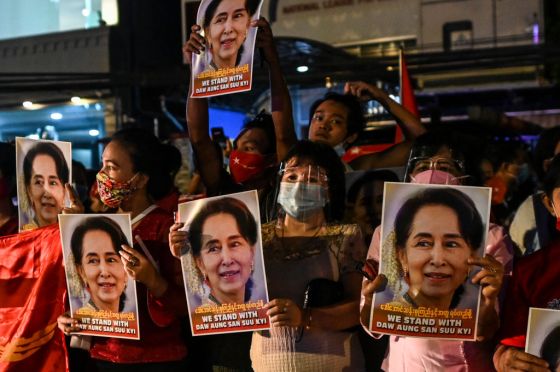
Ye Aung Thu—AFP/ Getty Images Supporters of the National League for Democracy (NLD) party hold posters with the image of Myanmar state counsellor Aung San Suu Kyi as supporters celebrate in front of the party’s headquarters in Yangon on November 9, 2020, as NLD officials said they were confident of a landslide victory in the weekend’s election.

On Jan. 29, the country’s election commission rejected allegations by the military that the election was fraudulent.

The same day, several Western diplomatic missions, including the U.S, issued a statement urging “the military, and all other parties in the country, to adhere to democratic norms.”

“We oppose any attempt to alter the outcome of the elections or impede Myanmar’s democratic transition,” the statement said.

Read More: Aung San Suu Kyi Defends Myanmar Against Rohingya Genocide Allegations at The Hague

Suu Kyi won a Nobel Peace Prize in 1991 for her non-violent resistance against the military dictatorship that kept her under house arrest for 15 years. But more recently, she faced international scorn for her response to a violent crackdown by security forces against the Rohingya, a mostly Muslim ethnic minority. U.N. investigators determined that the violent campaign of arson, rape and murder was carried out with genocidal intent. But Suu Kyi has publicly rejected accusations that the military waged a genocidal campaign against the Rohingya.

‘Would You Kill God Too?’ W.J. Lofton’s New Poem, Commissioned by Ava DuVernay, Puts a Spotlight on Breonna Taylor’s Killers


Filmmaker Ava DuVernay counts herself as one of the many people inspired by W.J. Lofton’s powerful visual poem “We Ask For Fire”—in which he repeats the words, “the cops who murdered Breonna Taylor are at home with their families”—as protesters around the world demanded justice following her death last March.

“I was deeply moved,” DuVernay tells TIME. “The idea that one artist was able to unite a very striking written voice with a visual voice—a marriage of the vocabulary it takes to be potent in both forms—was very interesting to me.”

DuVernay has now commissioned Lofton, 28, to create another visual poem for her Law Enforcement Accountability Project (LEAP), which she started in the days after George Floyd’s murder last May in Minneapolis, and aims to call attention to police brutality as well as the code of silence that exists around it. The resulting work, “Would You Kill God Too?,” debuts Sunday. In the poem, Lofton asks a series of questions to three Louisville Metro Police Department (LMPD) officers—Jonathan Mattingly, Brett Hankison and Myles Cosgrove—who conducted a “no knock” warrant raid on Taylor’s apartment late at night on March 13, 2020. During the raid, the officers fired more than thirty shots into her residence, killing her.

“How do you explain this to your children?” he asks the officers. “Did you tell them the blood on your shoes belonged to a Black girl, or is she not worth mentioning?… God was in the room when you made a massacre out of someone’s child.”

“I wanted to confront them like they confronted Breonna,” Lofton says. “It’s so important to constantly name the officers, so they don’t get to go back and just live their lives after they’ve taken someone’s life.”

(It is exceedingly rare for officers who have killed Black civilians to be charged; of the three officers, only Hankison has been charged—for “wanton endangerment,” for firing into Taylor’s neighbor’s apartment.)

“Once they kill Black people, do we just accept that they disappear behind a blue shield?” DuVernay asks. “As an artist, I have no domain on how to fight that other than to tell people in this country that we don’t have to let these officers walk away.”

Read more: Racial-Justice Organizers are TIME’s Guardians of the Year

LEAP is a two-year initiative that aims to raise awareness and put pressure on law enforcement through a series of creative works spanning film, theater, photography, poetry, music, sculpture and dance. (Inaugural funders included the Ford Foundation and Ryan Murphy.) Lofton’s piece is the second to be released. DuVernay says that a central challenge of the project has been realigning artists’ creative focus from the victim to the officers. “It’s the opposite of what our culture has trained us to do: It’s okay to say the victim’s name, but we’ve been asked to turn our back on the law enforcement side,” she notes. “We have to think about these cases differently.”

Lofton began writing the poem last September, turning to the music of Nina Simone and the art of Carrie Mae Weems for inspiration. “A life was snuffed out, and having to revisit this every day, having to carry this in my body and feel the weight of it—it was very emotionally difficult,” Lofton says.

After finishing the poem, Lofton then filmed visual accompaniments in Atlanta, where he lives, capturing images of Black love as well as tragedy. Visual references include a hoodie that quotes Sojourner Truth’s “Ain’t I A Woman” speech and a confederate flag. “ I wanted to put historical reminders throughout the film that challenge this idea we live in a post-racial society,” he says.

DuVernay hopes to put out a new LEAP piece every month. “We have the funds to identify artists who want to get into the dirt with us and make art that stands in contrast to the standard narrative around police killing Black folk,” she says.

Ten GOP Senators Propose Compromise on COVID-19 Relief in Letter to Biden


WASHINGTON — A group of Senate Republicans called on President Joe Biden to meet them at the negotiating table as the newly elected president signaled he could move to pass a new $1.9 trillion coronavirus aid package with all Democratic votes.

Ten Senate Republicans wrote Biden in a letter released Sunday that their smaller counterproposal will include $160 billion for vaccines, testing, treatment and personal protective equipment and will call for more targeted relief than Biden’s plan to issue $1,400 stimulus checks for most Americans.

“In the spirit of bipartisanship and unity, we have developed a COVID-19 relief framework that builds on prior COVID assistance laws, all of which passed with bipartisan support,” the Republican lawmakers wrote. “Our proposal reflects many of your stated priorities, and with your support, we believe that this plan could be approved quickly by Congress with bipartisan support.”

The call on Biden to give bipartisanship negotiations more time comes as the president has shown signs of impatience amid growing calls from the more liberal wing of his party to pass his $1.9 trillion legislation through budget reconciliation, a process that would allow him to move the massive bill with only the support of his Democratic majority.

The Republican lawmakers did not reveal the overall cost of their proposal, though they said it would be smaller than the $1.9 trillion price tag of the Biden package.

“My hope is that the president will meet with us and we’ll be able to work out something that is bipartisan,” said Ohio Sen. Rob Portman, one of the 10 GOP senators signing the letter.

Brian Deese, the top White House economic adviser who has been leading the administration’s outreach to Congress, said administration officials were reviewing the letter. He did not immediately commit to Biden meeting with the lawmakers.

Deese signaled the White House could be open to negotiating with Republicans on their proposal on further limiting who would receive stimulus checks.

“That is certainly a place that we’re willing to sit down and think about, are there ways to make the entire package more effective?” Deese said.

Both Portman and Deese spoke on CNN’s “State of the Union.”

Trump Parts With Impeachment Lawyers as Trial Nears


WASHINGTON — Former President Donald Trump has parted ways with his lead impeachment lawyers just over a week before his Senate trial is set to begin, two people familiar with the situation said Saturday.

Butch Bowers and Deborah Barbier, both South Carolina lawyers, are no longer with Trump’s defense team. One of the people described the parting as a “mutual decision” that reflected a difference of opinion on the direction of the case. Both insisted on anonymity to discuss private conversations.

One said new additions to the legal team were expected to be announced in a day or two.

The upheaval injects fresh uncertainty into the makeup and strategy of Trump’s defense team as he prepares to face charges that he incited the insurrection at the U.S. Capitol on Jan. 6. However, all but five Senate Republicans this week voted in favor of an effort to dismiss the trial before it even started, making clear a conviction of the former president is unlikely regardless of his defense team.

Greg Harris and Johnny Gasser, two former federal prosecutors from South Carolina, are also off the team, one of the people said.

According to a different person with knowledge of the legal hires, Bowers and Barbier left the team because Trump wanted them to use a defense that relied on allegations of election fraud, and the lawyers were not willing to do so. The person was not authorized to speak publicly about the situation and requested anonymity.

Trump has struggled to find attorneys willing to defend him after becoming the first president in history to be impeached twice. He is set to stand trial the week of Feb. 8 on a charge that he incited his supporters to storm Congress before President Joe Biden’s inauguration in an attempt to halt the peaceful transition of power.

After numerous attorneys who defended him previously declined to take on the case, Trump was introduced to Bowers by one of his closest allies in the Senate, South Carolina Sen. Lindsey Graham.

Bowers, a familiar figure in Republican legal circles, had years of experience representing elected officials and political candidates, including then-South Carolina Gov. Mark Sanford against a failed impeachment effort that morphed into an ethics probe.

Bowers and Barbier did not immediately return messages seeking comment Saturday evening.

Republicans and Trump aides have made clear that they intend to make a simple argument in the trial: Trump’s trial is unconstitutional because he is no longer in office.

While Republicans in Washington had seemed eager to part ways with Trump after the deadly events of Jan. 6, they have since eased off of their criticism, weary of angering the former president’s loyal voter base.

CNN was first to report the departure of the lawyers.

____

Associated Press writer Meg Kinnard in Columbia, South Carolina, contributed to this report.

Russia Arrests 3,300 During Wide Protests Backing Alexei Navalny


MOSCOW — Chanting slogans against President Vladimir Putin, tens of thousands took to the streets Sunday across Russia’s vast expanse to demand the release of jailed opposition leader Alexei Navalny, keeping up the nationwide protests that have rattled the Kremlin. More than 3,300 people were detained by police, according to a monitoring group, and some were beaten.

Russian authorities mounted a massive effort to stem the tide of demonstrations after tens of thousands rallied across the country last weekend in the largest, most widespread show of discontent that Russia has seen in years. Yet despite threats of jail terms, warnings to social media groups and tight police cordons, the protests again engulfed many cities on Sunday.

The 44-year-old Navalny, an anti-corruption investigator who is Putin’s best-known critic, was arrested on Jan. 17 upon returning from Germany, where he spent five months recovering from a nerve-agent poisoning that he blames on the Kremlin. Russian authorities have rejected the accusations. He was arrested for allegedly violating his parole conditions by not reporting for meetings with law enforcement when he was recuperating in Germany.

The United States urged Russia to release Navalny and criticized the crackdown on protests.

“The U.S. condemns the persistent use of harsh tactics against peaceful protesters and journalists by Russian authorities for a second week straight,” U.S. Secretary of State Antony Blinken said on Twitter.

The Russian Foreign Ministry rejected Blinken’s call as a “crude interference in Russia’s internal affairs” and accused Washington of trying to destabilize the situation in the country by backing the protests.

On Sunday, police detained over 3,300 people at protests held in cities across Russia’s 11 time zones, according to OVD-Info, a group that monitors political arrests.

In Moscow, authorities introduced unprecedented security measures in the city center, closing subway stations near the Kremlin, cutting bus traffic and ordering restaurants and stores to stay closed.

Navalny’s team initially called for Sunday’s protest to be held on Moscow’s Lubyanka Square, home to the main headquarters of the Federal Security Service, which Navalny claims was responsible for his poisoning. Facing police cordons around the square, the protest shifted to other central squares and streets.

Police were randomly picking up people and putting them into police buses, but thousands of protesters marched across the city center for hours, chanting “Putin, resign!” and Putin, thief!” a reference to an opulent Black Sea estate reportedly built for the Russian leader that was featured in a widely popular video released by Navalny’s team.

At some point, crowds of demonstrators walked toward the Matrosskaya Tishina prison where Navalny is being held. They were met by phalanxes of riot police who pushed the march back and chased protesters through courtyards, detaining scores and beating some with clubs. Still, protesters continued to march around the Russian capital, zigzagging around police cordons.

Nearly 900 people were detained in Moscow, including Navalny’s wife, Yulia, who joined the protest. “If we keep silent, they will come after any of us tomorrow,” she said on Instagram before turning out to protest.

Several thousand marched across Russia’s second-largest city of St. Petersburg, and occasional scuffles erupted as some demonstrators pushed back police who tried to make detentions. Nearly 600 were arrested.

Some of the biggest rallies were held in Novosibirsk in eastern Siberia and Yekaterinburg in the Urals.

“I do not want my grandchildren to live in such a country,” said 55-year-old Vyacheslav Vorobyov, who turned out for a rally in Yekaterinburg. “I want them to live in a free country.”

As part of a multipronged effort by authorities to block the protests, courts have jailed Navalny’s associates and activists across the country over the past week. His brother Oleg, top aide Lyubov Sobol and three other people were put Friday under a two-month house arrest on charges of allegedly violating coronavirus restrictions during last weekend’s protests.

Prosecutors also demanded that social media platforms block calls to join the protests.

The Interior Ministry issued stern warnings to the public not to join the protests, saying participants could be charged with taking part in mass riots, which carries a prison sentence of up to eight years. Those engaging in violence against police could face up to 15 years.

Nearly 4,000 people were reportedly detained at demonstrations on Jan. 23 calling for Navalny’s release that took place in more than 100 Russian cities, and some were given fines and jail terms. About 20 were accused of assaulting police and faced criminal charges.

Soon after Navalny’s arrest, his team released a two-hour video on his YouTube channel about the Black Sea residence purportedly built for Putin. The video has been viewed over 100 million times, helping fuel discontent and inspiring a stream of sarcastic jokes on the internet amid an economic downturn.

Russia has seen extensive corruption during Putin’s time in office while poverty has remained widespread.

Demonstrators in Moscow chanted “Aqua discotheque!,” a reference to one of the fancy amenities at the residence that also features a casino and a hookah lounge equipped for watching pole dances.

Putin says neither he nor any of his close relatives own the property. On Saturday, construction magnate Arkady Rotenberg, a longtime Putin confidant and his occasional judo sparring partner, claimed that he himself owned the property.

Navalny fell into a coma on Aug. 20 while on a domestic flight from Siberia to Moscow and the pilot diverted the plane so he could be treated in the city of Omsk. He was transferred to a Berlin hospital two days later. Labs in Germany, France and Sweden, and tests by the Organization for the Prohibition of Chemical Weapons, established that he was exposed to the Novichok nerve agent.

Russian authorities have refused to open a full-fledged criminal inquiry, claiming a lack of evidence that he was poisoned.

Navalny was arrested immediately when he returned to Russia earlier this month and jailed for 30 days on the request of Russia’s prison service, which alleged he had violated the probation of his suspended sentence from a 2014 money-laundering conviction that he has rejected as political revenge.

On Thursday, a Moscow court rejected Navalny’s appeal to be released, and another hearing next week could turn his 3 1/2-year suspended sentence into one he must serve in prison.

Here’s Everything New on Netflix in February 2021—And What’s Leaving


This February, Zendaya reunites with Euphoria creator Sam Levinson for the Netflix original film Malcom & Marie. The drama, which releases Feb. 5 and is written and directed by Levinson, stars Zendaya and John David Washington as a Hollywood couple reckoning with their relationship over the course of one turbulent night.

The third and final installment of the To All the Boys I’ve Loved Before film series, based on Jenny Han’s YA novels of the same name, will arrive on Feb. 12. In To All the Boys: Always and Forever, eternal romantic Lara Jean Covey (Lana Condor) and her teen-dream boyfriend Peter Kavinsky (Noah Centineo) consider the future as they graduate from high school and prepare for college.

There’s no shortage of laughs when comedian Tiffany Haddish returns for a second season of her Netflix original comedy series, Tiffany Haddish Presents: They Ready on Feb. 2. The series, which features six of Haddish’s favorite up-and-coming comedians, boasts a wealth of talent this season, including Saturday Night Live’s Dean Edwards and Late Night with Seth Myers’ Erin Jackson.

Here’s everything new on Netflix this month—and everything set to leave the streaming platform.

Here are the Netflix originals coming to Netflix in February 2021

Available Feb. 2

Kid Cosmic

Mighty Express, season 2

Tiffany Haddish Presents: They Ready, season 2

Available Feb. 3

All My Friends Are Dead

Black Beach .

Firefly Lane

Available Feb. 5

Hache, season 2

Invisible City

The Last Paradiso

Little Big Women

Malcolm & Marie

Space Sweepers

Strip Down, Rise Up

Available Feb. 10

Crime Scene: The Vanishing at the Cecil Hotel

The Misadventures of Hedi and Cokeman

Available Feb. 11

Capitani

Layla Majnun

Red Dot

Squared Love

Available Feb. 12

Buried by the Bernards

Nadiya Bakes

Hate by Dani Rovira

To All The Boys: Always And Forever

Xico’s Journey

Available Feb. 15

The Crew

Available Feb. 16

Animals on the Loose: A You vs. Wild Movie

Available Feb. 17

Behind Her Eyes

Hello, Me!

MeatEater, season 9 – part 2

Available Feb. 18

Thus Spoke Kishibe Rohan

Available Feb. 19

I Care A Lot

Tribes of Europa

Available Feb. 20

Classmates Minus

Available Feb. 23

Brian Regan: On The Rocks

Pelé

Available Feb. 24

Canine Intervention

Ginny & Georgia

Available Feb. 25

Geez & Ann

High-Rise Invasion

Available Feb. 26

Bigfoot Family

Caught by a Wave

Crazy About Her

Here are the TV shows and movies coming to Netflix in February 2021

Available Feb. 1

The Bank Job

Beverly Hills Ninja

Eat Pray Love

Inception

Love Daily, season 1

My Best Friend’s Wedding

My Dead Ex, season 1

National Lampoon’s Christmas Vacation

The Patriot

Rocks

Shutter Island

The Unsetting, season 1

Zac and Mia, seasons 1-2

Zathura

Available Feb. 6

The Sinner: Jamie

Available Feb. 8

iCarly, seasons 1-2

War Dogs

Available Feb. 10

The World We Make

Available Feb. 11

Middle of Nowhere

Available Feb. 13

Monsoon

Available Feb. 16

Good Girls, season 3

Available Feb. 21

The Conjuring

The Conjuring 2

Available Feb. 24

Two Sentence Horror Stories, season 2

Available Feb. 26

Captain Fantastic

No Escape

Our Idiot Brother

Here’s what’s leaving Netflix in February 2021

Leaving Feb. 4

Erased

Leaving Feb. 5

Lila & Eve

Woody Woodpecker

Leaving Feb. 7

Don’t Knock Twice

Swiped

Leaving Feb. 10

A Bad Moms Christmas

Leaving Feb. 11

The Other Guys

Leaving Feb. 14

Alone in Berlin

Hostiles

Leaving Feb. 16

Brave Miss World: Collection 1

Leaving Feb. 19

Bates Motel, seasons 1-5

Leaving Feb. 20

A Haunted House

Leaving Feb. 21

Trespass Against Us

Leaving Feb. 24

Dolphin Tale 2

Leaving Feb. 26

The Frozen Ground

Here’s What’s New on Amazon Prime in February 2021


This February, there’s a wealth of original content to stream on Amazon Prime Video, including Bliss, a reality-bending romance starring Owen Wilson and Salma Hayek that drops on Feb. 5, and The Map of Tiny Perfect Things, a rom-com and highly anticipated adaptation of Lev Grossman’s time loop short story of the same name, which releases on Feb. 12.

Ahead of the upcoming Amazon Prime original sequel Coming 2 America sequel in March, the hilarious original film joins the streaming platform on Feb. 1. Starring Eddie Murphy as Prince Akeem and Arsenio Hall as his hapless best friend, the movie follows as the royal searches for his queen in Queens, New York.

Music fans are in luck this month, with new documentaries about industry icons added to the streaming service. Whitney: Can I Be Me, an intimate 2017 documentary that features previously unreleased footage of the legendary singer, is available to stream starting Feb. 1. A four-part docuseries, Wu-Tang Clan: Of Mics and Men, also joins the platform on Feb. 1 and tells the story of how the NYC-based hip-hop group formed to become one of the most influential musical movements in the world.

Here are all the series and movies available on Amazon Prime Video this month.

Here are the new Amazon Prime Video originals in February 2021

Available Feb. 1

Tell Me Your Secrets, season 1

Available Feb. 5

Bliss

Available Feb. 12

Map Of Tiny Perfect Things

Here are the movies streaming on Amazon Prime Video in February 2021

Available Feb. 1

Antz

Australia

Be My Valentine

Burn Motherf**ker, Burn!

Coming To America

Courageous

Dazed And Confused

Down To Earth

Hitsville: The Making of Motown

How She Move

Imagine That

Just Wright

Kiki

Love by Accident

Love by the 10th Date

Moulin Rouge

Notes On A Scandal

Shanghai Noon

SMOOCH

Spy Next Door

The Haunting In Connecticut

The Ides Of March

The Last Appeal

The Prestige

There’s Something About Mary

The Village

Whitney: Can I Be Me

Available Feb. 16

Catfish

The Warrior Queen Of Jhansi

Available Feb. 18

Sonic The Hedgehog

Available Feb. 26

The Informer

Here are the TV shows streaming on Amazon Prime Video in February 2021

Available Feb. 1

19-2, season 1

African American Lives, season 1

Billions, seasons 1-3

Black in Latin America, season 1

Butter and Brown, season 1

City on a Hill, season 1

Civil War Journal, season 1

Faster With Finnegan, season 1

Finding Your Roots, season 1

For the Love of Jason, season 1

Genealogy Roadshow, season 1

I Killed My BFF, season 1

I Married Joan, season 1

Mercy Street, season 1

One On One, season 1-5

Raiders of Ghost City, season 1

Safe House, season 1

The Game, seasons 1-3

The White Princess, season 1

What’s New Scooby-Doo?, season 1

WuTang Clan: Of Mics and Men, season 1

Available Feb. 5

Little Coincidences (Pequeñas Coincidencias), season 3

Available Feb. 12

Clifford

Available Feb. 19

The Boarding School: Las Cumbres, season 1

Available Feb. 26

Top Class: The Life and Times of the Sierra Canyon Trailblazers, limited series

Saturday, 30 January 2021

Sophie, Grammy-Nominated Scottish Musician, Dies at 34


LONDON — Sophie, the Grammy-nominated Scottish disc jockey, producer and recording artist who had worked with the likes of Madonna and Charli XCX, has died following an accident in the Greek capital of Athens. She was 34.

In a statement, U.K. label Transgressive said the musician, whose full name was Sophie Xeon, died in the early hours of Saturday morning.

“Tragically, our beautiful Sophie passed away this morning after a terrible accident,” the statement said. “True to her spirituality she had climbed up to watch the full moon and accidentally slipped and fell.”

A police spokesperson in Athens confirmed that Sophie slipped and fell from the balcony of an apartment where she was staying and no foul play was suspected in her death. The person spoke to The Associated Press on condition of anonymity because the investigation is still ongoing.

Sophie, who was born in Glasgow, began releasing music in 2013 and was best known in the early part of her career for being one of the writers of Madonna’s 2015 single “Bitch I’m Madonna.”

She first used her own image and vocals for the October 2017 single “It’s Okay To Cry.” The recording paved the way for Sophie’s debut album, “Oil of Every Pearl’s Un-Insides.” Released in June 2018, it received a Grammy nomination for best dance/electronic album.

Tributes have poured in from across the LGBT community Sophie, who was transgender and widely considered one of the most pioneering artists in the music industry.

French singer/songwriter Christine and the Queens described Sophie as a “stellar producer, a visionary, a reference,” who rebelled against “the narrow, normative society by being an absolute triumph, both as an artist and as a woman.”

She added: “We need to honor and respect her memory and legacy. Cherish the pioneers.”

Discussing gender identity in a 2018 interview with Paper magazine, Sophie said, “Transness is taking control to bring your body more in line with your soul and spirit so the two aren’t fighting against each other and struggling to survive.”

“On this Earth, it’s that you can get closer to how you feel your true essence is without the societal pressures of having to fulfill certain traditional roles based on gender,” she said.

___

Demetris Nellas contributed reporting from Athens.

The Key Foreign Policy Challenges Facing President Biden


We’ve already dived into the U.S. domestic political divisions Joe Biden faces, but as his administration begins getting key officials confirmed this week, let’s survey some of the other big challenges he’ll have to tackle: the geopolitics, the economics, and the technology.

In geopolitics, Biden will spend time and political capital rebuilding the Transatlantic relationship, something other recent U.S. presidents never had to worry about. He’ll have to re-establish U.S. credibility in the region by reassuring South Korea, Japan and other Asian allies—who are rightly fearful that Trumpism might return—that the U.S. remains committed to help them manage challenges created by China’s rise. That means a tighter alignment of free-market democracies and a coordinated multilateral approach.

Biden will also need to persuade Russia that bad behavior, whether cyber operations targeted abroad or domestic political repression, will have consequences. On Iran, the goal is two-fold. First, avoid a near-term crisis while the Biden team finds a way to restart negotiations for an updated nuclear deal that will boost Iran’s economy and global security. Second, demonstrate that the U.S. will honor and enforce past commitments. For North Korea, Venezuela and Turkey, the Biden team needs at least to maintain the status quo in its turbulent relations with all three. None of these moves—even if successful—changes the fact that the global order is slowly slipping away from the U.S. The previous four years has demonstrated both the deep dysfunction of U.S. politics and the potential for sharp policy reversals over time. But if Biden can slow the erosion of U.S. influence, much can still be achieved.

Next, economics. The ongoing pandemic and its economic fallout confronts the new president with urgent domestic priorities. The U.S. vaccine rollout continues to move slowly (one and a half months into the vaccination drive, just 4.3 million people have been vaccinated with two-dose shots so far), and much more stimulus will be needed to keep Americans afloat until enough of the U.S. population has immunity to reach a stable new normal. The long-term question that Biden and team need to answer is how to respond to a world in which the global free market is giving way to a hybrid economy in which certain countries only trade particular goods and services with those politically aligned with them.

Why is this happening? China and the threat it poses in both developing and setting standards for emerging technologies are moving the world where toward a system of two competing tech ecosystems, a Chinese one and a Western one, and China has already begun exporting its tech to Beijing-friendly governments who depend on access to the Chinese market. While global trade can offer benefits to all who engage in it, tech competition between the U.S. and China—where control and access to data is paramount—is increasingly zero-sum. As technology plays an ever-larger role in our economies, that will fracture big pieces of the global free market. Absent a coherent strategy from the U.S. and other free market democracies to deal with this reality, state-capitalist China will be the most important player in this new economic order. (While the world’s most important tech companies are based in the U.S., they don’t report to Washington the way Chinese companies do to Beijing. Just ask Jack Ma.) And that means the Biden team must find a way to align with as many allies as possible on development and regulation of 5G and related emerging technologies to begin setting the terms of future international trade.

These are mammoth tasks, each complicated for its own unique reasons. But Biden can’t ignore any one of them, particularly because all three issues (geopolitics, economics and technology) will have an extraordinary impact on the fight against climate change. In fact, addressing climate can help Biden unlock progress across most of these other fronts—there is space for geopolitical collaboration to address global warming, the pandemic and its economic costs could provide the crisis needed to force a difficult-but-necessary transition to a more green economy, and there is no way out of our current climate change trajectory without new technologies that can help foster tech cooperation, not just tech competition.

Sometimes there are virtuous cycles at play even when it comes to global politics—the question is whether Biden can capitalize on this one.

Friday, 29 January 2021

The 5 Best New Shows Our TV Critic Watched in January 2021


It’s a wonder any of us were able to tear ourselves away from the news for long enough to watch anything else this month, which took America from insurrection to impeachment to the inauguration of our 46th President in the space of just two weeks. Then again, how else were we supposed to self-soothe?

Among the best televisual distractions to debut this month are two excellent foreign-language thrillers, two very different vehicles for two very different New York cult heroes and an imperfect but extremely worthwhile addition to the Masterpiece canon—plus, as a bonus, my favorite new-to-streaming dramedy that isn’t actually new. For more recommendations, here’s my list of the best shows of 2020.

The Long Song (PBS)


In this three-part BBC miniseries, adapted from the late Jamaican-British author Andrea Levy’s acclaimed 2010 historical novel and airing on PBS’s Masterpiece, a debate arises at a holiday dinner in Jamaica among white plantation owners over the threat of slaves taking up arms against their masters. “They lack any ability to organize themselves,” one man opines. Later that night—at the precise moment when a guest is putting his hand up the skirt of the show’s protagonist, an enslaved woman named July, in a casual act of sexual assault—soldiers burst in with news of the revolt. It’s an episode that at first appears to depict the fall of a brutal institution. But, true to history, the triumph is brief. Even after emancipation, we watch supposedly free Black Jamaicans harvest sugarcane in the same fields they worked before it, still supervised by white men with bullwhips. Such complexity is the essence of this unimaginatively adapted but still incisive story, which subverts the overly simplistic binaries of bondage and liberty, oppressed and oppressor, abolitionist and enslaver. [Read TIME’s full review.]

Losing Alice (Apple TV+)


Built around Daredevil alum Ayelet Zurer’s magnificently layered turn as the title character, this eight-part Israeli series from creator, director and writer Sigal Avin is the kind of twisty, fast-paced mystery that will inevitably be described as addictive. And it is. But that undersells Avin’s achievement. Losing Alice avoids the crutches of second-rate thrillers like The Undoing: unbelievable coincidences, characters whose inner lives are black boxes, cliffhangers that appear out of nowhere at the end of one episode only to be dispatched within the first few minutes of the next. Instead, Avin patiently investigates the nature of relationships between husbands and wives, parents and children, women of different generations, older men and younger women—and, in a stunning finale, between life and art. [Read more about Losing Alice and other great foreign-language TV.]

Lupin (Netflix)

The first big Netflix hit of 2021 is this French-language crime drama—a sharp, fun update of Maurice Leblanc’s frequently adapted novels about the gentleman thief Arsène Lupin. Instead of recasting the Lupin role yet again, creators George Kay and François Uzan dreamed up a righteous present-day outlaw who takes inspiration from the books. Omar Sy, best known in the U.S. for his roles in action blockbusters like Jurassic World and X-Men: Days of Future Past, gives an impossibly suave performance as Assane Diop, a Senegalese immigrant in Paris who has become a self-taught criminal mastermind in order to avenge the death of his single father when Assane was a teenager. It’s a quest he struggles to balance with his responsibilities to his own own teen son (Etan Simon), amid a long, complicated history with the boy’s mother (the wonderful Ludivine Sagnier). Lupin ranks among the most bingeable TV series ever made. The first three out of five episodes that dropped this month, all directed by Louis Leterrier (Now You See Me, The Dark Crystal: Age of Resistance), are master classes in slick, glamorous suspense. And although the remainder of Part 1 gets a bit bogged down by the addition of weak characters, the show deploys Sy, Sagnier and subtle statements on racism and colonial profiteering in France effectively enough to maintain anticipation for Part 2.

Painting With John (HBO)

Thirty years ago, the artistic polymath John Lurie—the downtown New York icon best known at the time for leading avant-garde jazz ensemble the Lounge Lizards and appearing in indie films such as Paris, Texas and Down by Law—blessed the world with cult-classic TV show Fishing With John. Over the course of six deeply idiosyncratic episodes, he traveled from Maine to Thailand to Costa Rica on fishing expeditions with famous pals like Willem Dafoe, Tom Waits and Dennis Hopper; you can watch the talky, hilariously absurdist results on Criterion Channel. Now, Lurie lives on an idyllic Caribbean island and spends much of his time painting. This spiritual sequel casts him as a sort of anti-Bob Ross, working away at the table he uses instead of an easel while insisting that not everyone is equipped to be an artist. So, instead of instruction, he offers musings on creativity and wild personal anecdotes ranging from a kitchen disaster that left him running around nude with a machete to that time he had to wrestle an eel to death for the purposes of shooting an album cover. His paintings are a compelling mix of global styles and Lurie’s strong artistic instincts, and a soundtrack pulled from his various musical projects makes most TV scores sound like elevator music. He has a knack for combining the spiritual and sincere with the sardonic and self-deprecating. This is a meditative show for people who can’t stomach meditation apps—and thank heavens for that.

Pretend It’s a City (Netflix)

If Pretend It’s a City has a thesis, it is that 70-year-old humorist, commentator, chronically blocked writer, sometime actor and Manhattan fixture Fran Lebowitz’s perhaps-masochistic devotion to observing what she calls her “fellow man” gives her a rare perspective on society—and particularly on the metropolis that has, over the years, been the most consistent object of her tough love. The title refers to her frustration with people so absorbed in their devices that they bump into you on the street. “Pretend it’s a city—where there are other people,” she pleads. But this is hardly a high-concept show. Director Martin Scorsese seems solely interested in putting a worthy frame around the living, breathing, eloquently complaining work of art that is Fran Lebowitz in conversation. [Read the full review]

Bonus: Flack (Amazon Prime)

Flack doesn’t quite qualify as a new show; it premiered almost two years ago in the UK, and the first season got a bit buried in the Peak TV glut when it aired stateside on Pop. As of this month, you can find it on Amazon Prime (with the year-old second season to appear on the service at some point in the future). And I strongly suggest that you do. Scandal meets UnREAL meets I Hate Suzie in this devastatingly quick-witted dramedy that casts Anna Paquin as an ingenious PR professional tasked with putting out fires for celebrity clients—a career that requires a near-sociopathic flair for deception. Even the story lines that don’t appear to be ripped directly from the headlines feel real; I can’t think of another show that’s half as insightful about entertainment in the age of social media and #MeToo. It’s also the most fun I’ve had watching TV in months.

‘Much More Work To Be Done.’ Advocates Call for More Action Against Private Prisons After Biden’s ‘First Step’ Executive Order


On Jan. 26, President Joe Biden signed an executive order directing the Department of Justice (DOJ) not to renew its contracts with private prisons, effectively returning to an Obama-era policy that had been overturned under former President Donald Trump. But while advocates have praised the move as a first step, many argue more must be done to address the privatization of the criminal justice system and prison industrial complex.

Advocates have long decried the use of private prisons, arguing that—among other issues—the facilities put incarcerated people at greater risk for abuse. A 2016 report by the DOJ’s Office of the Inspector General found that private prisons “incurred more safety and security incidents per capita than comparable [public federal] institutions.” The review also found that private prisons had a 28% higher average rate of inmate-on-inmate assault and more than double the rates of inmate-on-staff assaults compared to public federal prisons.

While Biden’s order will affect the 11 private prisons currently under contract by the DOJ—as well as the larger private prison industry—it will not actually free any people currently housed therein, and only impacts a small slice of the U.S. prison population. States will also be free to continue contracting with private prisons, which held roughly 88,500 state prisoners (or 7% of the states’ total prison population) at the end of 2019, according to the Bureau of Justice Statistics (BJS). Around 27,400 federal prisoners (or roughly 16% of the federal prison population) were housed in private prisons at the end of 2019, per the BJS. For comparison, a 2020 Prison Policy Initiative report found that over two million people are incarcerated in the American criminal justice system.

It could also take some time for the full impact of the order to go into effect, as it directs the DOJ to decline to renew private prison contracts whenever they expire, rather than sever them immediately. “They’ll have time to transfer these people from private facilities from non-private ones,” says John Pfaff, a professor of law at Fordham University School of Law. “It doesn’t necessarily mean a shrinking of the footprint of prisons, it just means a transfer from privates to the public.”

Though private prisons have long been used by state and federal authorities, the Department of Justice’s use of private facilities increased under President Trump. During his presidency, Trump “doubled private prison revenues,” according to Courthouse News Service; in just one example, in 2019 the federal government spent nearly $600 million on GEO Group, a for-profit group operating correctional facilities, compared to $260 million spent in 2014 during the Obama administration. (The Obama-era limitations on DOJ contracts with private prisons didn’t roll out until 2016.)

GEO Group released a statement on Jan. 26 calling Biden’s order “a solution in search of a problem,” and pointed to the fact that the Bureau of Prisons (BOP) had already chosen to not renew some private prison contracts in the past few months.

“Given the steps the BOP had already announced, President Biden’s executive order merely represents a political statement,” GEO Group’s statement reads, “which could carry serious negative unintended consequences, including the loss of hundreds of jobs and negative economic impact for the communities where our facilities are located, which are already struggling economically due to the COVID pandemic.”

Biden told reporters on Jan. 26 that the executive order is a “first step” to stop corporations from profiting off “incarceration that is less humane and less safe.” Asked for comment on criticism that the order does not go far enough, a White House official told TIME that “President Biden is committed to reducing mass incarceration while making our communities safer, which starts with ending DOJ’s reliance on private prisons and will continue with further work on criminal justice reform in the months ahead.”

Still, Pfaff says he hopes the order does not give the false impression that the issue of profiteering off the criminal justice system is so easily remedied. “Saying we’re taking the profit out of prisons by shutting down the private facilities ignores the massive amount of [financial incentives] on the public side,” he argues.

At the state level, over two thirds of the roughly $43 billion spent on corrections each year goes to to personnel costs, such as salaries, overtime and benefits, a 2015 Vera Institute report found. “That is very much a form of profit that encourages [legislators] to lobby aggressively to keep their prisons open,” Pfaff says.

“When you engage in a symbolic act, which [this order] mostly is,” Pfaff continues, “you have to make sure the symbolism doesn’t actually undermine the broader message that you need to convey.”

Read more: The True History of America’s Private Prison Industry

One of a series of executives orders Biden signed on Jan. 26, the White House has said his decision to end the DOJ’s use of private prisons is intended to help further racial equity.

Ash-Lee Woodard Henderson, an organizer with The Frontline and the Movement for Black Lives, says it marks a small step, but must serve as starting place for the administration on the issue of racial justice, rather than its ceiling. “It is by no means the victory being won,” she says. “So I think it’s even more incumbent on our social movements, to continue to put on political pressure.”

Pfaff also points out that “the choice of where we put people in prison [alone] isn’t what drives the racial disparities” apparent between inmates held in private and public prisons, and across the larger U.S. prison population. “What drives disparities are who we arrest, who we charge, what we decided to charge them with, what kinds of sentences we impose, either after trial, or after plea bargaining,” he says.

Advocates also note that the order does not address other privatized elements of the carceral state. In a statement acknowledging that Biden’s order “will start curtailing” what he described as the “insidious practice” of prison privatization, David Fathi, director of the American Civil Liberties Union’s (ACLU) National Prison Project, also flagged the impact of “for-profit prison health care companies, which have also been the source of much abuse and malfeasance in recent years.”

“There is much more work to be done,” Fathi said in a Jan. 26 statement.

Similarly, “the Biden administration must now address the private prison industry’s toxic relationship with the Department of Homeland Security (DHS),” said Silky Shah, the executive director of the advocacy group Detention Watch Network, in a Jan. 26 statement. “Ending immigration detention is part and parcel to the advancement of racial justice.”

Biden’s order only addresses private prisons under contract with the Department of Justice, not facilities contracted by the U.S. Immigration and Customs Enforcement (ICE) in the Department of Homeland Security (DHS). The use such facilities by the federal government grew under the Trump administration, and now make up around 75% of DHS detention contracts, according to the Center for American Progress. In the 2019 fiscal year, ICE detained on average 50,000 people a day, every day—and at points, over 56,000 people a day—according to a 2020 ACLU report.

That same report found that, in January 2020, a record-breaking 81% of people detained in ICE custody were held in facilities that were privately owned or managed.

Biden had addressed this issue on the campaign trail, pledging to “end the federal government’s use of private prisons” including in its “detention of undocumented immigrants.” POLITICO also reported Jan. 26 that Biden is considering another order that would address facilities detaining undocumented immigrants.

Holly Harris, the executive director of Justice Action Network, a bipartisan advocacy organization, tells TIME the order is an “important and critical step in right-sizing our justice system.”

“I get that advocates are frustrated, and I’m grateful that there are so many people out there pushing for more,” Harris says. But Biden was “very clear that much more is going to be done,” she continues. “For me, I’m willing to extend some grace on day six to this new administration.”

Cicely Tyson Didn’t Just Open Doors—She Opened Whole Worlds


One of the great actresses of the 1970s—and that’s if you’re drawing up a list of, say, three—didn’t have many big starring roles in film; she would end up landing some of her most prestigious parts in television and theater. But the career of Cicely Tyson can’t be assessed by the number of big film roles she had, especially given that in the ‘70s, Hollywood had no idea what to do with a Black woman possessed of gifts as magnificent as hers were. Tyson, who died on January 28, at age 96, leaves a legacy to be studied by generations going forward: working in an industry that could barely be bothered to make a place for her, she carved her own path out of rock, so that others might follow. Her performances will resonate forever, a ghost echo whose magnitude can’t be measured in Oscar nominations or other official accolades. And in her refusal to take roles that debased Black people, her greatness lies as much in the roles she refused to take as those that she did.

Tyson was born in East Harlem in 1924, the daughter of West Indian immigrants. After high school, she landed modeling jobs; she studied at the Actors Studio in the 1940s. (Her mother, a strict Christian who had raised Tyson and her siblings largely on her own, disapproved.) Early in her career, Tyson landed roles in television and onstage, often earning good notices. But it wasn’t until 1972, with her astonishing portrayal of Rebecca, a sharecropper, wife and mother in Martin Ritt’s Sounder, that the greater world got the chance to see her brilliance. Although the performance earned her an Academy Award nomination, great film roles didn’t automatically tumble her way. But Tyson worked hard, and she worked often: by the end of her life, she had appeared in 29 movies and more than twice as many television series or single episodes. Though most of the world knows her from her film and TV performances (she won three Emmys for the latter), she was also a formidable onstage presence: In 2013, at age 88, she became the oldest person to win a Tony, for her role in the revival of Horton Foote’s The Trip to Bountiful.

And Tyson, onscreen, onstage or off, was simply a magnificent presence. Her beauty was the generous kind, holding a mirror to other Black women of her generation, and all that would follow. Even without words, she urged them to see the same beauty in themselves. She helped bring the Dance Theater of Harlem into being. A school in East Orange, N.J., the Cicely Tyson School of Performing and Fine Arts, has been named after her. Just before her death, she published a memoir, Just As I Am. Tyson leaves behind not just a body of performances but a way of being, of living in the world, that it would do us all good to emulate.

A still of Cicely Tyson in Sounder in 1972
Stanley Bielecki Movie Collection/Getty ImagesTyson in a scene from the movie Sounder, 1972.

To gaze upon her onscreen is one way to celebrate her: In the 1974 television movie The Autobiography of Miss Jane Pittman, adapted from Earnest J. Gaines’s novel, she plays a woman who has reached the age of 110, a survivor of slavery who agrees to share her story with a young white journalist. For much of the performance, Tyson’s face is altered by age makeup, at the time less sophisticated than it is today. But those applied wrinkles can’t dim her resplendence. As Miss Pittman, Tyson shows us a robust spirit seeking to push the boundaries of a frail, aged body. Her gaze is soft, with flashes of flintiness; with her eyes alone, Tyson tells a story of hardship and fortitude that reaches a place beyond words. For all the ways in which our society remains twisted in its backwards vision, Tyson worked hard to push it forward.

Acting isn’t always just storytelling; at its best, it pushes so deep into our hearts that we become a vessel for the story. That’s what Tyson does in Sounder, set in 1933 Louisiana and adapted from William H. Armstrong’s novel. (It’s also an example of the socially progressive filmmaking that some directors could push into being in the ’70s, even within the Hollywood mainstream.) Tyson’s Rebecca is left alone to care for her three children when her husband, Nathan (Paul Winfield), is arrested and imprisoned after stealing a chicken to feed his family. Rebecca’s life of worry shows on her face—with cheekbones that accept and reflect light as if it were a gift, she’s never anything less than beautiful, but her radiance glows through a veil of anxiety. When Rebecca has to face a white storekeeper—also her family’s landlord—after her husband’s arrest, he reminds her, his voice metallic with condescension, how much he’s done to help her family. She accepts his scolding politely, because she has to. But there’s a sea of feeling rolling beneath the very surface of her face, some waves glinting with resentment and anger, but most of them shimmering with a pride, a sense of self, that can’t be touched. And in a late scene, when she first glimpses Nathan from across a field, finally returning after serving his sentence, the cautious joy on her face—a rush of concurrent relief and disbelief—tells thousands of stories in one.

Tyson knew how to teach—without instructing or lecturing—by inviting us deep into another person’s world, another person’s history. If you saw Sounder as a kid, upon its release, what she showed you has likely stayed with you for a lifetime. If greatness is a quality that continues to unfold over generations, then Tyson’s is nowhere close to reaching its half-life.

The Inside Story of How Alexey Navalny Uncovered Putin’s $1.3 Billion Palace


Two days after Alexey Navalny, head of Russia’s Anti-Corruption Foundation (FBK) was arrested on his return to Moscow from Berlin, he released a video expose that shocked Russians and people around the world. In the video, “Putin’s palace. History of the world’s largest bribe,” Navalny alleged that an opulent property near Gelendzhik, a town in the southern Russian region of Krasnodar, was constructed for Russian President Vladimir Putin with illicit funds of $1.35 billion, provided by members of his inner circle, and that Putin is the real owner of the palace.

The palace’s features apparently include a port, a vineyard, a church, a casino, an underground hockey rink, and toilet brushes costing $850 a piece. “It is a separate state within Russia… And in this state there is a single, irreplaceable tsar. Putin,” Navalny said in the video. Allegedly covering an area of 17, 691 square meters, it is the largest private residential building in Russia. Putin denied the claims. “Nothing listed there has ever belonged to me or my close relatives,” he said Tuesday.

Within 24 hours of its release to YouTube, the video reached 20 million views and within a week, 93 million, making it the activist’s most popular investigation. After Navalny’s arrest pushed thousands of people to protest in more than 100 cities across Russia on Saturday, demonstrators waved toilet brushes in the air. Police detained 3,711 people over the weekend, according to Moscow-based NGO OVD-Info, sparking international condemnation. TIME looked into how the investigation unfolded:

How did the investigation originate?

The idea to look into the Gelendzhik property came to Navalny a few days after he woke up from a coma in Berlin in early September, Maria Pevchikh, head of the investigations department at FBK tells TIME over the phone from her home in London on Monday. Pevchikh and FBK investigator Georgy Alburov began their research a few weeks later, while Navalny dug out leads as he was recovering in intensive care and wrote the video’s script. “I can’t say we started from scratch,” says Pevchikh. She and Alburov have been uncovering dozens of corruption scandals with FBK for over a decade. They knew where to look. “So many stories have somehow overlapped in terms of how Putin manages his corruption,” she says.

Putin-insider-turned-whistleblower, Sergei Kolesnikov, also laid some of the foundations for the investigation. Kolesnikov said he was responsible for building the property from 2005. Originally conceived as a “small house”, it started morphing into a “huge palace,” Kolesnikov tells Navalny in the video. Kolesnikov fled from Russia after publishing in 2010 an open letter calling on then-President Dmitry Medvedev to end Putin’s corruption, wherein he divulged how the palace came to be. “The debilitating corruption and greed plague millions of Russians,” he wrote. In the decade since, there have been no large-scale leaks about the residence.

But in the past few years, FBK had received snippets of leaked information about the palace, such as photos and a floorplan. Pevchikh says the documents came from a few of the thousand workers involved in constructing extensions to the palace, despite the fact that their phones were banned on site. “I think those who were building the palace passed the threshold for being able to contain the information,” she says.

How did Navalny’s team film the palace?

This was one of the most challenging tasks, Pevchikh says. The team decided to travel to Gelendzhik to capture a video of the heavily-guarded residence using a drone. Three FBK staff members, Alburov, Vyacheslav Gimadi, and Vladlen Los, took a train at night from the capital. Before Alburov and Gimadi disembarked near Gelendzhik, Los replaced their phones with burners and took the devices on to the Black Sea city of Sochi. That way, if the police or the FSB, Russia’s security service, were monitoring the team’s geolocation they would be directed some 240km away from the estate. “We know we’re under constant surveillance,” says Pevchikh.

The particularly high hostility toward FBK in the Krasnodar region made the cover up more urgent. “Whenever we go there we get into some kind of trouble,” Pevchikh says. Navalny and several FBK members were attacked by residents outside Anapa airport in Krasnodar in 2016.

Unable to get near the palace on land due to the high level of security, FBK travelled by boat to the Black Sea Coast. Ahead of their trip, the investigators contacted the FSB for permission to sail in the region—a particular requirement for this area only, said Navalny—and were asked (without justification) to maintain a 1-mile radius from the coast around the estate.

The FBK investigators and a cameraman rode in a motor-powered dinghy boat on a clear, sunny day wearing bright orange life jackets. Alburov and Gimadi seemed appropriately dressed for their seaside escapade, donning shorts and fish and floral print short-sleeved shirts. “We’re in a slightly unusual situation for us,” Alburov said in the video, as the boat bobbed. They stopped two miles from the residence, from where they tried to fly the drone. Four attempts later, they got the detailed footage they were after.

As for the palace’s interior, FBK produced visuals based on descriptions and photos from workers at the residence. Using architectural plans that listed Italian furniture brands, they inquired with the manufacturer about the appearance and cost of the products. “Each couch was the cost of a small flat on the outskirts of Moscow, and if you took all the furniture from the reading room you could buy a decent flat in London,” says Pevchikh.

It’s not clear how often Putin frequents the residence. According to FBK, all but essential staff are dismissed when he visits. Several sources told FBK that Putin takes “select” guests including world leaders to the palace for the “real fun”, after meetings in his official residence in Sochi, which the independent investigative news site Proekt has confirmed, says Pevchikh.

Who financed the palace?

By analysing more than 100,000 bank transactions, Pevchikh and Alburov say they uncovered a complex web of transfers and shell companies that facilitates the flow of money needed to sustain the palace and its vineyards. They include the state-owned pipeline monopoly Transneft, oil giant Rosneft and its Chief Executive Igor Sechin, and Gennady Timchenko, Putin’s business partner from the 1990s. Much of this money comes from rental agreements between state companies and two companies that own the palace and the vineyard respectively, FBK claims.

Navalny says that Transneft paid 4.3 billion rubles ($56.7 million) in ‘rent’ and to legitimize monthly payments of 120 million rubles ($1.6 million), and that Transeft president Nikolai Tokarev visits the area annually to deliver speeches and pose for photos.

“That is why we call it the world’s biggest bribe. Putin’s friends, who got the right from him to steal whatever they wanted in Russia, thanked him a lot. But they also chipped in, and collected 100 billion rubles and built a palace for their boss with this money,” Navalny wrote in the written version of the investigation.

Dozens of investigators said that a defining feature of Putin’s 21 years’ in power is his tacit contract with the oligarchs, the wealthiest Russians: keep out of politics, and you can keep most of your money. The FBK and others claim that Putin and other Kremlin officials have been taking a cut from businesses. Anders Aslund, a Swedish economist, estimates Putin’s net worth is between $100 billion and $160 billion, which could make him the third richest man in the world after Jeff Bezos and Elon Musk.

Who owns the palace?

According to Navalny’s video the palace is officially registered to Binom Joint Stock Company, a tiny firm based in a 100 square foot office in St. Petersburg.

Navalny said Binom’s employees are also employed by an obscure company, Aktsept, which is owned by Mikhail Shelomov, Putin’s cousin once removed (Putin and Shelomov’s grandparents were brother and sister). The link to a family member was significant, Pevchikh said, pointing out that Putin has transferred his palace’s management from individuals associated with the Kremlin to his own flesh and blood.

Through Aktsept, Shelomov owns 0.2 percent of Gazprom, worth more than 8 billion rubles ($108.6 million) and the annual dividends alone bring in more than 560 million rubles ($7.6 million), according to the investigation. Despite apparently becoming one of Russia’s richest people, Shelomov kept his day job at Sovcomflot, the country’s largest shipping company, and continued to live relatively modestly in a townhouse in St. Petersburg. This is because the wealth in his name really belongs to Putin, claims FBK — “he is just a nominee”, says Pevchikh.

On Jan.19, Kremlin spokesperson Dmitry Peskov said the allegations in the video were not new, and also false. “We explained many years ago that Putin does not have any palace in Gelendzhik,” he said.

What’s next for FBK?

Navalny faces three and half years in prison at his next hearing on Feb. 2 on charges of violating the terms of a suspended sentence from a 2014 embezzlement case that he said was “politically motivated”. Alburov and several FBK members, including press secretary Kira Yarmysh, were arrested in Moscow on Jan. 21, accused of inciting participation in Saturday’s protests. Police arrested Los, a Belarusian citizen, the same day and drove him to the Belarus border with a sack on his head, says Pevchikh. He is barred from re-entering Russia until November 2023.

Meanwhile, Pevchikh is planning the next corruption probe. “The palace investigation was just the start. We cracked the code, we figured out how they pay for things and where they get money from. We already know where to dig further,” she says.

With the authorities’ crackdown on FBK, she is well aware of the risks she faces. But she says it won’t stop her investigative work or plans to return to Russia. “That is exactly what the authorities want. Fear,” she says, “And I am not gifting it to them.”