(WASHINGTON) — President Donald Trump has signed a bill to fund the government through Dec. 11, averting the possibility of a government shutdown when the new fiscal year starts Thursday.
Trump signed the bill, which was approved by sweeping bipartisan agreement Wednesday, into law early Thursday morning shortly after returning from campaigning in Minnesota.
The temporary extension will set the stage for a lame-duck session of Congress later this year, where the agenda will be largely determined by the outcome of the presidential election.
The measure would keep the government running through Dec. 11 and passed by a 84-10 vote. The House passed the bill last week.
The stopgap spending bill is required because the GOP-controlled Senate has not acted on any of the 12 annual spending bills that fund the 30% of the government’s budget that is passed by Congress each year. If Democratic nominee Joe Biden wins the White House in November, it’s likely that another stopgap measure would fund the government into next year and that the next administration and Congress would deal with the leftover business.
The measure is the bare minimum accomplishment for Capitol Hill’s powerful Appropriations committees, who pride themselves on their deal-making abilities despite gridlock in other corners of Congress.
The legislation — called a continuing resolution, or CR, in Washington-speak — would keep every federal agency running at current funding levels through Dec. 11, which will keep the government afloat past an election that could reshuffle Washington’s balance of power.
The measure also extends many programs whose funding or authorizations lapse on Sept. 30, including the federal flood insurance program, highway and transit programs, and a long set of extensions of various health programs, such as a provision to prevent Medicaid cuts to hospitals that serve many poor people.
It also finances the possible transition to a new administration if Biden wins the White House and would stave off an unwelcome COVID-caused increase in Medicare Part B premiums for outpatient doctor visits.
Farm interests won language that would permit Trump’s farm bailout to continue without fear of interruption. In exchange, House Democrats won $8 billion in food aid for the poor.
Like most people, Jess spent a lot of time online during weeks of lockdown earlier this year. But the 36-year-old Australian wasn’t focused so much on playing Animal Crossing or watching Netflix. Instead, she found herself diving ever deeper into the Internet for information about QAnon.
Jess, who asked for her last name not to be used because her employer doesn’t allow her to share views on social media, says she became interested in the complex conspiracy theory in part because it claims to offer answers amid the turbulence of 2020.
She says she’s not always sure she believes everything she reads about QAnon online. But she has become active in the QAnon community on Twitter, tweeting out a mix of claims about secret pedophilia rings, anti-Joe Biden articles and pro-Trump content several times a day. “It seems to have really started picking up here. I think, because things are picking up so much over there in America,” Jess tells TIME from her Sydney home. “A lot of the stuff I read and see is shared by people in the U.S.”
TwitterJess, a mother from Sydney, Australia, says she became interested in QAnon during weeks of lockdown. She now tweets claims about secret pedophilia rings, anti-Joe Biden articles and pro-Trump content multiple times a day.
For a conspiracy theory with origins in American politics, QAnon is proving remarkably malleable for export outside the U.S., fueled by growing frustration over COVID-19 restrictions around the world. In Australia and New Zealand, especially, it has taken on a life of its own—with followers adapting QAnon to incorporate local politicians and causes.
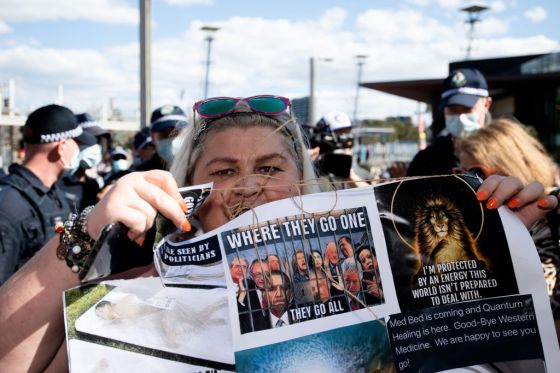
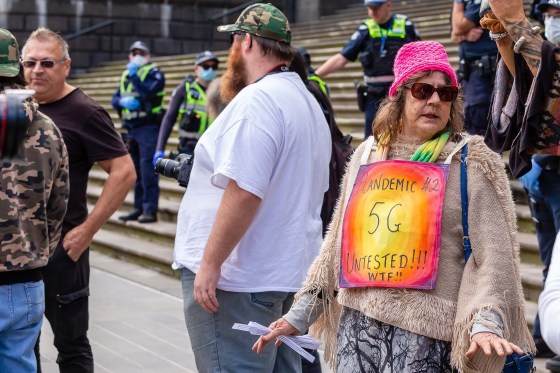
As in the United States, QAnon in Australia and New Zealand has mixed with other global conspiracy theories, including false beliefs that 5G towers are spreading coronavirus, unfounded claims that COVID-19 was either pre-planned or is a hoax and baseless theories about public vaccination programs. That turgid brew of misinformation is increasingly moving offline and spilling over into the streets in the form of protests or sometimes aggressive refusals to follow social distancing restrictions.
“We have seen the emergence of transnational, amorphous conspiracy-theory based movements,” says Joshua Roose, a senior research fellow at Deakin University in Australia. “All share a strong distrust in government and state institutions.”
QAnon began in 2017 as a uniquely American conspiracy theory. Followers of the movement, which has moved from far-right Internet forums onto mainstream social media sites, believe that President Donald Trump is fighting against a shadowy secret society that runs the world. Supporters claim this elite cabal is comprised of Democratic politicians, Satan-worshipping pedophiles and Hollywood celebrities who run a global child sex-trafficking ring, harvesting the blood of children for life-sustaining chemicals. None of this has any basis in fact.
The local strain of QAnon appears to be spurred by anger at COVID-19 restrictions: A resurgence of COVID in July forced the Australian state of Victoria—where Melbourne is located—into one of the most restrictive lockdowns in the world for weeks. In New Zealand, a small coronavirus outbreak in August also forced the government to reimpose restrictions in Auckland, the largest city.
Lockdown measures have eased in both countries, but supporters of QAnon continue to spread their conspiracy theories online—and, increasingly, offline. QAnon signs cropped up at “Freedom Day” anti-lockdown protests across Australia on Sept. 5, as well as at similar protests in Auckland.
Speed Media/Icon Sportswire/Getty ImagesA protester holds a sign up during the Freedom Day Rally in Sydney on Sept. 5, 2020.
At checkpoints set up to ensure citizens are following COVID-19 movement restrictions in the state of Victoria in August, police were forced to smash several peoples’ car windows and drag them out for refusing to provide personal details because they claimed to be “sovereign citizens”.
The fringe movement started in the United States in the 1970s, with followers believing that ultimate power is vested in individuals, who are therefore not obligated to obey government rules they disagree with, whether that be motor vehicle regulations, answering to the police or paying taxes. Videos of the Victoria arrests have been widely shared on social media accounts that also spread QAnon theories—further fueling anger over COVID-19 restrictions.
QAnon may center around an American conspiracy theory, but that hasn’t stopped supporters in Australia and New Zealand from adding their own local flavors.
One twist involves the hundred miles of storm drain tunnels running beneath Melbourne. Some Australian QAnon posts claim that Melbourne’s coronavirus lockdown was meant to keep the streets clear for an operation to rescue child sex-trafficking victims in the tunnels. (There is no evidence of this.)
The conspiracy theory also predicts the arrest of high-level officials for sex trafficking crimes. Again, resourceful Australian QAnon followers have adapted that narrative for their home turf. One Facebook post seen by TIME (falsely) alleged that Australia’s Prime Minister Scott Morrison has been under house arrest since January. The evidence? Blurry, close-up photos of Morrison wearing long pants, which appear to have either bunched up or been folded at the ankle and supposedly prove the Australian leader is wearing an ankle monitor.
Similar (false) rumors have also circulated using pictures that show Victoria Premier Dan Andrews walking down the street. Andrews, who has faced heavy criticism from the right for weeks-long coronavirus lockdowns this summer, features heavily in posts on QAnon-affiliated pages.
At a rally in New Zealand in early September, protesters referenced multiple COVID-19 conspiracy theories, according to local reports. But demonstrators have also woven in local causes. Some protesters were seen holding signs calling to “ban 1080,” a reference to the government’s use of poison to control populations of invasive rodents (the cause has been supported by some mainstream groups in recent years, but has been fodder for conspiracy theorists.) At least one protester was spotted with a sign that depicted Prime Minister Jacinda Ardern as Adolf Hitler.
At the anti-lockdown rally in Aotea Square today the organiser told the crowd he found it "exhausting to go along with tyranny and to forgo my freedom of speech and my freedom to associate". There was also this. pic.twitter.com/jaStobR4Gc
One social media post in May claimed that Bill Gates was in New Zealand and asserted that the country of 5 million is a “perfect” nation “to test and trial” a vaccine for the coronavirus. (A spokesperson for the Bill & Melinda Gates Foundation said Gates had not been in New Zealand.)
And combining QAnon’s American roots with local feelings often meshes in inconsistent ways. For example, many Australian QAnon-affiliated accounts are highly critical of Australian police, who have used tough responses to enforce COVID-19 restrictions. Those posts are often shared alongside rightwing U.S. media articles praising American officers.
Despite its presence at protests, QAnon really thrives online, and it gained a substantial foothold in Australia and New Zealand during COVID-19 lockdowns. One Facebook group started in Australia, comprising a mix of people denying the existence of the coronavirus, anti-vaxxers, so-called sovereign citizens and QAnon supporters, had more than 65,000 members before it was removed by the social media giant.
“You put marginalized people under pressure and fear and they look for non-mainstream and unorthodox theories to regain their sense of control and agency,” says Michael Grimshaw, of the University of Canterbury in New Zealand.
The conspiracy theories—and opposition to coronavirus restrictions in general—remain at the fringes in both nations. A recent Pew poll shows that 94% of Australians think the country did a good job handling the pandemic (the same poll reported that only 47% of Americans felt the same way). An August poll found that public confidence in health officials in New Zealand was above 80%.
But misinformation is increasingly bleeding over into the mainstream. Australian television chef Pete Evans—who has 275,000 Instagram followers—has posted QAnon-related content on Instagram in recent months. In New Zealand, a lifestyle influencer with more than 60,000 followers posted in support of QAnon claims in her Instagram story. “There’s soooooo much I want and need to address on here. But I’m going to start slowly and it will start with Hollywood, Cabal and Human Trafficking,” she said in one Instagram story. “People may think why? That’s America it has nothing to do with us. In the big scheme of things it has EVERYTHING to do with us. All you need to do is research Jacinda Ardern and her ties with Bill Gates…”
Both Facebook and Twitter say they’re taking action against QAnon-related content. Twitter announced in late July a stronger approach to dealing with QAnon, including permanently suspending accounts that violate its policies, banning URLs associated with QAnon from being shared on the site, limiting content from its trends and recommendations and not highlighting it in searches.
Facebook said in August it had removed 790 groups, 100 pages and 1,500 ads tied to QAnon and other groups it said support violence and blocked more than 300 hashtags across Facebook and Instagram worldwide. The company says that QAnon pages, groups and accounts will be removed when they violate Facebook’s community standards, including inciting violence. The company also said it will limit some content from recommendations and the ranking of this content will be lower in News Feed.
Despite their efforts to reduce the accessibility of QAnon content, a quick search shows Australia and New Zealand-specific QAnon conspiracy theories are widely available on both platforms. TIME found at least three separate Twitter accounts, with thousands of followers each, that used Australian QAnon hashtags in their profiles. TIME also found public Facebook groups specific to Australia and New Zealand that hosted QAnon posts, each with hundreds of members.
Three Facebook groups with QAnon-related posts that TIME asked the company about remain public. Facebook said that one post alleging the Australian Prime Minister is under house arrest would be removed when TIME inquired about it. But days later the post was still available on the platform. Facebook said this was due to a technical glitch on their end. However, at least one other post on the group also made the same false allegation about the Prime Minister.
One Australia-focused QAnon account with more than 4,000 followers was removed by Twitter for “multiple account violations” after TIME inquired about it.
Entering the mainstream
Increasingly, ordinary Internet users are spreading QAnon-related memes and theories. Lydia Khalil, a research fellow at the Sydney-based think-tank the Lowy Institute, says some conspiracy theories have spread via mommy blogs, and fitness and wellness influencers, who have latched on to the child-sex trafficking and anti-vaccine elements of these theories.
“Not all of the people spreading this stuff are hard-core conspiracy theorists or extremists, they’re picking up on hashtags or more nebulous elements of this and then pushing it out without really understanding who’s behind it and where it’s coming from,” she says.
But leaders in Australia and New Zealand have been forced to publicly address some of the conspiracy theories because they became so prevalent. Australian officials have been forced to publicly refute the link between 5G and coronavirus, and on a television program on Aug. 5, Prime Minister Scott Morrison told people identifying as “sovereign citizens” and anti-maskers intentionally defying coronavirus restrictions to “get real.”
New Zealand’s health minister asked the public at a Sept. 10 COVID-19 briefing to “think twice before sharing information that can’t be verified.”
Speed Media/Icon Sportswire/Getty ImagesMany protesters blame 5G technology for the Coronavirus during the Coronavirus (COVID-19) Anti-Lockdown Protest at Parliament House in Melbourne on May 10, 2020.
Matthew Schlapfer, a business consultant who lives in the Australian city of Perth, says he’s unfriended or been unfriended by about 10 people in recent months as he got fed up with seeing conspiracy theories filling his Facebook feed.
“I started getting really annoyed and reaching out and saying ‘where are you getting your information from?'” he says. “I would ask ‘what’s the source for this?'” and they couldn’t tell me.
Schalpfer, who is in his mid-forties, says many of the posts that started the disagreements were related to QAnon. Others argued against the use of vaccines, or falsely proclaimed that COVID is a hoax. Some of his former friends—including two ex-girlfriends, three former colleagues and several high school acquaintances—have posted messages supporting Trump.
“They have fully bought into this Trump saving us from the deep state and this global child pedophilia ring run by the liberal elites thing,” Schlapfer says.
As Tuesday’s chaotic Presidential debate shifted to a discussion about the U.S. economy, President Donald Trump and former Vice President Joe Biden seemed, yet again, to be operating in different stratospheres. As Trump boasted—without corroborating evidence—that “our country is coming back incredibly well” from the economic shutdown precipitated by the coronavirus pandemic, Biden countered that the recovery hasn’t been so simple.
Though some measures indicate revival, he argued, the growth has primarily been concentrated in the stock market, where gains are made by people who have funds to invest. “Millionaires and billionaires like him in the middle of the COVID crisis have done very well,” Biden said. “But you folks at home, you folks living in Scranton and Claymont and all the small towns and working class towns in America, how well are you doing?”
This exchange was largely drowned out by other arguments in the turbulent conversation. But Biden’s rhetoric hit on a theme that economists have been warning about for months: that America’s economic recovery from the coronavirus pandemic has been “K-shaped,” or mainly benefitting the affluent. American billionaires saw their wealth skyrocket by $282 billion between mid-March and mid-April, according to an analysis by the Institute for Policy Studies. Interest rates are down, allowing people who own their homes to refinance their mortgages. Those with jobs that provide 401Ks have seen their account balances rise to near pre-pandemic levels. Even pandemic-fueled price changes have tended to reduce the prices of goods and services that mostly benefit people who have money to burn; new cars, travel, and food delivery services have gotten cheaper.
Then there’s what’s happening to millions of less fortunate Americans. During the same March to April time period that saw billionaires’ gains spike, more than 22 million Americans lost their jobs. Those numbers have recovered somewhat, but the unemployment rate was still 8.4% in August—more than double the 3.5% before the pandemic hit. Eight million more people are unemployed today than were jobless in February. The same price shifts that made luxuries like food delivery cheaper have caused the inexpensive grocery store items that poor households rely on to become pricier.
The pain shows little sign of abating for this unlucky group; in many ways, it’s just getting worse. This week alone, Disney laid off 28,000 workers, and hundreds of thousands of airline workers could face a similar fate if Washington does not renew a federal assistance program that has been keeping the embattled industry afloat. Congress is still struggling to come to an agreement on the next coronavirus relief deal, even as several of the key programs serving as an economic lifeline have expired. One of the food assistance programs that was quickly rolled out to help children hit by the coronavirus-induced economic crisis is slated to end in several states this week. Evictions, which have been temporarily paused for most people who have been financially affected by the virus, will kick off again in the dead of winter.
This inequitable economic recovery can partially be blamed on Congressional inaction. Rare bipartisan camaraderie behind emergency relief efforts ended soon after Congress overwhelmingly passed a $2.2 trillion relief package in March. House Democrats subsequently passed a $3 trillion package in May, which would have extended many of these programs, but Senate Majority Leader Mitch McConnell refused to vote on it, dismissing it as a “liberal wish list.”
The White House began negotiating with Democrats in July, but have been unable to reach an agreement on another round of relief since. As frustration has mounted within the Democratic caucus and the pandemic continued to rage across the country, Democratic leadership unveiled a pared down proposal and House Speaker Nancy Pelosi continues to confer with Treasury Secretary Steven Mnuchin. But there is no guarantee an agreement that pleases all parties involved will come to fruition this time, either. Mnuchin said Wednesday evening that the total cost was still too high. House Democrats had expected to vote on the bill Wednesday evening, but postponed a vote until Thursday to allow more room for further discussion, according to a Democratic aide. And any bill will need support from at least thirteen Republican Senators and the White House’s approval to actually become law.
As negotiations lurched along this summer, programs that provided critical assistance have vanished, with more expiration dates on the way. The Payroll Support Program, which has been providing airlines with financial assistance to keep workers on payroll, ends October 1. Airline executives have been warning for weeks that if no deal appears likely, hundreds of thousands of workers—which includes baggage handlers who earn a median income of $28,000 per year—will be furloughed. Two months ago, the Federal Pandemic Unemployment Compensation program stopped sending a weekly allotment of $600 to supplement state unemployment benefits. And the Paycheck Protection Program, which administered millions of potentially forgivable loans to small businesses, closed on August 8.
Lobbyists on both sides of the aisle, particularly those advocating for industries hit hardest in the pandemic, are astounded their calls for help have fallen on mostly deaf ears. “Congressional inaction is occurring when restaurants are literally at the weakest point they’ve been in six months,” says Sean Kennedy, executive Vice President at the National Restaurant Association. With the weather getting colder in much of the country, he argued, restaurants need extra reinforcements at the federal level that will enable them to stay open and adhere to safety standards, or otherwise risk permanent closure. “It’s amazing that restaurants suffering this much can’t galvanize or secure relief when every time a member of Congress goes home to their district they’re shocked to learn another restaurant [or] favorite hangout has closed their doors for good.”
Michele Evermore, a senior policy analyst at the National Employment Law project, thinks the inability to reach an agreement in Washington stems partially from the fact that the recovery has disproportionately benefited the wealthiest Americans—including those who serve in Congress and the people in their social circles. “I think people see numbers improving and they actually don’t know anybody who’s struggling,” Evermore says. “The kind of people who serve in Congress don’t tend to have a lot of broke friends.”
Time is also running out on pandemic relief benefits that have kept children in low-income families from going hungry. Pandemic-EBT is a Department of Agriculture program that launched when schools closed to support to families whose children would normally qualify for free and reduced-price school meals by loading funds onto a prepaid card otherwise used for food stamp benefits. It ends September 30, despite the fact somewhere around half of the nation’s public school students are still fully remote. (A few states have recently been authorized to continue the program on a more limited basis.) The Summer Food Service Program, also funded by the USDA, enabled kids in families of all income brackets to obtain free meals distributed by schools throughout their closures. It will lose funding in January.
Health care practitioners have already been seeing the impact of families’ scrambling to make ends meet on children’s health. “What I see every single day from the pandemic is really amazingly increased numbers of severely underweight children coming to our clinic, and parents really panicked about how they are going to find enough food,” Dr. Megan Sandel, co-director of the Grow Clinic for Children at Boston Medical Center and a lead investigator of Children’s HealthWatch, said on a recent press call.
Housing experts also fear what is to come in January, when a Centers for Disease Control and Prevention eviction moratorium ends. At that point, renters who have so far avoided evictions because of eviction protections will owe months’ worth of back-rent, in addition to any late fees their leases stipulated. It is not yet known how many people may suddenly lose their homes during one of the coldest months of the year—but unless some form of rent relief or direct payment is passed, the figure will surely be staggering.
With all of this unraveling under his watch, Trump still claimed during Tuesday’s debate that he had built the “greatest economy in history” before the pandemic struck. If only examining the gains made by people who share Trump’s billionaire status, that might be right. But even before COVID-19 sent the economy into a tailspin, many low-income Americans probably would have disagreed. In 2018, nearly 40% of Americans couldn’t cover an unplanned $400 expense without going into debt, carrying a balance on their credit card, or borrowing the funds, according to a report from the Federal Reserve. Around the same time, three men in the U.S. collectively held more wealth than the poorest half of Americans, according to an Institute for Policy Studies report.
For some, the looming loss of housing and food protections—in addition to the lack of a second stimulus check and the standstill in Congress over extending protections for payroll relief—is only going to make things harder. Worse, says Evermore, is that few in power seem to care. “Goodwill toward people who lost work through no fault of their own has dissipated faster during this recession,” she says, “than at any time in history.”
We need one million more citizens to volunteer for the COVID-19 vaccine trials. Almost half a million Americans have signed up to be part of the clinical trials, but in order to complete the study, the COVID-19 Prevention Network—formed by the National Institute of Allergy and Infectious Diseases (NIAID) at the U.S. National Institutes of Health—will need more volunteers, and especially more volunteers from diverse backgrounds. The sooner the clinical trials finish accruing patients the sooner we will have results of the vaccine studies.
I am a cancer doctor, but like many doctors and researchers have been called in to assist in any way we can to help the effort to fight COVID-19. We are all seeing too much suffering from this devastating virus. While there are many clinical trials across the country working on treatments for COVID-19 and prevention strategies, few are as important as our national vaccine effort. I teamed with David Ellison, a Hollywood producer, and his amazing team, as well as the incomparable Harrison Ford, to put together a public service announcement to encourage every citizen to consider enrolling in the vaccine trial effort.
To aid in this effort, the COVID-19 Prevention Network sent an email out to those that had already volunteered, asking them why they did it. What they received back was overwhelming: an outpouring of inspirational and emotional videos, each giving a personal reason for becoming part of the trials.
It’s inspiring that we have seen so many Americans come forward to help one another and be part of the solution to COVID-19. But, for the clinical trials to be completed, we need more volunteers. I am not a part of the COVID-19 Prevention Network, but am privileged to play my part to assist them fight this invisible enemy, and I so hope many others do the same.
Please see PreventCOVID.org for more information and to register for the trial.
In 2011, Sandra Diaz was working as a housekeeper at the Trump National Golf Club in Bedminster, New Jersey where she says she was tasked with cleaning the personal residence of Donald and Melania Trump, in addition to that of Ivanka Trump and Jared Kushner. She folded their laundry, mopped their floors, and cleaned their bathrooms. If the Trumps indicated they were headed to their private properties unexpectedly on a weekend, Diaz would drop everything to rush over and make the dwellings spick and span for their arrival. She says she would start work as early as 6 am, finish as late as 10 pm, and sometimes work as often as seven days per week.
Her W2 tax form for that tax year shows she was paid $26,792.90 for her labor, with $413.14 withheld in federal income taxes. In other words, Diaz, then an undocumented immigrant from Costa Rica, contributed more to the federal government in 2011 than the $0 that Trump—who is estimated to be a billionaire—paid in federal income taxes during 10 of the 15 years between 2000-2015, according to the New York Times’ bombshell reporting on the President’s long sought-after tax records.
As an undocumented immigrant at the time, Diaz’s tax dollars were paying for public services from which she couldn’t personally benefit: She had no health insurance, could not vote, and was not eligible for certain government assistance programs that help people in and near her relatively low income bracket.
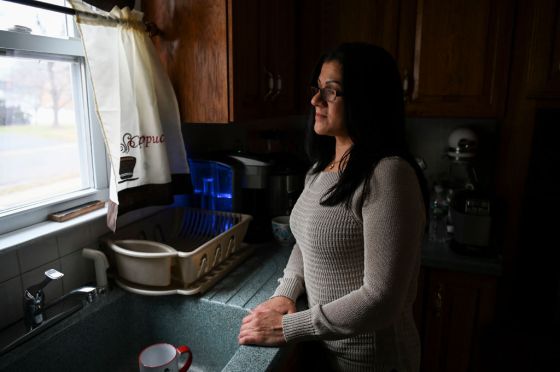
Diaz says was happy to do the hard work and contribute to the country she loved, regardless. “I’m really happy. Because [immigrants] do what is needed,” Diaz, now 48, tells TIME. “We want to pay taxes and be part of America.”
Photo by Carolyn Van Houten/The Washington Post via Getty ImagesSandra Diaz, who worked at the Trump National Golf Club Bedminster before getting her Green Card, poses for a portrait at home in Bound Brook, NJ on January 7, 2019.
Diaz, who has previously spoken to the Washington Post and the New York Times about Trump’s employment of undocumented immigrants, is hardly alone in paying more federal income taxes than Trump in the years before he moved into the White House. The average U.S. household paid $8,831 in federal income taxes in 2019, according to the Bureau of Labor Statistics. That’s $8,081 more than the $750 that the New York Times reported Trump paid in 2017. Even an assistant manager at McDonald’s, who Glassdoor estimates to earn an average of $26,000 per year, will pay about $685 more in federal taxes in 2020 than the President paid the year he won the White House if they claim the standard deduction.
If you want to know how a person who washes bed sheets or makes french fries in exchange for pennies on the dollar ends up paying more in federal tax dollars than a real estate mogul and reality TV star turned President of the United States, look no further than the U.S. tax code.
Wealthy Americans have ways to reduce their tax burden through tax deductions and tools that don’t necessarily make sense for Americans of more modest means to use. Rich people benefit more from being strategic about deducting their stock market losses from their stock market gains in order to be taxed on less of the gains. They can try classifying second or third or fourth or fifth properties as “investments” in order to deduct routine maintenance as business expenses. They can funnel millions of dollars to heirs that won’t be subject to estate taxes until those contributions exceed $11 million. In all, almost 60% of tax benefits from major non-business tax expenditures go to the richest 20% of American households according to an analysis by the Tax Policy Center. Of those, nearly 25% of tax benefits go to the richest 1%.
To be sure, some Americans who make very low wages, are disabled, elderly, or some combination of the above often pay little or no federal income taxes. There are also provisions of the tax code designed to help working- and middle-class earners, such as the earned income tax credit (EITC) and child tax credits, but these deductions and credits are significantly lower in sum than the savings extremely wealthy Americans can take advantage of through itemizing large deductions and writing off sizable business expenses.
Ironically, Americans earning less income often come under greater tax scrutiny than their wealthier neighbors. Because extremely wealthy people have to document a myriad of business expenses, investments, and deductions for the Internal Revenue Service (IRS), it is much more costly and time-intensive for the IRS to sift through their many assets and earnings to ascertain whether tax aversion or tax evasion is transpiring than it would be for the agency to audit an American who has one simple W2 or 1099 form and limited investments. In fact, recipients of the EITC—who make less than $20,000 per year on average—were more likely to face inquiries from the IRS than individuals making twenty times as much, according to a 2018 ProPublica report.
Auditing the taxes of a low-income earner who claims the EITC to ensure they qualify for the tax credit is quite easy and may even use simple computer algorithms, says Mark Mazur, director of the Urban-Brookings Tax Policy Center. “You contrast that with an audit of a very complicated set of businesses held by individuals with various forms of interlocking entities, and [the IRS needs] a whole team of auditors who are highly paid, highly skilled to work their way through and then probably wind up with the taxpayer appealing the audit results, and maybe even litigating it,” he says. “It’s just way more costly.
Practically speaking, the loss of revenue from wealthy Americans’ averting tax payments hurts everyone: When top earners avert paying taxes and get away with it, there are less federal funds to cover the military, roads, Social Security, welfare programs, Medicaid, disability and emergency economic relief efforts like the stimulus checks sent out earlier this year.
But the New York Times’ reporting also underscores another long-debated question about the intersection of morality and the economy: Should the U.S. have a tax code that rewards businesses and wealthy individuals for making investments and profiting off them in order to stimulate trickle-down economics? Or should the tax system make stronger efforts not to cast heavy tax burdens on those just barely making ends meet and work to reduce America’s substantial wealth gap, in which three men possess more wealth than the poorest 50% of Americans?
As he himself has indicated in the past, Trump’s avoidance of large tax payments is intentional. “I fight like hell not to pay a lot of tax,” he said in 2016.
In practice, some of his efforts to do that have been unusually “aggressive,” as Mazur puts it. As the New York Times reports, he wrote off more than $70,000 for hair care services during the years that the television show The Apprentice ran—despite the fact that a U.S. Tax Court has ruled vanity expenses such as teeth-whitening, haircuts and office attire aren’t generally valid deductions, even among news anchors and celebrities.
The Times’ reporting that Trump also claimed deductions for $109,433 worth of linen and silver and $197,829 for landscaping in 2017 at his Mar-A-Lago resort points to yet another systemic inequity in the tax code. While big business owners can claim sizable deductions, not every individual is as fortunate: A school teacher in the United States can legally only claim $250 per year in deductions for personal purchases of classroom supplies, despite teachers reporting they pay almost $500 on average out of their own pockets, according to a National Center for Education Statistics report.
Another way Trump has averted significant tax debts is by offsetting business gains with businesses losses: An individual can do this by cashing in on one investment that decreased in value to reduce the taxes on another investment that increased in value so the investor doesn’t have to pay as much in capital gains taxes—which are generally already less than federal income taxes. This isn’t abnormal for people who have built substantial investment portfolios, nor is it illegal. But the strategy does underscore the discrepancy between the relatively low tax rates on capital gains versus the higher tax rates on ordinary income; those with wealth who tend to have investment assets and can benefit from those rates.
Unlike millions of Americans who are priced out of owning even one home, Trump’s large real estate empire has also helped him avoid some tax debts. According to the Times’ reporting, Trump claimed his Seven Springs estate, a 50,000-square-foot mansion sitting on more than 200 acres of land outside New York City, as an investment property in 2014, allowing him to write off more than $2.2 million in property taxes as a business expense in the years since. A middle-class family who owns a small second home on a lake in Michigan or Minnesota would have a hard time classifying it as a business expense without significant proof that it was primarily used as an investment, rather than a personal dwelling, says Mazur. But Trump’s family seems to make use of the New York mega-property for rest and relaxation rather than to turn a profit. “Today, Seven Springs is used as a retreat for the Trump family,” reads the Trump Organization website.
Back in New Jersey, Sandra Diaz isn’t visiting any luxe mansions—nor is she claiming business expenses on them to skirt taxes—though she’s no longer folding laundry for the Trump family either. The COVID-19 pandemic temporarily resulted in her losing some hours and income at a new housekeeping job, but she is about to go back to work full-time.
And even though her tax burdens have gone up significantly as she has found jobs that pay her higher wages than the Trump National Golf Club did, she says she doesn’t mind contributing her fair share to keep the country running. “Poor people follow the rules [and] pay the taxes,” she says. She just wishes Trump would, too.
This article is part of the The DC Brief, TIME’s politics newsletter. Sign uphereto get stories like this sent to your inbox every weekday.
Typically, after a presidential debate, the top staffers and high-profile supporters of the nominees engage in one of the more absurd practices in modern politics: they “work the refs,” or try to shape the coverage by spinning the reporters who will write the first draft of that night’s history. But the pandemic nixxed the spin room for last night’s clash and sent us all dialing into post-debate conference calls.
During normal times, debates wrap up and volunteers march into the area where journalists have set up their workstations. These civic-minded neighbors — or children of VIP donors and super-activists as if often the case — are handed signs announcing the names of the designated campaign representatives. Reporters crowd around in a free-for-all and, depending on how they’re ping-ponging between campaigns, ask some variation of the same obvious question repeatedly to irked campaign hands who, in turn, dutifully repeat a variation of the talking point that theirs was the winning team.
Now, we press “one” on our touch screens to ask a question.
It was just a small reminder that what we all watched last night was like nothing I’ve ever seen or imagined. As much as the pandemic changed the footprint of the first presidential debate of the 2020 race, the incumbent shattered it. The evening tested my own understanding of “bananas.” President Donald Trump interrupted Vice President Joe Biden so often that I was waiting for the moderator, Fox News’ Chris Wallace, to threaten to turn this car around if the fighting didn’t stop. Trump was indifferent to the facts and still pressed forward as though nothing mattered.
It was a shock to witness just how far expectations and scandal have moved the norms of debate. I remember in 2004 when an ill-steamed jacket gave conspiracy theorists permission to allege President George W. Bush was wearing a wireless transmitter and being fed answers during one debate. Last night, the President of the United States was telling white supremacist groups to “stand by” if the results from Nov. 3 aren’t to Trump’s liking. This wasn’t an evolution of debates. It was a mutation.
But at least one thing remains the same: reporters still get to ask the big question of these campaign reps. And there was one enormous query hanging in the air after last a night in which Trump was so belligerent that Biden eventually called the sitting President a “clown.” Three times on the post-debate call with the Biden team reporters brought the most obvious question: Will the former V.P., a man who so tries to follow the rules of the game that he cut himself off for time during his primaries, put himself through that again?
“We are going to the debates, guys,” Biden’s exasperated deputy campaign manager Kate Bedingfield told reporters in the 11 p.m. hour. But, when asked why the campaign would agree to another three hours of such a debacle, she said “those conversations are always ongoing” with debate organizers about remedies for continued bellicosity from Trump. By midday Wednesday, the debate organizers publicly acknowledged the need for better guardrails against Trump’s scofflaw treatment of the rules. No details were immediately available but it was clear that a repeat of the night before was not an option.
Very little of the on-stage exercise determines any part of what the American people ultimately render as their verdict on the debate’s winner. The off-stage spin probably matters even less. But there are cornerstones to what campaigns should feel like. This wasn’t it. Trump repeatedly spoke over Biden, made assertions designed to cut deep personally for Biden and generally commandeered the conversation with innuendo, falsehoods and conspiracy theories.
Biden, during debate prep, practiced what to confront in the moment and what to trust to the fact-checkers later. Biden was judicious in his use of real-time rulings, not wanting to miss the opportunity to make the affirmative case for a Biden presidency by spending all of his time setting the record straight. Trump tried for the opposite tactic, seemingly determined to bulldoze Biden from the start.
It was, in the words of CNN’s Jake Tapper, “a hot mess inside a dumpster fire inside a train wreck… That was the worst debate I have ever seen, in fact it wasn’t even a debate. It was a disgrace.”
Biden’s allies did nothing to refute that what had just transpired was pretty terrible. Instead, Biden’s press secretary, T.J. Ducklo, deployed some of his dry gallows humor as he wrapped up the spin call with reporters as the clock ticked toward midnight. “Sorry we can’t see you in person,” he said, before a quick turn. “Maybe not that sorry.”
Becton Dickinson and Co.’s COVID-19 test that returns results in 15 minutes has been cleared for use in countries that accept Europe’s CE marking, the diagnostics maker said Wednesday.
The test is part of a new class of quicker screening tools named for the identifying proteins called antigens they detect on the surface of SARS-CoV-2. Becton Dickinson expects to begin selling the test, which runs on the company’s cellphone-sized BD Veritor Plus System, in European markets at the end of October. It will likely be used by emergency departments, general practitioners and pediatricians.
“It is really a game-changing introduction here in Europe,” said Fernand Goldblat, BD’s head of diagnostics for Europe. Europe was really at the epicenter of the pandemic in April and May, “and unfortunately I think we’re headed back in that direction. So the need will be extremely high,” he said.
Antigen tests have emerged as a valuable tool because they produce results much more quickly than gold-standard PCR diagnostic assays. However, they are generally less accurate. In the U.S., for instance, instructions for BD’s system recommend that negative results be confirmed by a molecular testing method.
Becton Dickinson said its antigen assay is 93.5% sensitive, a measure of how often it correctly identifies infections, and 99.3% specific, the rate of correct negative tests. The data, which differ from the U.S. label’s 84% sensitivity and 100% specificity, come from a new clinical study that was recently submitted to the U.S. Food and Drug Administration, spokesman Troy Kirkpatrick said.
European Inroads
Rapid antigen testing has been making inroads in Europe as well as the U.S. Roche Holding AG said this month it would launch its own 15-minute antigen test to European markets accepting the CE mark. Another test developer, LumiraDx, received CE marking for its antigen test late last month. It said it planned to manufacture 2 million tests in September and as many as 10 million in December.
Becton Dickinson’s Veritor system has been used largely to screen for flu in Europe to date, but the new assay could help drive wider antigen testing adoption, including for influenza and other respiratory viruses, said Goldblat.
The company is currently having conversations in multiple European countries, largely with governments and health authorities, about “where and how our solutions would fit,” he said.
The test is already available in the U.S. Becton Dickinson said it is on track to produce about 8 million each month by October across its global markets, and 12 million monthly by March 2021.
Goldblat declined to comment on how those tests would be allocated in Europe and the U.S., except that “a good portion” would be coming to Europe. Pricing will depend on commitments made and the reimbursement environment in a given country, among other factors, he said.
In the U.S., where regulators cleared the assay in July, the Veritor Plus System has an average selling price of $250 to $300, and the tests themselves are about $20 each.
More than 40 states have absentee ballot applications that are not fully accessible to millions of visually impaired voters and those with other disabilities, according to the results of an audit being released by digital accessibility company Deque Systems on Wednesday.
As the coronavirus pandemic and the 2020 election collided this year, states rushed to expand their mail-in voting operations to help people cast ballots and avoid exposure to COVID-19. But while Americans are voting by mail in record numbers, that won’t help everyone. Absentee or mail-in voting has traditionally involved filling out a paper request and a paper ballot—actions that voters who are blind or who have a range of mobility or cognitive disabilities can’t do independently.
This forces these voters to make a difficult choice, according to Christina Brandt-Young, managing attorney at Disability Rights Advocates. They must either give up their right to an independent and private vote by asking for help filling out their ballot, risk exposure to COVID-19 by voting in person, or not vote at all. “Voters without disabilities don’t have to do that. And voters with disabilities shouldn’t have to,” Brandt-Young says.
Absentee ballots, along with election websites and absentee ballot applications, all fall under Title II of the Americans with Disabilities Act (ADA), which says that “any program, service or activity of a government has to be accessible to people with disabilities,” according to Brandt-Young.
Disability rights advocates have filed lawsuitsor pushed elections officials to add an accessible absentee ballot option in at least a dozen states this year. Some states, including Maryland, West Virginia and Ohio, had already added accessible absentee systems in previous years. But many states still do not have a fully accessible voting system.
These concerns could potentially disenfranchise a huge number of voters.New projections from researchers at Rutgers Universityshow that more than 38 million eligible voters have disabilities, amounting to nearly one sixth of the electorate. That includes an estimated 21.3 million eligible voters with mobility disabilities, 13.1 million with cognitive disabilities, 11.6 million with hearing disabilities and seven million with visual disabilities. (Some voters fall into more than one category.)
Voters with disabilities typically turn out in lower numbers than those without disabilities, butvoter turnout among disabled Americans surged in 2018, and advocacy groups have been hoping to repeat that this year. Research from Rutgers also shows that disability turnout is higher in states with all-mail or no-excuse mail ballot systems than in those that require an excuse, suggesting that voting by mail could be positive for turnout—if it is accessible.
Even for states that have added accessible electronic absentee voting this year, Deque Systems found that they often still point voters toward inaccessible PDF forms in order to apply to use those systems.
The company reviewed the absentee ballot applications available on 43 states’ websites, and found that every state had at least one “critical” issue that would make it nearly impossible for someone using assistive technology, such as a screen reader, to complete the application correctly. Overall, states had an average of 10 critical or serious accessibility issues.
To evaluate the PDF applications, Deque used its own automated accessibility tools, Adobe Acrobat, and a team of experts that included blind individuals who conducted user assessments with screen-reading software. Deque did not audit California, Colorado, Hawaii, Utah or Washington state, some of the states where all registered voters are automatically receiving a mail-in ballot, or Massachusetts or Michigan, which it found have accessible applications.
Some of the issues the team encountered included instructions that couldn’t be logically converted into audio messages by screen-reading software, forms that could not be filled out in their correct order using keyboard commands, and images without any descriptive text for the screen reader to interpret.
While disability rights lawyers say inaccessible ballot applications would likely violate the ADA, Deque Systems CEO Preety Kumar was not interested in filing a lawsuit. “We decided that we would download every single request for a mail-in ballot, see what’s wrong, and fix them and make them available to state election officials,” Kumar says.The company has made accessible versions of the applicationsavailable on its website, and Deque staff has reached out to election officials in all the states it reviewed.
Even if these absentee ballot applications are more accessible than the versions currently on states’ websites, disabled voters and advocates say there is a lot more work to do to ensure they can vote safely this year—and in the future. A report byMiami Lighthouse for the Blindthis month found that election websites for 12 battleground states do not meet web accessibility guidelines. And several states are still involved in litigation over various other voting access issues.
While the ADA was passed 30 years ago, disability rights attorney Eve Hill notes that part of the problem ensuring the rights it guarantees is there are only two enforcement mechanisms for the law: private people suing and the Justice Department. Since President Donald Trump took office in 2017, the Justice Department has significantlylimited its civil rights enforcement.
Leaving it up to nonprofits and private companies to remind states to make voting accessible takes longer, costs more money, and leaves people with disabilities voting at the last minute, Hill says. The National Federation of the Blind, which Hill represents, sent letters to states with inaccessible absentee ballot systems last September, and has continued to press the issue.
“For any state that has ignored this, we’ve told them it’s required over and over again,” Hill says. “They therefore have knowledge of the requirement. And if they ignore it, and people are denied the right to vote absentee privately and independently, they will get sued. And they will have to pay damages to those people.”
Hill says that people with disabilities have gotten used to navigating a series of obstacles in order to vote, but that has caused problems for years, and COVID-19 has made it more clear than ever the situation needs to change.
“For 30 years, they’ve honestly fought tooth and nail against letting us vote in any way,” Hill says. “People have been trying to get the job done more than trying to force the state to make it easier. And we’re tired of that.”
The word dated is thrown around too casually these days, often used pejoratively whenever someone finds an older movie, book or play strange or just not in tune with how we think today—as if the work of the past were somehow responsible for reading into the future and fine-tuning itself accordingly. Yet works that are very specifically of their time can be more useful to us than safe, generically timeless ones. They show us where we’ve been and how far we’ve come—sometimes even as they reveal failings we still have to work on.
That’s the value of Joe Mantello’s adaptation of Mart Crowley’s revelatory 1968 play, The Boys in the Band, now streaming on Netflix. Things are different now: when it appeared, Crowley’s off-Broadway play astonished audiences with its frank treatment of the shame, guilt and fear—as well as the sense of joy and community—of gay life in New York City at the time. But in a country where legal gay marriage is a fairly recent development—and in a world where prejudice of all sorts, over race or sexual orientation or gender identity or any combination thereof, still thrives—The Boys in the Band is anything but a relic. This version, produced by Ryan Murphy and performed by the same cast that appeared in the play’s 2018 revival on Broadway, is like an unusually strong telescope, giving us a clear and vivid view into a not-so-distant past.
Jim Parsons plays Michael, a screenwriter with expensive tastes who has fallen into debt; he also drinks too much, and has taken steps to rectify that. He’s about to host a birthday party for a close friend, smooth Jewish hipster Harold (Zachary Quinto), when he gets a call from his old college roommate, Alan (Brian Hutchison), who’s in town from Washington. Alan is nearly in tears, and desperate to see his old friend. Michael staves him off; Alan still doesn’t know—or pretends not to know—that Michael is gay. Michael hasn’t clued him in, but he knows there’ll be no keeping that secret once Alan meets Harold and his other party guests: There’s Donald (Matt Bomer), an old flame of Michael’s who has left New York in an effort to overcome his seemingly insurmountable neuroses; Emory (Robin de Jesus), a bubbly professional decorator; well-mannered librarian Bernard (Michael Benjamin Washington); and Larry (Andrew Rannells), a commercial artist, and Hank (Tuc Watkins), a math teacher who has just left his wife and kids—the two are now a couple, but the tension brewing between them is close to boiling over. There’s also an adorable but not-too-smart singing cowboy (Charlie Carver), whom Emory has hired for the amusement of the birthday boy.
Alan does show up at the party, and Michael becomes so stressed out that he pours himself a drink—and then another, and another. Michael’s apartment is modest (at least by Manhattan movie apartment standards), but he does have a little terrace, where he’s set up lights, chairs and a table for the party. There, the men flirt and bicker and tease one another with sexual innuendoes; they also dance to records and eat cake. This group is extremely close, even when it seems they can barely stand one another: Hank becomes jealous—or more jealous than usual—when he realizes that Larry is perhaps a little too well acquainted with one of the other guests. (“We’ve never met, but we’ve seen each other,” Larry explains cryptically.) Emory and Bernard, both of whom are Black, needle one another in ways that go beyond good-natured jibing; there’s some class resentment there, another layer of tension in the group dynamic. And Michael, whom the others mock for his reliance on religion, which they see as hypocritical, can barely hide his self-loathing, particularly after a few drinks. The story hinges on a cruel party game that he devises, which demands that his guests—including straitlaced, homophobic Alan—publicly confront certain painful aspects of their lives.
The first thing you’re likely to notice about The Boys in the Band is its mildly stiff artificiality, a common trait of material that has made the transition from stage to screen: this is not quite a film and not quite a filmed play, but perhaps something in between. And to modern audiences, these characters may seem like convenient gay “types”—the flamboyant decorator, the bitter, lonely writer, the randy swinger who’s not sure monogamy is for him.
But for gay men in 1968, it was rare to see even a type—that is, a gay man whose sexuality was just part of living, as opposed to a narrative tool used to make some cautionary point, or as a mark of weakness or evil. Crowley rounds out each character with layers of detail, and this ensemble of actors rises to the challenge of making us see these men as more than just a bunch of guys who lived a long time ago, in the days before the radical changes wrought by Stonewall and, later, the AIDS crisis. Their lives were complicated, and lived partially in shadow, but the intensity with which they lived was no less for that. We see that Hank’s hetero marriage, even if it was a lie, was painful for him to leave behind; that Michael is cruel to others—albeit sometimes amusingly so—because even though he makes a great show of keeping everything together, he’s shredded by self-doubt; that Bernard is rankled by Emory’s sometimes nasty racial teasing, but that the two share a bond the others can’t understand. The Boys in the Band is a product of its time, but that doesn’t mean it can’t speak to ours too. In the context of human civilization, 50-something years is barely a blip. And our yearning to be our best selves, even when it seems that every card is stacked against us, doesn’t go away, no matter how enlightened we think we’ve become.
Cable and streaming have been eating away at the traditional TV season for decades now, but as recently as last year, September still meant something. It was the month when each of the Big 5 broadcasters sent out a new batch of sitcoms and procedurals to compete for primetime supremacy, whether a nation that preferred to binge on Game of Thrones and Stranger Things was paying attention or not. But 2020 might break that norm once and for all, now that production schedules interrupted by the coronavirus pandemic have dispersed what would normally be a couple of weeks’ worth of premieres throughout the whole of autumn. Which might explain why great new shows have been relatively tough to find on any platform this past month. In large part because so many high-profile projects (Gillian Flynn’s Utopia, Luca Guadagnino’s We Are Who We Are, Ryan Murphy’s Ratched, Trump-Russia docudrama The Comey Rule) have proven disappointing, I’ve mostly enjoyed lighter stuff this September: a funny talk show with a righteous core, a nighttime soap starring Kim Cattrall, a comforting British detective redux. For more serious picks, here are my favorites from August,July,Juneand thefirst half of the year.
Agents of Chaos (HBO)
HBO’s Agents of Chaos resists the temptation to turn American politics, surreal as they can be, into mustache-twirling melodrama. The series from documentary institution Alex Gibney (Going Clear, The Inventor) dissects the much-debated but still poorly understood topic of Russian election meddling in all its intricacy—and when the filmmaker hits a wall with easily available information, he investigates. Crucially, he doesn’t hide his confusion. Narration has gone a bit out of style for documentaries; blame Michael Moore. But Gibney (who shares directing credits on the second episode with Javier Alberto Botero) uses it to great effect, talking viewers through his own search for clarity and making his process transparent enough to preempt some of the accusations of media bias that are inevitable in the current political climate. [Read TIME’s full review of Agents of Chaos and Showtime’s The Comey Rule.]
The Amber Ruffin Show(Peacock)
Amber Ruffin should’ve gotten her own show years ago. A comedian and writer with credits on A Black Lady Sketch Show, Drunk History, Detroiters and her current home, Late Night With Seth Meyers—where her segments “Amber Says What” and “Jokes Seth Can’t Tell” are consistent highlights—she’s a ball of kinetic energy with a keen mind for social commentary. That rare combination of effervescence and insight yields a uniquely electrifying brand of humor.
And that’s why I feel so confident endorsing her new Friday talk show after just one half-hour episode. Ruffin is the only TV host who could pull off a bit on “things people need to know that aren’t being said” that pairs timely, earnest affirmations (“You matter, even though there are protests against having you around or making sure you’re cared for or have rights”) with observational jokes like: “Old women in New York City, stop cutting in line and being like, What? Me? I didn’t know! I know you know. You’ve been on this earth a thousand years and you don’t know what a line is?” Wisely eschewing guests in favor of sketches amid a late-night landscape overcrowded with celebrity interviews, The Amber Ruffin Show finds the host bantering with her announcer pal, Tarik Davis, and creating her own delightful characters. (The premiere introduced Fun Auntie, a warm, gossipy condo owner who says things like, “My Playboy money ran out in the ’90s.”) Trust me: she has enough personality to keep things interesting. [Read TIME’s interview with Amber Ruffin.]
Filthy Rich (Fox)
Six months into the pandemic, comfort TV is trending, Netflix subscriptions are soaring and new streaming services like HBO Max and Peacock have unlocked decades’ worth of nostalgia viewing. All that’s missing is the kind of primetime soap opera that once united the nation in some much-needed frivolity. A Dallas. A Dynasty—the original, not the CW’s mediocre reboot. Even a Desperate Housewives or a Melrose Place would do the trick. Sadly, the past decade saw scripted soaps overshadowed by Kardashian Kontent, as an explosion of viewing options fragmented audiences to such an extent that consensus hits are now rare. But the format isn’t entirely extinct. On the heels of 2010s efforts like Revenge and Empire—both of which began as good fun but ran out of ideas after a few seasons—comes Fox’s Filthy Rich, whose Sept. 21 premiere kicks off a sparse, delayed network premiere season that will stretch into November. A smartly cast chronicle of a super-rich televangelist family in crisis, it’s executed with just the right mix of self-aware sudsiness and addictive drama. [Read the full review.]
The Third Day (HBO)
Jude Law paces on a bucolic road, shouting into his phone about money and police. He hikes through sun-dappled woods, cues up “Dog Days Are Over” by Florence + the Machine, sits down next to a waterfall, sobs operatically for a while, then gently places a child-sized striped T-shirt in the bubbling river and watches it float away. On the way back to his car, he stumbles upon a teenage girl and a younger boy, arriving just in time to see her hang herself from a tree branch and her companion run off into the forest. He saves the girl’s life and drives her home, to Osea Island, whose eccentric residents are preparing for a festival. If you’ve seen The Wicker Man, you can probably guess that things only get weirder once they arrive.
Yet for all its familiarity, The Third Day, an eerily beautiful psychological thriller co-produced by HBO and Sky UK, rarely comes across as derivative. Creators Felix Barrett (who founded Punchdrunk, the immersive theater company best known for their long-running Macbeth riff Sleep No More) and Dennis Kelly (who created the original, British Utopia) seem keenly aware of the mysterious-island trope. More than a pastiche, their story accesses layers of emotional resonance in centuries’ worth of lore, encompassing The Tempest and The Island of Doctor Moreau as well as more contemporary tales like Lost and Shutter Island. [Read the full review.]
Van der Valk (PBS)
A British drama about a jaded, sardonic detective isn’t exactly reinventing the wheel, but this Masterpiece Mystery (which debuted this spring on ITV in the UK) is an especially enjoyable variation on the old formula. Based on a series of novels by Nicolas Freeling, as well as a long-running ITV adaptation from the ’70s, this reboot casts the icily handsome Marc Warren (The Good Wife, Jonathan Strange & Mr. Norrell) as Piet van der Valk—a stubborn, brooding, but talented and ultimately goodhearted police investigator in Amsterdam. Van der Valk says things like: “I think politicians should be shot.” He’s got a loyal partner, Lucienne (Maimie McCoy), who matches him quip for quip; an unwanted, eager-to-please new assistant (Elliot Barnes-Worrell) whose competence Van der Valk is loath to acknowledge; a skittish boss (Emma Fielding); and a pathologist (Darrell D’Silva) who always seems to be nursing a nasty hangover.
Yet the show’s greatest pleasure might be its setting. Our hero lives on a boat in the city’s canals, traverses its cobblestone streets, hosts meetings at its hole-in-the-wall pubs and indulges his love of art—a recurring theme in the series—at its legendary museums and galleries. Particularly in pandemic-stricken times, this sophisticated portrait of Old World city life makes for some pretty solid prestige-TV escapism. And although this first season runs just three episodes, at 90 minutes apiece, each one feels like a self-contained movie.