(SAO PAULO) — Major social media companies are taking aim at Brazilian President Jair Bolsonaro’s dismissal of social distancing, joining others in the country who have lined up against his controversial stance regarding the new coronavirus.
Facebook and Instagram removed posts by the far-right leader Monday night that showed Bolsonaro walking around outside capital Brasilia on Sunday and mingling with groups. It was yet another affront to World Health Organization recommendations to self-isolate as a means to contain the pandemic. The companies’ move came one day after Twitter also removed some Bolsonaro posts.
Facebook, which owns Instagram, said in a statement that it removes content “that violates our community standards, which do not allow disinformation that might cause real damage to people.”
Twitter justified its decision by saying in a statement that its rules prohibit content that runs “against public health information given by official sources and can put people at greater risk of transmitting COVID-19.”
Bolsonaro is one of few world leaders who say the virus itself will cause less harm than shutting down the economy. In a national address Tuesday night, while repeating that same argument, he changed his rhetoric, calling the pandemic he once described as “a little flu” as “the biggest challenge of our generation.” His speech was met with pot-banging protests for the 15th night in a row.
His defiance has received vocal backing from supporters — both on social media and in several cities where they staged demonstrations demanding life return to normal — but his attitude has also been rejected by mayors, state governors and judges. Even some members of Bolsonaro’s own administration have insisted on broad lockdown measures that run contrary to his statements.
Last Thursday, Bolsonaro issued a decree that added religious activities to the list of “essential services,” meaning churches could remain open even though governors had banned large gatherings. The decree was overruled by a federal court the following day.
Supreme Court Justice Marco Aurélio Mello authorized an opposition lawmaker’s request for Bolsonaro’s own prosecutor general to investigate an alleged crime committed by the president, the Supreme Court’s website said Tuesday. The allegation of endangering the public is based on Bolsonaro encouraging people to disobey isolation measures, calling concern over the pandemic “hysteria” and characterizing the virus itself as “a little cold.” The judge’s action requires the prosecutor general to issue a legal opinion.
In an interview with the newspaper O Globo, Prosecutor General Augusto Aras said that Bolsonaro is free to express his opinion and go out in public so long as he doesn’t issue any official decrees that counter broad lockdown guidelines, which could tread into territory that requires legal evaluation.
Despite the president’s open skepticism, senior members of his own Cabinet have insisted on hewing closely to guidelines recommended by international health authorities. “Always technical, always scientific, always doing the maximum we can to preserve lives,” Health Minister Luiz Henrique Mandetta told reporters on Monday.
On Tuesday, Brazil’s health ministry reported 5,717 cases of Covid-19 and 201 deaths, the largest figures in Latin America. That included more than 1,100 new cases since the prior day — by far Brazil’s biggest single-day increase yet.
For most people, the new coronavirus causes mild or moderate symptoms, such as fever and cough that clear up in two to three weeks. For some, especially the elderly and people with preexisting health conditions, it can cause more severe illness, including pneumonia and death.
Bolsonaro has 12 million followers on Facebook, almost 16 million on Instagram and more than 6 million on Twitter. Social media was key for his election victory in 2018.
Twitter recently deleted posts from Venezuela’s President Nicolás Maduro for sharing speculation about possible unusual cures for Covid-19.
On Friday, Mar. 27, President Donald Trump took what appeared to be bold, decisive action in the fight against the new coronavirus. Reaching for wartime powers under the Defense Production Act, Trump ordered the federal government to “use any and all authority” to force auto giant General Motors to produce ventilators, the life-saving medical devices desperately needed by patients and hospitals struggling to survive the fast-spreading COVID-19 respiratory illness. For good measure, Trump tweeted, “General Motors MUST immediately open their stupidly abandoned Lordstown plant in Ohio, or some other plant, and START MAKING VENTILATORS, NOW!!!!!!”
But if Trump’s Friday performance conveyed urgency and action, four days later, neither is anywhere in evidence. Despite the tough talk and the invocation of presidential powers, Trump and his team by midday on Tuesday had yet to formally file a single order for a GM-made ventilator. While negotiations were ongoing, they had set no mandatory timeline for delivery of the machines, or even suggested a voluntary one. And they had not informed GM of what prices the federal government will pay for the machines under Trump’s executive order. For its part, GM has continued following the plan to produce ventilators that it had discussed with the White House for weeks prior to Trump’s order, a plan that was already well underway when he issued it, according to documents reviewed by TIME.
The GM episode is just the latest in what has become a common Trump-led scene during the pandemic’s spread. As known U.S. cases skyrocketed from 98 to 177,300 over the last four weeks, Trump has made vocal public shows of action that in several cases have yielded few real results. On Mar. 13, he declared Google was building a website to help people find local coronavirus testing sites. Thus far, it has ended up being little more than a bare-bones, aggregational site with a series of links. That same day, he promised big box retailers—Walgreens, Walmart and CVS—would roll out drive-thru testing sites in their parking lots, a notion that also hasn’t fully materialized.
Sign up for our daily coronavirus newsletter by clicking on this link, and please send any tips, leads, and stories to virus@time.com.
It’s not unusual for a president to use his position to project optimism and progress at times of crisis. FDR famously declared in 1932, during the depths of the Great Depression, that America demanded “bold, persistent experimentation” and that if a first effort failed to “admit it frankly and try another.” Trump aides claim that his efforts are spurring action and setting a positive tone at the top. But Republican and Democratic critics say Trump’s approach appears to be less focused on solving the life and death problems that COVID-19 are imposing on Americans, than on the political challenges the disease is presenting to him.
The GM case in particular brought together several political vulnerabilities for Trump. First, it was taking place in Michigan, a state he barely won in 2016, where Republicans fared poorly in the 2018 mid-terms and where Trump is currently trailing Joe Biden by 3 or more percentage points in several polls. More broadly, Trump’s order came as he was under repeated criticism for not taking more action to help states in desperate need of assistance. “They were getting a lot of pressure,” says Michigan Democratic Rep. Elissa Slotkin, a former Defense Department and CIA official who sponsored bipartisan legislation to require the president to implement the DPA to speed the production and distribution of supplies.
As Trump continues to project action and accomplishment, COVID-19 cases continue to spike and so does the urgency of demand from mayors, governors and leaders around the world for ventilators. The coronavirus pandemic has killed more than 41,650 people across the globe, including more than 3,500 Americans. The sickest of those infected have severe inflammation in their lungs, which stiffens them, and makes it impossible to breathe without help from a ventilator. Some of these victims need the device for weeks at a time. Hospital staff say they are concerned about shortages of specialized equipment. If the system swells over capacity, doctors and nurses worry they may ultimately have to ration health care and decide who lives and who dies. Trump’s medical advisors said Monday that even if everything goes perfectly the number of deaths in America could hit 240,000.
Some at GM say it is unfair for the President to make them the bad guys. “It felt like we were getting punched in the gut,” says a long-time GM employee, who wasn’t authorized to speak publicly on the matter. “We did everything in our power to transition from building Tahoes to building ventilators without any guarantee of a federal contract.”
In any case, the company’s officials say, they’re not waiting for direction from the federal government or anyone else. GM forged a deal with Seattle-area ventilator manufacturer Ventec Life Systems and already has begun retooling a factory to build thousands of them beginning next month. “We’re not waiting around for anyone to dictate what number of ventilators need to be made,” says Chris Brooks, Ventec’s chief strategy officer. “Our north star has always been to make as many ventilators as possible, as quickly as possible, to arm front-line medical professionals with the tools they need to save lives.”
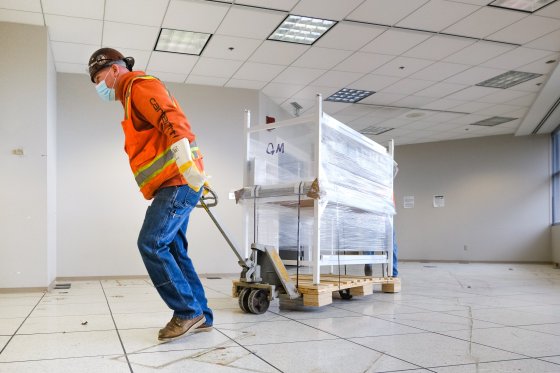
AJ Mast for General MotorsWork being done Monday, March 30, 2020 at the General Motors manufacturing facility in Kokomo, Indiana, where GM and Ventec Life Systems are partnering to produce Ventec VOCSN critical care ventilators.
GM’s strategy to build ventilators began as the company was facing its own coronavirus crisis. Like other companies around the country, it was projecting dramatic contraction in demand for its cars as unemployment spiked and spending plummeted nationwide. At the same time, it needed to temporarily close plants to prevent the spread of the virus. On March 17, ten days before Trump’s big announcement, and the day before GM announced it would shutter all of its North American factories due to coronavirus, GM CEO Mary Barra called White House economic adviser Larry Kudlow to discuss converting factory space for ventilator production.
Kudlow and the White House turned to a newly formed organization of business leaders, called StopTheSpread.org, for help. The group is led by the former American Express CEO Kenneth Chenault and Rachel Carlson, founder of the online education firm Guild Education, who volunteered to help the Trump Administration in harnessing private industry. In exploratory phone calls with GM, the group discovered what the automaker needed was a medical device-making partner with a reputable product.
StopTheSpread.org matched them up with Ventec, maker of a toaster-sized device known by its acronym, VOCSN (for ventilator, oxygen, cough, suction and nebulizer). On Mar. 18, the two companies held initial phone calls to discuss what could be done. The next day, GM chartered a late-night flight and four engineers, including Phil Kienle, manufacturing chief for North America, flew from Detroit to Seattle for face-to-face talks.
The GM team spent the next three days at Ventec’s headquarters in Bothell, Wash. examining machines that breathe life into immobilized people who can’t do it on their own. They pored over blueprints illustrating where each of the device’s 700 parts come together largely by hand. Images of the parts were handed to a GM purchasing agent see if suppliers could replicate the handiwork. “We sourced literally hundreds of parts and components in just over a week, which is lighting speed, and we will begin production by mid-April,” says Gerald Johnson, GM executive vice president of global manufacturing. “From there, production will scale up to 10,000 or more per month very quickly.”
Next up were workers. GM called 1,000 workers to see if they were willing to come to work for the company on ventilators. Greg Wohlford, chairman of United Auto Workers Local 292, which represents the shuttered GM plant in Kokomo, Ind., told the Kokomo Tribune he was just waiting to hear about the training details. “It’s going to happen, we’re just trying to work out all the details,” he said. “But everybody is thrilled. Everyone is really excited.” New manufacturing space was located in a 2.6 million square foot facility with clean rooms where small electronic components for cars are manufactured. Construction workers began tearing up carpet and knocking down partitions to make way for additional workstations. Cameras were installed to document the progress.
All told, it took less than a week for GM to forge a partnership with Ventec, according to internal communications, travel logs and interviews with both companies’ officials. The companies produced a full set of manufacturing plans that leveraged union labor, industrial buying power and a worldwide chain of 700 suppliers. Ultimately, the companies claimed they would be able to produce up to 21,000 ventilators a month, if needed.
On Mar. 23, GM and Ventec presented the Federal Emergency Management Agency with the strategy. The companies provided the administration with an itemized list that laid out how many ventilators could be produced, how quickly and at what cost, depending on the options the federal government selected, according to two officials involved in the contracting process.
And then they waited to hear back.
Four days later, they got their response. First, at 11:16 a.m. on March 27, Trump issued a series of tweets blasting GM and Barra. Then, later, at the White House, he elaborated. “We don’t want prices to be double, triple what they should be,” he told reporters. “So General Motors, we’ll see what happens, but now they’re talking. But they weren’t talking the right way at the beginning, and that was not right to the country.” GM pushed back in a public statement that said the company’s commitment to the Ventec ventilator project “has never wavered” and that “GM is contributing its resources at cost.” Officials insisted nothing had changed in their schedule.
As usual with “this” General Motors, things just never seem to work out. They said they were going to give us 40,000 much needed Ventilators, “very quickly”. Now they are saying it will only be 6000, in late April, and they want top dollar. Always a mess with Mary B. Invoke “P”.
In the days leading up to Trump’s comments, governors and lawmakers from the hardest-hit states pleaded with him to use the DPA, a little-known Cold War-era law that enables the president to force businesses to accept and prioritize government contracts during natural disasters, terrorist attacks and other emergencies. Dwindling supplies of respirator masks, gowns, gloves and other basic protective equipment are pushing the nation’s front-line medical workers toward a breaking point.
Politicians from both parties were convinced that using the statute could prevent counterproductive bidding wars that were breaking out across the country, as states competed with each other to acquire the same medical supplies from suppliers. New York Governor Andrew Cuomo said ventilators on the market now cost more than $50,000, which represents a 150% increase from the $20,000 when his state first tried to purchase them.
Trump has insisted that invoking the DPA was government overreach and that companies were stepping up on their own. But perceptions of a weak federal response to the growing crisis is seen as a political liability to Trump in key election states, including Ohio and Michigan. When on Mar. 26, for example, Michigan Governor Gretchen Whitmer, a Democrat, publicly said her state wasn’t getting the medical equipment it needed, Trump responded on Twitter that she was “way in over her head” and that she “doesn’t have a clue.”
The administration says Trump’s Mar. 27 flare-up had nothing to do with politics. By invoking the DPA, the president compelled GM to “to accept, perform, and prioritize contracts or orders for the number of ventilators,” according the executive order. Peter Navarro, Trump’s Trade Adviser and Policy Coordinator for the DPA, told TIME in a statement that the GM action aimed to jumpstart work on ventilators. “Prior to the DPA order being signed, the GM/Ventec venture was sputtering. Since the DPA order was signed, GM has moved into high gear. That’s the poster child of an effective DPA action,” Navarro said.
Navarro also says the President’s declaration was designed to spur competition between different automakers turning to produce ventilators. Ford is working with GE Healthcare to increase GE’s production of its own advanced ventilators, although manufacturing details remain unclear. Ford announced Monday it plans to make as many as 50,000 smaller ventilators, which are licensed by GE, within 100 days at a plant in Ypsilanti, Mich. Now that GM has been pushed publicly by Trump, Navarro suggests, there will be urgency to sprint to the market first. “Now let’s see which venture rolls the first hundred ventilators off their new assembly lines—Ford/GE or GM/Ventec. We expect that within the next 30 days, American lives are at stake, and GM’s lesson from this should be you can’t get to the finish line until you first get to the starting line. Now, a very real race is on.”
Whatever the logic behind Trump’s public statements about GM and his use of emergency powers, the company maintains that Trump’s tough talk resulted in no change from the Mar. 23 plan they presented to his government. After his Mar. 27 statements, on Sunday, Trump was asked at the White House how negotiations GM were going since he invoked DPA two days earlier. Although nothing had changed, he responded that the automaker was now doing a “fantastic job.”
On Friday, Mar. 27, President Donald Trump took what appeared to be bold, decisive action in the fight against the new coronavirus. Reaching for wartime powers under the Defense Production Act, Trump ordered the federal government to “use any and all authority” to force auto giant General Motors to produce ventilators, the life-saving medical devices desperately needed by patients and hospitals struggling to survive the fast-spreading COVID-19 respiratory illness. For good measure, Trump tweeted, “General Motors MUST immediately open their stupidly abandoned Lordstown plant in Ohio, or some other plant, and START MAKING VENTILATORS, NOW!!!!!!”
But if Trump’s Friday performance conveyed urgency and action, four days later, neither is anywhere in evidence. Despite the tough talk and the invocation of presidential powers, Trump and his team by midday on Tuesday had yet to formally file a single order for a GM-made ventilator. While negotiations were ongoing, they had set no mandatory timeline for delivery of the machines, or even suggested a voluntary one. And they had not informed GM of what prices the federal government will pay for the machines under Trump’s executive order. For its part, GM has continued following the plan to produce ventilators that it had discussed with the White House for weeks prior to Trump’s order, a plan that was already well underway when he issued it, according to documents reviewed by TIME.
The GM episode is just the latest in what has become a common Trump-led scene during the pandemic’s spread. As known U.S. cases skyrocketed from 98 to 177,300 over the last four weeks, Trump has made vocal public shows of action that in several cases have yielded few real results. On Mar. 13, he declared Google was building a website to help people find local coronavirus testing sites. Thus far, it has ended up being little more than a bare-bones, aggregational site with a series of links. That same day, he promised big box retailers—Walgreens, Walmart and CVS—would roll out drive-thru testing sites in their parking lots, a notion that also hasn’t fully materialized.
Sign up for our daily coronavirus newsletter by clicking on this link, and please send any tips, leads, and stories to virus@time.com.
It’s not unusual for a president to use his position to project optimism and progress at times of crisis. FDR famously declared in 1932, during the depths of the Great Depression, that America demanded “bold, persistent experimentation” and that if a first effort failed to “admit it frankly and try another.” Trump aides claim that his efforts are spurring action and setting a positive tone at the top. But Republican and Democratic critics say Trump’s approach appears to be less focused on solving the life and death problems that COVID-19 are imposing on Americans, than on the political challenges the disease is presenting to him.
The GM case in particular brought together several political vulnerabilities for Trump. First, it was taking place in Michigan, a state he barely won in 2016, where Republicans fared poorly in the 2018 mid-terms and where Trump is currently trailing Joe Biden by 3 or more percentage points in several polls. More broadly, Trump’s order came as he was under repeated criticism for not taking more action to help states in desperate need of assistance. “They were getting a lot of pressure,” says Michigan Democratic Rep. Elissa Slotkin, a former Defense Department and CIA official who sponsored bipartisan legislation to require the president to implement the DPA to speed the production and distribution of supplies.
As Trump continues to project action and accomplishment, COVID-19 cases continue to spike and so does the urgency of demand from mayors, governors and leaders around the world for ventilators. The coronavirus pandemic has killed more than 41,650 people across the globe, including more than 3,500 Americans. The sickest of those infected have severe inflammation in their lungs, which stiffens them, and makes it impossible to breathe without help from a ventilator. Some of these victims need the device for weeks at a time. Hospital staff say they are concerned about shortages of specialized equipment. If the system swells over capacity, doctors and nurses worry they may ultimately have to ration health care and decide who lives and who dies. Trump’s medical advisors said Monday that even if everything goes perfectly the number of deaths in America could hit 240,000.
Some at GM say it is unfair for the President to make them the bad guys. “It felt like we were getting punched in the gut,” says a long-time GM employee, who wasn’t authorized to speak publicly on the matter. “We did everything in our power to transition from building Tahoes to building ventilators without any guarantee of a federal contract.”
In any case, the company’s officials say, they’re not waiting for direction from the federal government or anyone else. GM forged a deal with Seattle-area ventilator manufacturer Ventec Life Systems and already has begun retooling a factory to build thousands of them beginning next month. “We’re not waiting around for anyone to dictate what number of ventilators need to be made,” says Chris Brooks, Ventec’s chief strategy officer. “Our north star has always been to make as many ventilators as possible, as quickly as possible, to arm front-line medical professionals with the tools they need to save lives.”
AJ Mast for General MotorsWork being done Monday, March 30, 2020 at the General Motors manufacturing facility in Kokomo, Indiana, where GM and Ventec Life Systems are partnering to produce Ventec VOCSN critical care ventilators.
GM’s strategy to build ventilators began as the company was facing its own coronavirus crisis. Like other companies around the country, it was projecting dramatic contraction in demand for its cars as unemployment spiked and spending plummeted nationwide. At the same time, it needed to temporarily close plants to prevent the spread of the virus. On March 17, ten days before Trump’s big announcement, and the day before GM announced it would shutter all of its North American factories due to coronavirus, GM CEO Mary Barra called White House economic adviser Larry Kudlow to discuss converting factory space for ventilator production.
Kudlow and the White House turned to a newly formed organization of business leaders, called StopTheSpread.org, for help. The group is led by the former American Express CEO Kenneth Chenault and Rachel Carlson, founder of the online education firm Guild Education, who volunteered to help the Trump Administration in harnessing private industry. In exploratory phone calls with GM, the group discovered what the automaker needed was a medical device-making partner with a reputable product.
StopTheSpread.org matched them up with Ventec, maker of a toaster-sized device known by its acronym, VOCSN (for ventilator, oxygen, cough, suction and nebulizer). On Mar. 18, the two companies held initial phone calls to discuss what could be done. The next day, GM chartered a late-night flight and four engineers, including Phil Kienle, manufacturing chief for North America, flew from Detroit to Seattle for face-to-face talks.
The GM team spent the next three days at Ventec’s headquarters in Bothell, Wash. examining machines that breathe life into immobilized people who can’t do it on their own. They pored over blueprints illustrating where each of the device’s 700 parts come together largely by hand. Images of the parts were handed to a GM purchasing agent see if suppliers could replicate the handiwork. “We sourced literally hundreds of parts and components in just over a week, which is lighting speed, and we will begin production by mid-April,” says Gerald Johnson, GM executive vice president of global manufacturing. “From there, production will scale up to 10,000 or more per month very quickly.”
Next up were workers. GM called 1,000 workers to see if they were willing to come to work for the company on ventilators. Greg Wohlford, chairman of United Auto Workers Local 292, which represents the shuttered GM plant in Kokomo, Ind., told the Kokomo Tribune he was just waiting to hear about the training details. “It’s going to happen, we’re just trying to work out all the details,” he said. “But everybody is thrilled. Everyone is really excited.” New manufacturing space was located in a 2.6 million square foot facility with clean rooms where small electronic components for cars are manufactured. Construction workers began tearing up carpet and knocking down partitions to make way for additional workstations. Cameras were installed to document the progress.
All told, it took less than a week for GM to forge a partnership with Ventec, according to internal communications, travel logs and interviews with both companies’ officials. The companies produced a full set of manufacturing plans that leveraged union labor, industrial buying power and a worldwide chain of 700 suppliers. Ultimately, the companies claimed they would be able to produce up to 21,000 ventilators a month, if needed.
On Mar. 23, GM and Ventec presented the Federal Emergency Management Agency with the strategy. The companies provided the administration with an itemized list that laid out how many ventilators could be produced, how quickly and at what cost, depending on the options the federal government selected, according to two officials involved in the contracting process.
And then they waited to hear back.
Four days later, they got their response. First, at 11:16 a.m. on March 27, Trump issued a series of tweets blasting GM and Barra. Then, later, at the White House, he elaborated. “We don’t want prices to be double, triple what they should be,” he told reporters. “So General Motors, we’ll see what happens, but now they’re talking. But they weren’t talking the right way at the beginning, and that was not right to the country.” GM pushed back in a public statement that said the company’s commitment to the Ventec ventilator project “has never wavered” and that “GM is contributing its resources at cost.” Officials insisted nothing had changed in their schedule.
As usual with “this” General Motors, things just never seem to work out. They said they were going to give us 40,000 much needed Ventilators, “very quickly”. Now they are saying it will only be 6000, in late April, and they want top dollar. Always a mess with Mary B. Invoke “P”.
In the days leading up to Trump’s comments, governors and lawmakers from the hardest-hit states pleaded with him to use the DPA, a little-known Cold War-era law that enables the president to force businesses to accept and prioritize government contracts during natural disasters, terrorist attacks and other emergencies. Dwindling supplies of respirator masks, gowns, gloves and other basic protective equipment are pushing the nation’s front-line medical workers toward a breaking point.
Politicians from both parties were convinced that using the statute could prevent counterproductive bidding wars that were breaking out across the country, as states competed with each other to acquire the same medical supplies from suppliers. New York Governor Andrew Cuomo said ventilators on the market now cost more than $50,000, which represents a 150% increase from the $20,000 when his state first tried to purchase them.
Trump has insisted that invoking the DPA was government overreach and that companies were stepping up on their own. But perceptions of a weak federal response to the growing crisis is seen as a political liability to Trump in key election states, including Ohio and Michigan. When on Mar. 26, for example, Michigan Governor Gretchen Whitmer, a Democrat, publicly said her state wasn’t getting the medical equipment it needed, Trump responded on Twitter that she was “way in over her head” and that she “doesn’t have a clue.”
The administration says Trump’s Mar. 27 flare-up had nothing to do with politics. By invoking the DPA, the president compelled GM to “to accept, perform, and prioritize contracts or orders for the number of ventilators,” according the executive order. Peter Navarro, Trump’s Trade Adviser and Policy Coordinator for the DPA, told TIME in a statement that the GM action aimed to jumpstart work on ventilators. “Prior to the DPA order being signed, the GM/Ventec venture was sputtering. Since the DPA order was signed, GM has moved into high gear. That’s the poster child of an effective DPA action,” Navarro said.
Navarro also says the President’s declaration was designed to spur competition between different automakers turning to produce ventilators. Ford is working with GE Healthcare to increase GE’s production of its own advanced ventilators, although manufacturing details remain unclear. Ford announced Monday it plans to make as many as 50,000 smaller ventilators, which are licensed by GE, within 100 days at a plant in Ypsilanti, Mich. Now that GM has been pushed publicly by Trump, Navarro suggests, there will be urgency to sprint to the market first. “Now let’s see which venture rolls the first hundred ventilators off their new assembly lines—Ford/GE or GM/Ventec. We expect that within the next 30 days, American lives are at stake, and GM’s lesson from this should be you can’t get to the finish line until you first get to the starting line. Now, a very real race is on.”
Whatever the logic behind Trump’s public statements about GM and his use of emergency powers, the company maintains that Trump’s tough talk resulted in no change from the Mar. 23 plan they presented to his government. After his Mar. 27 statements, on Sunday, Trump was asked at the White House how negotiations GM were going since he invoked DPA two days earlier. Although nothing had changed, he responded that the automaker was now doing a “fantastic job.”
While many movies’ theatrical releases have been postponed because of coronavirus, there’s no lack of great movies and shows to stream on Netflix while practicing social distancing and self-isolation this month.
If you’re looking for a little distraction from the uncertainty in the world right now, the streaming platform has plenty of comedic offerings, including Middleditch & Schwartz, a three-part special starring pals Thomas Middleditch (Silicon Valley) and Ben Schwartz (Parks andRecreation);each segment is an improv performance based on a random audience suggestion, resulting in some seriously zany scenarios. All three segments drop on April 21.
Those looking to get their documentary fix might consider A Secret Love, which tells the real-life, seven-decade queer love story between Terry Donahue, a player for the women’s professional baseball league that was the inspiration for A League of Their Own, and her longtime partner, Pat Henschel. How to Fix a DrugScandal and Murder to Mercy: The Cyntoia Brown Story are also titles to look for in April.
For anyone who’s using their time in quarantine to flex their skills in the kitchen, take inspiration (and perhaps lessons on what not to do) from the return of beloved baking show Nailed It!, back for its fourth season on April 1. It will be joined by Nadiya’s Time to Eat and Cooking with Cannabis, both Netflix original series, on April 29 and April 20, respectively. And for those who couldn’t get enough of Netflix’s reality dating show, Love IsBlind, released in February, there’s another original (and outrageous) reality dating show, Too Hot to Handle, hitting the streaming service on April 17.
Here’s everything coming to Netflix — and everything leaving — in April 2020.
Here are the Netflix originals coming to Netflix in April 2020
Available April 1
David Batra: Elefanten I Rummet
How to Fix a Drug Scandal
The Iliza Shlesinger Sketch Show
Nailed It!: Season 4
Sunderland ‘Til I Die: Season 2
Available April 3
Coffee & Kareem
La casa de papel: Part 4
Money Heist: The Phenomenon
Spirit Riding Free: Riding Academy
StarBeam
Available April 6
The Big Show Show
Available April 7
TERRACE HOUSE: TOKYO 2019-2020: Part 3
Available April 9
Hi Score Girl: Season 2
Available April 10
Brews Brothers
LA Originals
La vie scolaire
Love Wedding Repeat
The Main Event
Tigertail
Available April 14
Chris D’Elia: No Pain
Available April 15
The Innocence Files
Outer Banks
Available April 16
Fary: Hexagone: Season 2
Fauda: Season 3
Mauricio Meirelles: Levando o Caos
Available April 17
Betonrausch
#blackAF
Earth and Blood (La terre et le sang)
The Last Kids on Earth: Book 2
Legado en los huesos
Sergio
Too Hot to Handle
Available April 20
Cooked with Cannabis
The Midnight Gospel
Available April 21
Middleditch & Schwartz
Available April 22
Absurd Planet
Circus of Books
El silencio del pantano
The Plagues of Breslau
The Willoughbys
Win the Wilderness
Available April 23
The House of Flowers : Season 3
Available April 24
After Life: Season 2
Extraction
Hello Ninja: Season 2
Yours Sincerely, Kanan Gill
Available April 26
The Last Kingdom: Season 4
Available April 27
Never Have I Ever
Available April 29
A Secret Love
Extracurricular
Murder to Mercy: The Cyntoia Brown Story
Nadiya’s Time to Eat
Summertime
Available April 30
Dangerous Lies
Drifting Dragons
The Forest of Love: Deep Cut
Rich in Love (Ricos de Amor)
The Victims’ Game
Here are the TV shows and movies coming to Netflix in April 2020
Available April 2
The Good, the Bad and the Ugly
Violet Evergarden: Eternity and the Auto Memory Doll
Available April 4
Angel Has Fallen
Available April 5
The Killing of a Sacred Deer
Available April 11
CODE 8
Available April 16
Despicable Me
Hail, Caesar!
Jem and the Holograms
Available April 18
The Green Hornet
Available April 20
The Vatican Tapes
Available April 21
Bleach: The Assault
Bleach: The Bount
Available April 25
The Artist
Django Unchained
Available April 27
Battle: Los Angeles
Here’s what’s leaving Netflix in April 2020
Leaving April 4
American Odyssey: Season 1
Leaving April 8
Movie 43
Leaving April 15
21 & Over
Leaving April 16
Lost Girl: Season 1-5
Leaving April 17
Big Fat Liar
Leaving April 19
The Longest Yard
Leaving April 24
The Ugly Truth
Leaving April 29
National Treasure
Leaving 4/30/20
A Cinderella Story
A Little Princess
A Nightmare on Elm Street
Blade Runner: The Final Cut
The Craft
Crash
Crouching Tiger, Hidden Dragon
The Dirty Dozen
Dirty Harry
Driving Miss Daisy
Friday the 13th
Good Burger
GoodFellas
The Hangover
Harold & Kumar Go to White Castle
Lemony Snicket’s A Series of Unfortunate Events
Police Academy
Police Academy 2: Their First Assignment
Police Academy 3: Back in TrainingPolice Academy 4: Citizens on Patrol
As more people work from home to help mitigate the spread of COVID-19, they’re using their home internet networks for activities usually reserved for the workplace. But your home network may not be equipped to handle all the video conferencing and file-uploading you may be doing at the moment.
What can you do if your home Internet connection isn’t up to the job? Here are eight ways to get an internet speed boost while you’re working from home.
Consider time-shifting video chats
Getting the best possible Internet speed is all about finding the balance between what data you’re moving online and when you need to move it. Gotta start your meeting at 9 o’clock sharp, huh? That may not be the best idea — if lots of people in your area are doing high-bandwidth activities at the same time, it could slow things down for everyone.
The solution? Just wait a few minutes. Time shift your call five to 10 minutes ahead or behind to avoid any connection issues and put less strain on the calling and videoconferencing services you’re using. Even a 10-minute delay in a call can improve quality and decrease the likelihood of disconnections.
Schedule big downloads and updates for the evening
Similar to time shifting calls a few minutes, scheduling huge downloads and updates during times when internet use is lower can help things move faster. You can schedule updates for your PC or Mac to occur in the middle of the night, when internet use is down and congestion is low.
On Windows, you can pause downloads for a week, or schedule them to resume on a day of your choosing (like the weekend). You can also adjust the automatic installation of updates to accommodate the hours you set manually. Visit the Start menu, select Settings, Update & Security, Windows Update, and select “Change active hours.” From the same Windows Update menu, you can select “Pause update for 7 days” to put a stop to any downloads until you’re done working for the day or week.
While you can’t schedule updates to happen at night on your Mac, you can disable its automatic update feature and update yourself manually whenever the mood strikes you. Hit the Apple logo in the top left, then select About this Mac. Select Software Update, Advanced, and uncheck the “Download new updates when available” option.
Turn off your idle devices
While you might be the only one working from home, you aren’t using the only device that’s accessing the web. While you might not think your smartphone is doing a lot of downloading in your pocket or your PlayStation is doing much in rest mode, idle devices can still pull down software updates, eating up precious bandwidth. Shut down, unplug or disconnect your extra devices while they’re not in use if speed is your priority.
Understand your router’s strengths
While every router is different, yours might have a few extra tricks up its sleeve. Many routers allow you to customize how traffic is divided among devices, letting you prioritize a particular device, putting your computer or smartphone first in line when it comes to sending and receiving data. It’s a great feature perfect for that conference call that’s more important than your kid’s Netflix binge in the next room over.
Moreover, if you’ve got a dual-band router (one that supports both the 2.4GHz and 5GHz frequencies), consider moving your computer to the 5GHz band, which typically offers faster speeds at the cost of decreased range. If you’re a room over, you should be fine, but the farther you move away the more degraded your connection will be.
Don’t hide your router
Look, it’s not your fault your router isn’t much of a looker. Hiding it behind some knick knacks or putting it under a table might be one way to disguise it while staying online, but all that obfuscation is not doing you any favors in terms of connectivity. Doors, walls, and everything else in your router’s way will degrade the range and connection strength, especially if you’re working in another room.
To alleviate the issue, consider showing off your wireless router, placing it somewhere prominent — or at least somewhere unobstructed. After all, it’s not like anyone’s coming over to criticize your interior design these days.
Or just get a new one
But chances are you haven’t upgraded your router lately, or you’re using your modem’s built-in wireless router capabilities to stay online. If you’ve got multiple people at home, all vying for the same internet connection, you might want to upgrade your router to one more capable of handling all that traffic from multiple devices.
If you already work near your wireless router, you could be fine upgrading to one that supports MU-MIMO, a standard that lets multiple devices transmit and receive data simultaneously instead of waiting their turn (if both your router and the device you’re using supports MIMO.) You could also invest in a mesh router network to fix any internet dead spots. Using a mesh network also means less stress on mesh router, as devices will connect to the closest router.
Whatever you do, it’s generally a good idea to avoid using the router that your Internet provider supplied. They’re generally slower than routers you can buy for yourself, and buying your own router can save you money on equipment rental fees in the long run.
Wired connections are always better
If you’ve got the option to forego the wireless web completely, consider breaking out the Ethernet cable and making a direct connection between your device and your router. Wireless internet is certainly convenient, but one drawback is its latency — the time it takes for signals to go back and forth between router and device — especially compared to a wired connection.
That matters even more when doing activities in real time, like playing competitive games or video conferencing with colleagues. That latency leads to lost information, which leads to lag, degraded quality, or missed headshots (hopefully not during your conference call.)
Upgrade time
If the above tips don’t help enough, you can consider paying extra for a faster Internet connection, either from your current provider or by switching to a new one, if available. Keep in mind, though, that your actual Internet speeds might fall short of the advertised numbers, for a variety of reasons. And, if applicable, check with your employer to see if they’re offering any kind of reimbursement for your Internet bill while you’re working from home.
With a deadly coronavirus epidemic creeping northward and the nearest hospital 230 miles away, Galen Gilbert, First Chief of Arctic Village, Alaska, knew his 200-person town could not afford to take any chances. A single case of COVID-19 could lead to the virus quickly spreading around the tight-knit community, but anybody who needed hospitalization would likely face an overstretched medevac system.As national infection rates rose, the 32-year-old leader and his village made an agonizing decision: rather than risk a potentially devastating outbreak, Arctic Village cut itself off almost entirely from the outside world.
“It’s a sacrifice we have to do for our people, because it’s such a small community,” Gilbert says. “You gotta do what you gotta do to survive.”
In recent weeks, dozens of villages like Gilbert’s, mainly populated by indigenous Alaskans orGwich’inand overseen by tribal authorities, have restricted or completely halted travel in order to keep COVID-19 at bay, in addition to instituting social distancing rules within their borders. Barring travel is an extreme measure for such isolated communities, but leaders say it’s better than risking outbreaks in settlements where a lack of local medical capacity means an infection could easily become a death sentence. “They really don’t have any way other than that to protect themselves,” saysVictor Joseph, chief and chairman of the Tanana Chiefs Conference, an Alaska Native non-profit corporation that provides social and health services to 37 federally-recognized tribes spread across an area a bit smaller than the state of Texas.
Keep up to date with our daily coronavirus newsletter by clickinghere.
100 miles to the south of Arctic Village lies Fort Yukon, a 580-person town where temperatures have reached -79F and the nearest big city is 150 miles away. Leaders there suspended all inbound passenger air travel on March 23, exempting only medical personnel, patients returning from treatment, public safety officers and those who make it through a restrictive waiver process. Anyone who has arrived since March 14 is subject to a mandatory two-week quarantine. Patrolling villagers discourage anyone from entering the settlement by snowmobile.
“We really don’t have the capacity to handle one serious case,” says Dacho Alexander, a local Tribal Council member representing Fort Yukon’s majorityGwich’in community. “We’re just afraid that if we have a single case, that it has the potential to spread through the community like wildfire.”
Sarah BeatyDacho Alexander, a Tribal Council member in Fort Yukon, Alaska
Communities like Arctic Village and Fort Yukon have almost no local medical infrastructure. Instead, they largely depend on medevac services based in cities like Fairbanks and Anchorage to airlift patients in emergencies. But just like ambulance networks in hard-hit cities like New York, village leaders are concerned that those airlift services could quickly be overwhelmed if COVID-19 spreads among numerous villages. Furthermore, the healthcare systems in Alaska’s big cities could easily be consumed with fighting their own local outbreaks.
The new rules have disrupted life in major ways for village residents. Some were away from home when they went into effect, and are now stranded indefinitely. “We got a lot of phone calls about people who are out of town and they want to come home,” says Gilbert. “We straight up tell them the Council doesn’t want people in or out of the village because it’s too risky.”Fort Yukon’s tribal government may pay hotel expenses for some in temporary exile.Gilbert’s own mother is stuck in Fairbanks, which has reported 30 area COVID-19 cases as of March 30. She wishes she could come home, Gilbert says, but she understands the policy.
Not everyone has been so cooperative. A group of Fort Yukon residents recently rode in on snowmobile, bucking the rules.The violators refused to leave, but agreed to at least isolate themselves in their homes. The incident forced the village to restart a community-wide 14-day lockdown.
Elliott HinzFort Yukon, Alaska has taken extreme measures to keep COVID-19 at bay
There’s evidence that the villages’ strict isolation could be effective. “Historically there’s precedent for it,” says Dr. Howard Markel, a medical history professor atthe University of Michigan’s School of Public Health. He worked on a2006 Defense Department studyexamining communities that weathered the1918 flu epidemicwith few or no influenza-related deaths. Those communities, which included the San Francisco Naval Training Station on Yerba Buena Island; Princeton University in New Jersey; and Gunnison, Colorado, effectively shut themselves off from the outside world as the pandemic raged, and emerged months later almost unscathed. Markel says so-called “protective sequestration” can work for small communities, but they come with an enormous degree of social disruption. “It’s a very bold move,” he says. “But if they have the wherewithal to maintain it, it could save a lot of lives.”
In Arctic Village, Fort Yukon, and other small Alaskan villages, that wherewithal comes in large part from a reverence for the elderly, who are particularly at risk from COVID-19, and who have a great deal of influence within these communities.“To protect our elders, that was our main concern,” says Gilbert. It’s an attitude in stark contrast with the calls of some American leaders who have suggested lettingthe elderly “take care of ourselves.” That COVID-19 is proving especially deadly for older patients makes it a particular treat for many of these communities, which tend to be older than average. (The Yukon-Koyukuk Census Area, which spans nearly 150,000 square miles across central Alaska and has just over 5,000 people — including residents of Arctic Village and Fort Yukon — has asignificantly largerproportion of elderly people than the state as a whole.)
Some elders have shared stories of past outbreaks that decimated native communities, helping to convince residents that isolation is the right move. Records are scarce, but a 1927 survey of the Spanish influenza pandemic indicates that the mortality rate of the disease may have been four times higher among Native Americans than for whites. The vast majority of influenza deaths in Alaska, more than 80%, were among native people.
“We had a lot of folks in this area suffer from TB all the way up until the mid 1940s,” says Alexander, who adds that the 1918 pandemic killed massive numbers of people in Fort Yukon. “A lot of folks remember losing a lot of loved ones, and so while it’s not fresh on everyone’s minds, it’s not that far in the past.”
Galen GilbertGalen Gilbert and his family in May 2017, at his daughter’s kindergarten graduation
For those who regularly hazard long, sometimes dangerous trips over Alaska’s interior, the new protective measures have been ominously apparent. In communities that rely on an airstrip as their only conduit to the outside world, bush plane touchdowns are, in normal times, often met by crowds of residents. But amid the COVID-19 outbreak, those impromptu celebratory gatherings have stopped.
“Usually lots of people get involved … throwing boxes, unloading the plane,” says Max Hanft, chief pilot at the Fairbanks-based Wright Air Service. “It’s usually a fairly festive event, whereas now pretty much all we’re dealing with is our village agents, and no one else is really coming out to meet the plane.”
Hanft and other pilots are still making lonely flights across mountain ranges and vast stretches of boreal forest to resupply settlements like Arctic Village and Fort Yukon, where he says the packages are handled “like hazmat.” But without many passengers to fly, Alaska’s bush airlines have drastically reduced their service.Joseph, of the Tanana Chiefs Conference, worries that fewer flights could mean food shortages in towns that are only accessible by air. A representative of Wright Air Service says it’s committed to keep flying, and that despite “devastating” financial losses, it’s still “part of the societal contract.”
Max HanftA view from Max Hanft’s Cessna Caravan above the Alaska wilderness.
And though many villages are dependent on air transport for important supplies — including online orders — the people of Fort Yukon tend to have a good deal of frozen game put away, says Alexander. He adds that they’re prepared to live off the land if need be.“Elders have always said there may be a time when people are going to need the resources that the land provides,” Alexander says. “And so the people of the Yukon Flats have been protecting that resource for the last hundred years.” It’s unclear how the effects of climate change may affect locals’ ability to hunt, fish, and so on.
Arctic Village is similarly dependent on air shipments, though Gilbert says residents rely on caribou as their main food source, along with moose, ptarmigan and ground squirrel, as well as river grayling, pike, trout and other fish from the area’s lakes and the Chandalar River. Even with those resources at hand, he doesn’t underestimate the seriousness of the pandemic threat, or the severity of the measures in response.
“I had some people of mine that were really freaked out,” says Gilbert. “That’s part of my job, is encouraging them, give them strength and give them hope as well.”Alexander, meanwhile, takes solace in the fact that keeping a pandemic at bay is not altogether different from riding out the punishing winters of the Yukon Flats. “We had minus 40 to minus 50 below for two months,” he says of the past winter. “If anyone is prepared to self isolate, I think it’s the Gwich’in.”
Please send any tips, leads, and stories tovirus@time.com.