Friday, 31 January 2020

Inside the Company That’s Hot Wiring Vaccine Research in the Race to Combat the Coronavirus


Three months. That’s as long as Dr. Anthony Fauci, director of the National Institute of Allergy and Infectious Diseases at the National Institutes of Health, is willing to wait to get a vaccine candidate against the latest coronavirus that he can start testing in people.

Since the virus was identified for the first time in people who fell ill with pneumonia-like symptoms in Wuhan, China, last December, the World Health Organization has declared this coronavirus outbreak, named 2019n-CoV, a public health emergency of international concern. In just over a month, more 11,000 people have tested positive for the virus in 18 countries, and more than 250 have died.

When it comes to infectious diseases like this one, vaccines are the strongest weapons that health officials have. Getting vaccinated can protect people from getting infected in the first place, and if viruses or bacteria have nowhere to go, they have no way to spread from person to person.

The problem is, vaccines take time to develop. Traditional methods, while extremely effective in controlling highly contagious diseases like measles, require growing large amounts of virus or bacteria, which takes months. Those microbes then become the key element in a vaccine — the so-called antigen that alerts the human immune system that some foreign interlopers have invaded the body and need to be evicted.

However, researchers at Moderna Therapeutics, Cambridge, Mass., have developed a potential shortcut to this laborious process that could shorten the time it takes to develop vaccines against ongoing outbreaks like the current coronavirus. They’re turning the human body into a living lab for churning out the viral red flags that activate the immune system.

Vaccines essentially give the immune system a crash course in recognizing and rallying defenses against disease-causing microbes like bacteria or viruses. They do this by priming the immune cells with a taste of what they’re supposed to recognize — in some cases vaccines contain killed or compromised bacteria or viruses that aren’t able to cause disease, but still set off alarms to the immune cells that they are foreign and unwelcome intruders. Once the body sees these microbes, they can make antibodies that mark them for destruction, and these antibodies remain as sentries for recognizing future invasions by the same microscopic marauders.

Other vaccines educate the immune system by simply exposing immune cells not to the microbes themselves, but only the proteins that the viruses or bacteria make; enough of these foreign proteins can also prime immune cells to recognize them as unwelcome.

Researchers at Moderna hot wired this process by packing their vaccine with mRNA, the genetic material that comes from DNA and makes proteins. Moderna’s idea is to load its coronavirus vaccine with mRNA that codes for the right coronavirus proteins and then inject that into the body. Immune cells in the lymph can process that mRNA and start making the protein in just the right way for other immune cells to recognize and mark them for destruction. Dr. Stephen Hoge, president of Moderna, explains that “mRNA is really like a software molecule in biology.” “So our vaccine is like the software program to the body, which then goes and makes the [viral] proteins that can generate an immune response.”

Because this method doesn’t involve live or dead viruses, it can be scaled up quickly — a necessity as new diseases emerge and work their way quickly through unprotected populations.

And there are health benefits to this strategy as well. “One of the things that we are able to do with an mRNA vaccine is more closely mimic what it means to get a viral infection,” says Hoge. “The way the body processes the viral protein can and often is very different from the way it processes the same protein made in a stainless steel tank. So one of the theoretical advantages of putting mRNA in a vaccine is that the body then makes the viral protein in the exact same way the virus would have instructed the host to do.”

The first step in developing this vaccine, which is being funded by the Coalition for Epidemic Preparedness Innovations, was deciding which proteins made by the 2019-nCoV virus should be included in the vaccine. Chinese scientists publicly posted the genomic sequence of the newly identified coronavirus on Jan. 10, so from that, researchers at the NIH settled on a genetic snippet that coded for proteins they believed were most likely to alert and trigger alarms for the human immune system. When they sent the team at Moderna their picks, scientists at the company began writing the genetic ‘software’ for their vaccine — in the form of the mRNA instructions that the human body’s cells would need to make the coronavirus protein. To be safe, the team picked a leading viral protein to seed a vaccine, and six backup proteins as well.

That process is ongoing, as the team works to continuously debug the software, ensuring that the final mRNA product is as biological stable and reliable as possible. Within a few weeks, when a satisfactory mRNA is made, it will become the key component of the vaccine that’s developed to test in people. Then, says Hoge, “we will be more deliberate and careful in all of the manufacturing steps to make sure we’re doing it in a high-quality way because at the end of the day, this is going to go into humans.”

If the vaccine is effective in generating strong immune reactions against this coronavirus, it could serve as a template for other vaccines against as-yet unknown coronaviruses that might emerge in coming decades. That’s because once the scientists know the genetic makeup of a virus, they can pick out the specific proteins it uses to make people sick, and create the mRNA coding for that protein to put into a vaccine. “Fundamentally and conceptually, it would not be a big deal to do that, says Fauci. “We would be ahead of the game.”
‘They Have to Defeat Cynicism.’ Jon Favreau on What Democrats Can Learn From Swing Voters


Jon Favreau is on a mission to figure out how the Democratic Party can defeat President Donald Trump. So for the second season of his Crooked Media podcast, The Wilderness, Barack Obama’s former top speechwriter gathered the types of voters Democrats need to win in 2020 and asked them what they wanted. The goal was to learn what they thought of the Trump presidency, and what they wanted from a Democratic candidate.

The top-line result: it’s hard to win over voters when they’re so thoroughly disgusted with politics that they’re tuning you out.

In October, Favreau convened four different focus groups: Obama-Trump voters in Wisconsin who voted for Democrats in 2018; voters in Arizona who voted for Republican Mitt Romney in 2012 and Democratic nominee Hillary Clinton in 2016; voters in Florida who voted for Obama but stayed home or voted third party in 2016; and Democratic-leaning voters in Pennsylvania who don’t pay much attention to the news.

The first thing Favreau noticed in this coveted cross-section of voters was that many of them are barely paying attention to the presidential election unfolding. Most people in the focus groups had only heard of Vice President Joe Biden and Senator Bernie Sanders. A handful had heard of Senator Elizabeth Warren. And the overwhelming sensation was exhaustion.

“People are so turned off by politics and so distrustful of all of our institutions,” says Favreau. “They’re cynical, they’re distrustful, they’re sad.”

Favreau tried to start each focus group with small talk to lighten the mood, but “people brought up Trump immediately,” Favreau says in an interview. “He’s a national psychic wound on our politics. He’s succeeded in making people even more cynical about everything.”

Nearly all the voters were deeply frustrated with the political system. “You have people who say ‘I’m so sick of the parties, I wish they would work together and get something done,’ and then people will say ‘I want the blow up the system, I just want to get something done,'” Favreau says. “Voters are saying, ‘I don’t care which way you do it. Just do something that fixes my life.'”

He noticed a few broad trends. Health care was the top issue for each group. Only a handful of participants said they would consider voting for Trump again, while roughly half said they’d definitely vote for the Democratic nominee.

While Biden and Sanders were the most well-known candidates, neither seemed universally admired. When Biden’s name came up, a few voters suggested he may be too old or out of touch, but mostly Favreau noticed a sort of bland indifference. “I was surprised at how few had an opinion of him,” he says.

Sanders was more divisive. Voters in Pennsylvania and Wisconsin—including several who had voted for Trump—told Favreau that they respected Sanders because “they knew where he stood.” But in Arizona and Florida voters raised concerns about whether Sanders was too far left. “They don’t like Trump, but if we present them with Bernie Sanders, what will they do?” Favreau says.

Favreau asked the voters to name the attributes they’d like to see in their ideal candidate. The responses: honesty, integrity, an even temperament, “someone who’s not going to tweet all the time, someone who’s an outsider, someone who’s not too far to the left.” To Favreau, “it sounded like they were trying to construct Pete Buttigieg.”

Overall, Favreau came away with a sense that Democrats had a bigger opponent than Trump: they had to overcome malaise. “For a Democratic candidate to break through,” he says, “they can’t just beat Trump. They have to defeat the cynicism.”

Indian Police Rescue 23 Children From Hostage Situation, Killing Alleged Captor


(LUCKNOW, India) — Authorities rescued 23 children and killed the man who allegedly held them hostage for nearly 11 hours after inviting them to his home for his daughter’s birthday party in northern India, police said Friday.

Officer Mohit Agarwal said two police officers were injured after the man, identified as Subhash Batham, fired at them on Thursday night as they tried to enter his home in Kasaria village in Uttar Pradesh state. The exchange of gunfire occurred after efforts to negotiate Batham’s surrender over the phone had failed, police said.

Agarwal said Batham was a suspect in a murder case who was out on bail.

The incident occurred in Farrukhabad, a small town 300 kilometers (200 miles) southwest of Lucknow, the state capital.

Batham’s motive for taking the children hostage was not immediately known. He kept them in the basement of his home, police said, and was drunk when the police encounter occurred.

At one stage during the hostage crisis, Batham handed a six-month-old girl over to a neighbor from his balcony. But he later fired his weapon when anyone tried to speak to him, according to the Press Trust of India news agency, citing Home Secretary Awanish Awasthi.

Batham demanded to speak to a state lawmaker representing his area, but refused to communicate with the man when he arrived at the scene.

Bantham’s wife was also killed. Awasthi said she died in the exchange of gunfire, but PTI reported that angry villagers beat her to death when she tried to escape.

An autopsy will determine the cause of death, Agarwal said.

American Environmental Journalist Deported From Indonesia After Prolonged Detention


An American environmental journalist was deported from Indonesia Friday, after being detained for more than six weeks on suspicions he violated the conditions of his visa.

Philip Jacobson, 31, an editor for the U.S.-based environmental science website Mongabay was traveling in Palangkaraya, the capital of Central Kalimantan province on the island of Borneo, when he was detained by Indonesian immigration authorities on Dec. 17. He faced up to five years in prison on charges of violating the 2011 immigration law.

The case appeared to center on Jacobson’s use of a business visa rather than a tourist visa, according to his lawyer, Aryo Nugroho, the head of Indonesian Legal Aid. But his detention prompted an outpouring of criticism from rights activists, who saw it as indicative of a broader clampdown on Indonesia’s press freedom.

Upon his release, Jacobson told Mongabay he was both relieved and saddened.

“It’s good to be out of prison and I’m relieved the prospect of a five-year jail sentence is no longer something I have to contemplate,” he said.

“At the same time, I am deeply saddened to be deported from the country. Indonesia is a magnificent country with a big heart, full of some of the funniest and most generous people on Earth. I am fortunate to have made some of my dearest friendships with people from around the archipelago.”

He vowed to return, after applying for a journalist visa.

“I look forward to returning to Indonesia at the earliest opportunity,” he said.

Prior to the Friday night deportation, Jacobson’s father told TIME of his son’s love for Southeast Asia. He has traveled the entire region, and deeply integrated himself in Indonesia,” says Randy Jacobson, who lives in Chicago. “He speaks fluent Bahasa Indonesia, has many Indonesian friends, and has a true affinity for Indonesian culture.”

Jacobson’s prolonged detention sparked calls for Indonesia to improve its press freedom. While the government had pledged to ease its opaque visa restrictions for foreign journalists after President Joko Widodo (commonly known as “Jokowi”) took office in 2014, critics say he has failed to keep his promise. Instead, his presidency has been marked by serious press freedom violations, especially restrictions on media access to West Papua, which was gripped by unrest in 2019.
Last year, Indonesia ranked 124 out of 180 countries on Reporters Without Borders’ annual World Press Freedom Index.
“[Reporters Without Borders] is deeply relieved to learn that Phil Jacobson is not behind bars anymore, but it is unacceptable that he is forced into deportation while possessing a proper visa,” Daniel Bastard, the head of RSF’s Asia-Pacific desk, tells TIME.
“At this time, it is crucial that president Jokowi’s government show more commitment towards press freedom, especially in letting Indonesian and foreign journalists report freely and without fear of reprisal,” Bastard says.
He added that the process of obtaining a journalist visa “must not be arbitrary as it is now.”
Andreas Harsono, Indonesia researcher at Human Rights Watch, tells TIME that applications for journalist visas can get mired in red tape, sometimes without ever obtaining approval.
“Some sensitive subjects include Papua, religious freedom, environment sustainability and LGBT rights,” Harsono says.

Jacobson’s arrest came after he attended a public meeting between lawmakers and a local chapter of Indonesia’s largest indigenous rights group in December. While he had covered corporate malfeasance, deforestation and scrutinized Jokowi’s track record on environmental issues for Mongabay, his lawyer said the case did not appear to be motivated by any particular article. While some activists speculated that his detainment may have been related to his environmental work, Jacobson’s colleagues said he was in the country at the time for meetings, not reporting.

While Jacobson was in jail, he and a colleague were awarded second prize for excellence in environmental journalism at Switzerland’s Fetisov Journalism Awards for an investigation into a paper producer’s ties to deforestation in Borneo (a claim the company denied).

“We’re very proud of him for doing work that helps to shine a light on some of the planet’s most pressing environmental issues,” Randy Jacobson told TIME.
Jacobson is not the first foreign journalist to have been recently jailed over administrative issues in Indonesia. In 2014, two French journalists spent two and a half months in jail for filming a documentary in West Papua while on tourist visas. The following year, two British journalists were handed a similar sentence for making a film while on tourist visas. Others have been deported for allegedly failing to obtain journalist visas.

Former Maryland Rep. John Delaney Ends 2020 Presidential Campaign


(WASHINGTON) — John Delaney, the longest-running Democratic candidate in the 2020 presidential race, is ending his campaign after pouring millions of his own money into an effort that failed to resonate with voters. The announcement, made Friday morning, further winnowed down a primary field that had once stood at more than two dozen.

“At this moment in time, this is not the purpose God has for me,” Delaney said, in an interview with CNN. “We’ve clearly shaped the debate in a very positive way.”

The former Maryland congressman has been running for president since July 2017, though Delaney’s early start did little to give him an advantage in the race or raise his name recognition with Democratic primary voters.

In a field dominated by well-known candidates from the liberal wing of the party, Delaney, 56, called for a moderate approach with “real solutions, not impossible promises,” and dubbed the progressive goal of “Medicare for All” to be “political suicide.”

Delaney last appeared on the Democratic debate stage in July 2019 but continued to campaign even as his presidential effort largely faded to gain traction. Delaney joins other candidates like Montana Gov. Steve Bullock and former Colorado Gov. John Hickenlooper who unsuccessfully tried to woo moderate voters before ending their respective campaigns.

Campaign finance reports showed Delaney’s campaign was more than $10 million in debt largely because of loans Delaney made to his campaign. At the end of September, months after he had last been on a debate stage, the former lawmaker had just over $548,000 in cash on hand.

Before billionaires Tom Steyer and Michael Bloomberg entered the presidential race and used their substantial wealth to gain attention, Delaney tried a similar approach. Back in March, he promised to donate $2 to charity for every new donor who donated on his website. Then in October, Delaney dangled “two club-level” World Series tickets, with hotel and airfare included, as a prize for those that donated to his campaign.

Sen. Bernie Sanders of Vermont and Sen. Elizabeth Warren of Massachusetts were frequent targets of Delaney as he warned during the July debate that the “free everything” policy approach would alienate independents and ensure President Donald Trump’s reelection. He compared the two senators to failed Democratic standard-bearers of the past, including George McGovern, Walter Mondale and Michael Dukakis.

Delaney renewed that criticism on his way out of the race, saying the true hope for the party lay in moderates like former Vice President Joe Biden and Minnesota Sen. Amy Klobuchar.

“People like Bernie Sanders who are running on throwing the whole U.S. economy out the window and starting from scratch…I just think that makes our job so much harder, in terms of beating Trump,” Delaney said Friday morning. “I also think that’s not real governing. That’s not responsible leadership because those things aren’t going to happen.”

Despite the criticisms, Delaney pledged to “campaign incredibly hard” for whoever won the Democratic nomination.

The Teenager Who Needed a Double Lung Transplant Because He Vaped Has Something to Say


Daniel Ament went to sleep one day and woke up months later with a new set of lungs.

Ament, 17 and a high school junior in Grosse Pointe, Mich., (anonymously) made headlines this past fall after becoming the first person to receive a double lung transplant due to what doctors attribute to vaping-related damage. But Ament—who spent more than a month critically ill and hospitalized before his surgery—doesn’t remember any of it.

“I was trying to think of the last thing I could remember, and it was summer,” says Ament, talking on the record for the first time. [When I woke up,] it was almost snowing outside.”

Ament hadn’t meant to pick up a vaping habit. He was a devoted runner and sailor, and for years, he says, he didn’t want to do anything that could jeopardize his athletic performance. But after a knee injury sidelined him from running, his resolve started to slip. Starting around the winter of 2018, his sophomore year, Ament would hit friends’ vapes at parties or while driving around; it didn’t really matter who it belonged to or what brand it was. It was easy to do, at a time when the federal government estimates about a fifth of high school students were using e-cigarettes—a number Ament says is an underestimate, at least in his world.

“It would be more rare to find someone who doesn’t vape,” he says. “Everyone was doing it and nothing bad was happening.”

Still, it wasn’t until this past summer, when a friend left a Juul e-cigarette in his car, that Ament started vaping every day—usually nicotine via his Juul, but sometimes products containing THC, the marijuana compound, too. “My plan was to vape for the rest of the summer and then I would stop at school,” he remembers.

He followed through on that plan, but on his second day back at school this past September, he woke up feeling awful, with a headache, back pain, fatigue and a high temperature. He went to school anyway, not wanting to fall behind so early in the semester. But when he felt just as bad the next day, he went to his pediatrician’s office.

His doctor, who did not know about Ament’s vaping habit, thought the teenager either had pneumonia, or an infection from a sailing-related cut on his arm. Ament went home. But soon after, he began to have difficulty breathing and started to fear his illness was serious.

He went to the emergency room at Detroit’s St. John Hospital for further evaluation, and decided to tell the truth about his vaping habit. He’d heard about a nationwide outbreak of vaping-related lung illnesses—which has, as of latest count, sickened about 2,700 people and killed 60—and began to wonder if his case might be related. “If it was vaping, they needed to know,” he says.

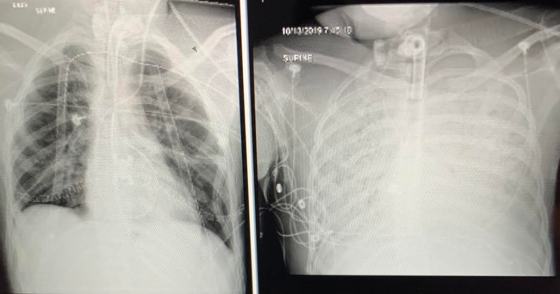
Doctors took a chest x-ray but didn’t see much out of the ordinary; they thought, at first, he might have pneumonia. Ament’s breathing problems persisted, so St. John admitted him on Sept. 5—and that, he says, is about where his memory drops off. As Ament drifted in and out of consciousness, his condition worsened. Doctors at St. John intubated him on Sept. 12, and five days later transferred him to Children’s Hospital of Michigan for more intensive care. There, he was hooked up to an ECMO machine, which oxygenates the body’s blood and organs so the lungs can rest. But Ament kept getting worse, and it quickly became clear that a double lung transplant was the only way to keep him alive. That’s when Dr. Hassan Nemeh, a thoracic surgeon at Detroit’s Henry Ford Hospital, got involved.

Ament-lung-xrays
Courtesy of the Ament familyAment’s lung x-rays.

“His case, to the best of my ability to remember, is the worst [lung damage] that I’ve seen,” Nemeh says. “We were against a wall. We had to transplant him or pull support. I truly don’t think he had a lot of time left.”

The severity of Ament’s case was a mixed blessing. Patients in immediate need of a lifesaving organ transplant are moved up the waiting list, potentially allowing doctors to accept matches from other states or regions if it means a donor comes through in time. After Ament was listed on Oct. 8, he moved to the top of the list almost immediately. While double lung transplants are fairly rare, especially for a teenager—only 37 were performed on 11- to 17-year-old Americans in 2019, according to federal data—Nemeh and his team were able to find a deceased donor who was a match for Ament about a week later. They performed a double lung transplant on Oct. 15.

When the surgeons removed Ament’s lungs, Nemeh remembers, “they were so scarred they didn’t even deflate. It was definitely a different kind of damage than we usually see. This lung was literally solid, as if it was made out of truck-tire rubber.”

Nemeh isn’t entirely sure what could have caused that unusual damage, but says he is confident it had to do with Ament’s vaping habit. Most people who have reported vaping-related lung injuries got sick after using products containing THC, and the U.S. Centers for Disease Control and Prevention has found a strong connection between illnesses and the oily additive vitamin E acetate, which is used to dilute THC content in vaping oils.

When Ament finally came to after surgery, his muscles were so weak from months in a hospital bed that he couldn’t talk and could hardly breathe; he wasn’t taken off a ventilator until Oct. 27. “I was kind of freaking out when I woke up,” Ament says. “I kept having nightmares and hallucinating. I don’t think I processed it at first.”

Even months later, Ament says he’s still processing what happened. “I still have moments where I’ll kind of have a reality check,” he says. “I think about it a lot.”

He also thinks a lot about something he and Nehmeh discussed after the surgery: the need to do good. “I talked to him quite a bit to give him pep talks and try to build up his spirit and give him hope for the future,” Nemeh says. “He has a unique chance to make a huge difference, because his word is very credible to many kids. They can see him as a living example.”

Ament is using that platform to try to dissuade his peers—including his own friends and brother, who still vape—from using e-cigarettes. He’s working on founding a nonprofit called Fight4Wellness that he hopes will enable him to tell his story more widely, through speaking at schools and developing toolkits that educators can use to help kids quit the habit. Ament isn’t back in school yet, but hopes to be soon; he still aspires to graduate high school and go to college, though his health problems and long recovery have put his old dream of attending the U.S. Naval Academyfurther from reach.

Ament says he wants other teenagers to know they’re “not invincible. Any plans they have for the future, any sports they play, anything they’re really passionate about, it’ll all be way harder to do if this happens to them. What’s the point of getting that small buzz [from vaping]?”

He’s especially committed to spreading that message, because he wants to thank his organ donor’s family for making his second chance possible. “It’s not going to be in vain,” Ament says. “I’m going to take good care of my body and use [these lungs] well.”


New Photos Reveal Sun’s Turbulent Surface in ‘Unprecedented’ Detail


(NEW YORK) — A telescope in Hawaii has produced its first images of the sun, revealing its turbulent gas surface in what scientists called unprecedented detail.

They show the surface covered with bright cell-like areas, each about the size of Texas, that result from the transporting of heat from the sun’s interior. The telescope can reveal features as small as 18 miles (30 km) across, according to the National Science Foundation, which released the images.

Further observations will help scientists understand and predict solar activity that can disrupt satellite communications and affect power grids, the foundation said. The telescope is on the island of Maui.

10 Men Jailed in Mauritania Over ‘Gay Marriage’ Video, and Could Face Death Sentences


(NOUAKCHOTT, Mauritania) — Authorities in Mauritania have arrested 10 men after a video appeared on social media of a gay couple appearing to take part in a traditional wedding ceremony, human rights groups said.

Police later determined the gathering was a birthday party but the men remain in custody with no trial date set yet.

Mauritania practices strict Islamic law known as Shariah and homosexuality is criminalized. If convicted, the men could face the death penalty though executions have not been carried out in more than a decade, according to Amnesty International.

“It is a serious attack on the individual and collective freedom of these young people who have the right to display their difference and intimate preferences,” said Brahim Bilal, the president of a human rights organization in Mauritania.

Video of the festive ceremony prompted an outcry to what was suspected of being the first gay marriage in Mauritania.

The Nouakchott public prosecutor’s office then opened an investigation, and the police arrested the 10 young men. The case marks a rare enforcement of Islamic law: In 2018 Human Rights Watch said there were no known cases of people being jailed or sentenced to death for homosexual acts in Mauritania.

Same-sex acts are illegal in more than 33 African countries and can lead to death sentences in parts of at least four, including Mauritania, Sudan, northern Nigeria and southern Somalia, according to Amnesty International.

Why Coronavirus Seems to Be Striking More Adults Than Kids


More than 8,000 people worldwide have been infected, and 171 have been killed, by a novel coronavirus that originated in Wuhan, China last month. But early research out of Wuhan suggests one group has been largely spared by the contagious disease: young children.

A paper published in the New England Journal of Medicine on Thursday analyzed characteristics of 425 of the first people in Wuhan infected by the virus known as 2019-nCoV and found that none were younger than 15. The median age of patients was 59, and, at least as of mid-January, the youngest person to die from the disease was 36.

Though there are not good data to show how many children have been infected as the virus spread beyond those first 425 patients, it’s certain that that number is no longer zero: a nine-month-old baby in Beijing is the youngest known patient, according to city health authorities. Even still, the early patient characteristics reported in NEJM provides clues about who the virus is, or is not, infecting.

It also provides another point of comparison to fellow coronavirus severe acute respiratory syndrome, or SARS, says Dr. Mark Denison, a pediatric infectious disease specialist at Vanderbilt University School of Medicine. SARS was “dramatically less common” among children than adults during the outbreak that began in China around 2003, and Denison says kids younger than 13 reported much less severe symptoms than older patients.

It’s possible that, due to some quirk of biology, children are simply less susceptible than adults to 2019-nCoV infection; their cells may be less hospitable to the virus, making it more difficult for 2019-nCoV to replicate and jump to other people, Denison says. The NEJM authors write that kids may be getting the virus but showing milder symptoms than adults, making them less likely to seek medical care and thus excluding them from research and case counts.

Denison says that tracks with the behavior of many other viral illnesses. “Evolutionarily, we’re designed to be exposed to these things as kids, and then we have broad-based immunity,” he says. “Get it now while you’re more likely to survive, and then you won’t get it later.”

Take the seasonal flu, for example. Plenty of kids in the U.S. get the influenza virus each year, but far fewer children than adults die from the disease. During the 2018-2019 season, for example, an estimated 7.6 million kids ages five to 17 got the flu, but only 211 died, for a mortality rate of 0.002%. By contrast, an estimated 11.9 million adults 18 to 49 got the flu, but 2,450 died—a mortality rate of 0.02%.

Dr. Sharon Nachman, a pediatric infectious disease specialist at Stony Brook Children’s Hospital, in Stony Brook, N.Y., adds that children’s environments may help them. Kids may see more common coronaviruses—a class of viruses that includes some that can cause the common cold—than adults do, potentially giving them a certain amount of umbrella immunity. “They’re in school and daycare; they’re in a milieu of infectious diseases,” Nachman says. “Maybe there’s some immunity from coronaviruses that [they develop, but] doesn’t last lifelong.”

Kids are also often plain healthier than adults, Nachman says. “If you’re well and you get an illness, you often do better than if you have” other underlying conditions, she says. Children may also be more up-to-date on their vaccinations, sparing them secondary infections that can often come along with an illness and bring about complications.

Still, Denison cautions that these are just theories at this point, and “do not mean that children can’t get infected and they can’t transmit infection.”

Nachman adds that routine behaviors can help keep populations healthy, regardless of the disease in question. “Good hand-washing helps. Staying healthy and eating healthy will also help,” she says. “The things we take for granted actually do work. It doesn’t matter what the virus is. The routine things work.”

Here’s Everything New on Amazon Prime Video in February 2020


Hunting for a new show to binge? Amazon Prime Video is rolling out a new series Feb. 21 — and it has Al Pacino in a starring role and Jordan Peele (Get Out, Us) as executive producer. Created by David Weil, Hunters tells the fictional story of a squad of Nazi hunters in 1970s New York.

The Amazon original movie Honey Boy, which had a theatrical release in November 2019, is available on the streamer on Feb. 7. The film, directed by Alma Har’el and written by Shia LaBeouf, is a semi-autobiographical depiction of LaBeouf’s own life. The writer stars as an on-screen version of his real-life father, with Lucas Hedges playing a stand-in for LaBeouf as an adult and Noah Jupe for him as a child.

If you missed Awkwafina’s Golden Globe-winning performance in Lulu Wang’s The Farewell: rejoice! The film is available on Amazon on Feb. 12. The same goes for Tom Hanks’ turn as Fred Rogers in A Beautiful Day in the Neighborhood and Scarlett Johansson in Jojo Rabbit, both of which can be rented or purchased on Amazon Prime on Feb. 4.

In addition to the original content, Amazon is adding some older romantic movies just in time for Valentine’s Day, including Bridget Jones’s Diary and Ghost.

Here’s everything new on Amazon Prime Video in February 2020.

Here are the new Amazon Prime originals in February 2020

Available Feb. 7

Honey Boy

All or Nothing: The Philadelphia Eagles

Clifford: Season 1B

If You Give a Mouse a Cookie Valentine’s Day Special

Pete the Cat Valentine’s Day Special

Available Feb. 21

Hunters

Here are the TV shows and movies streaming on Amazon Prime in February 2020

Available Feb. 1

Beat the Devil

Bridget Jones’s Diary

Buffalo ’66

Captain Kronos — Vampire Hunter

Cheech & Chong’s Still Smokin’

Crashing Through Danger

Dick Tracy

Earth Girls Are Easy

Emergency Landing

Father Steps Out

Ghost

Guess What We Learned in School Today?

High Voltage

Judgment Day

Little Tough Guy

Lord of War

Magic Mike

National Lampoon’s Dirty Movie

National Lampoon’s Dorm Daze 2

North of the Border

People Are Funny

Posledniy Bogatyr

Precious

Southie

Taken Heart

The Big Lift

The Fabulous Dorseys

The Last Stand

The Little Princess

The Man Who Could Cheat Death

The Spy Next Door

Touched With Fire

Counterpart: Seasons 1 and 2

Escape at Dannemora: Season 1

Available Feb. 2

Tyler Perry’s a Madea Family Funeral

Available Feb. 3

The Cabin in The Woods

Available Feb. 4

Jallikattu

Available Feb. 5

Warrior

Available Feb. 6

Disaster Movie

Available Feb. 9

Alive

Available Feb. 12

The Farewell


Available Feb. 15

American Ultra

Danger Close

Available Feb. 16

47 Meters Down: Uncaged

Available Feb. 18

Super 8

Available Feb. 21

Ice Princess Lily

Available Feb. 25

Run the Race

Grantchester: Season 4

Here are the movies available for rent or purchase on Amazon Prime in February 2020

Available Feb. 4

A Beautiful Day in the Neighborhood

Midway

Jojo Rabbit

Here’s Everything New on Netflix in February 2020—and What’s Leaving


One of Netflix’s most-anticipated films of the year is almost here. No, not The Irishman, not Marriage Story, but the sequel to the streamer’s 2018 viral sensation, To All the Boys I’ve Loved Before.

To All the Boys: P.S. I Still Love You stars Lana Condor and Noah Centineo as lovebirds Lara Jean and Peter, but in this film, another adaptation of Jenny Han’s young adult book series of the same name, John Ambrose McClaren (Jordan Fisher) interferes with their storybook romance.

While To All the Boys premieres on Feb. 12, just in time for Valentine’s Day, Netflix has the romance ready all month long, adding love stories like Dear John and The Notebook on Feb. 1.

But if love stories aren’t your thing, there’s plenty of counter-programming. On the more somber end of the spectrum, The Pharmacist, an original docuseries following a small-town pharmacist who ends up exposing aspects of the opioid epidemic, hits the streamer on Feb. 5. And the Sundance drama-thriller Horse Girl, directed by Jeff Baena, who co-wrote the screenplay with star Alison Brie, hits Netflix on Feb. 7, with Debby Ryan and Molly Shannon co-starring.

From romantic comedies to animé series, here’s everything new on Netflix—and everything leaving the streamer—in February 2020.

Here are the Netflix originals coming to Netflix in February 2020

Available TBD

Amit Tandon: Family Tendencies

Taj Mahal 1989

Available Feb. 3

Sordo

Team Kaylie: Part 3

Available Feb. 4

Tom Papa: You’re Doing Great!

Available Feb. 5

The Pharmacist

Available Feb. 6

Cagaster of an Insect Cage

Available Feb. 7

Dragons: Rescue Riders: Season 2

Horse Girl

Locke & Key

My Holo Love

Available Feb. 8

The Coldest Game

Available Feb. 9

Captain Underpants Epic Choice-o-Rama

Available Feb. 11

CAMINO A ROMA

Available Feb. 12

To All the Boys: P.S. I Still Love You

Available Feb. 13

Dragon Quest Your Story

Love is Blind

Narcos: Mexico: Season 2

Available Feb. 14

Cable Girls: Final Season

Isi & Ossi

A Shaun the Sheep Movie: Farmageddon

Available Feb. 17

The Expanding Universe of Ashley Garcia

Available Feb. 19

Chef Show: Volume 3

Available Feb. 20

Spectros

Available Feb. 21

Babies

Gentefied

Glitch Techs

Puerta 7

System Crasher

Available Feb. 26

I Am Not Okay With This

Available Feb. 27

Altered Carbon: Season 2

Followers

Pokémon: Mewtwo Strikes Back—Evolution

Available Feb. 28

All the Bright Places

Babylon Berlin: Season 3

Formula 1: Drive to Survive: Season 2

La trinchera infinita

Queen Sono

Restaurants on the Edge

Unstoppable

Here are the TV shows and movies coming to Netflix in February 2020

Available Feb. 1

A Bad Moms Christmas

A Little Princess

Back to the Future Part III

Blade Runner: The Final Cut

Center Stage

Cookie’s Fortune

Dear John

The Dirty Dozen

Dirty Harry

Driving Miss Daisy

Elizabeth

Elizabeth: The Golden Age

Fools Rush In

Hancock

Love Jacked

The Notebook

The Other Guys

The Pianist

Police Academy

Police Academy 2: Their First Assignment

Police Academy 3: Back in Training

Police Academy 4: Citizens on Patrol

Police Academy 5: Assignment: Miami Beach

Police Academy 6: City Under Siege

Police Academy 7: Mission to Moscow

Purple Rain

Robin Hood: Prince of Thieves

Scary Movie 2

Sex and the City 2

Available Feb. 4

Faith, Hope & Love

She Did That

Available Feb. 5

Black Hollywood: ‘They’ve Gotta Have Us’

#cats_the_mewvie

Available Feb. 7

The Ballad of Lefty Brown

Who Killed Malcolm X?

Available Feb. 9

Better Call Saul: Season 4

Polaroid

Available Feb. 11

Good Time

Q Ball

Available Feb. 12

Anna Karenina

Available Feb. 15

Starship Troopers

Available Feb. 21

A Haunted House

Available Feb. 22

Girl On the Third Floor

Available Feb. 23

Full Count

Available Feb. 25

Every Time I Die

Available Feb. 27

The Angry Birds Movie 2

Jeopardy!: Celebrate Alex Collection

Jeopardy!: Cindy Stowell Collection

Jeopardy!: Seth Wilson Collection

Available Feb. 29

Jerry Maguire

Here’s what’s leaving Netflix in February 2020

Leaving Feb. 11

Clouds of Sils Maria

Leaving Feb. 14

District 9

Leaving Feb. 15

Milk

Operator

Peter Rabbit

Leaving Feb. 18

The 2000s: Season 1

Leaving Feb. 19

Charlotte’s Web

Gangs of New York

The Eighties: Season 1

The Nineties: Season 1

The Seventies: Season 1

Leaving Feb. 20

Lincoln

Leaving Feb. 21

The Texas Chainsaw Massacre

Leaving Feb. 26

Our Idiot Brother

Leaving Feb. 27

Jeopardy!: Buzzy Cohen Collection

Jeopardy!: College Championship II

Jeopardy!: Teachers’ Tournament II

Jeopardy!: Teen Tournament III

Jeopardy!: Tournament of Champions III

Leaving Feb. 28

My Little Pony Equestria Girls: Rainbow Rocks

Primal Fear

Trainspotting

Leaving Feb. 29

50/50

American Beauty

Anger Management

Charlie and the Chocolate Factory

Free Willy

Hustle & Flow

Igor

Layer Cake

Rachel Getting Married

Stripes

The Matrix

The Matrix Reloaded

The Matrix Revolutions

The Mind of a Chef: Season 1-5

The Taking of Pelham 123

Up in the Air

Bernie Sanders Releases His Disability Policy Plan Ahead of Iowa Caucuses


With four days to go until the Iowa caucuses, Bernie Sanders unveiled a proposed disability policy on Friday, joining nearly every other top Democratic presidential candidate in spotlighting the concerns of a historically marginalized group.

People with disabilities make up one quarter of the U.S. adult population, but they have in the past received little attention from politicians seeking the White House. This cycle has been markedly different, with at least seven current and former Democratic candidates releasing disability policies in the past few months, and many involving disabled people in shaping those ideas. Former Vice President Joe Biden is the only remaining top-polling candidate who has not yet released a plan.

While disability rights advocates have expressed some support for many of the other Democratic candidates’ proposals — particularly Massachusetts Sen. Elizabeth Warren’s, which was released earlier this month — Sanders’ plan is the most ambitious. His proposed policy, which opens by declaring that “disability rights are civil rights,” is wide-ranging and covers issues including health care, employment, Social Security, education, environmental justice, housing, immigration, incarceration, technology and voting.

“Nearly thirty years after the ADA, it is unacceptable that people with disabilities do not enjoy full equality and inclusion everywhere in America, and we will not wait to advance disability rights,” Sanders said in a statement. “This is an issue of fundamental civil rights. Every person with a disability deserves the right to live in their community and have the support they need to thrive. This right must be available to all, free of waiting lists and means tests. It is our moral responsibility to make it happen.”

The idea of ensuring that people with disabilities are included in their communities is core to disability advocates’ vision, and Sanders mentions the goal throughout the 13,000 word document. The plan begins by outlining a number of steps Sanders would take using executive action, including appointing an Attorney General who would aggressively enforce the Supreme Court’s Olmstead v. L.C. decision that requires states to offer services to disabled people in integrated settings.

“Starting off with community integration shows that the Sanders campaign is clearly in touch with the energy and priorities of the grassroots,” says Rebecca Cokley, director of the Center for American Progress’s Disability Justice Initiative, who advised Sanders on his plan and has also worked with other candidates, including Warren.

Some ideas in Sanders plan echo his fellow Democrats’ proposals. Many of the other candidates, including Warren, Biden, former South Bend, Ind., Mayor Pete Buttigieg and Senator Amy Klobuchar, have called for fully funding the Individuals with Disabilities Education Act and ending the sub-minimum wage, a policy that allows employers to pay some people with disabilities very low wages as an enticement to hire them.

Also like Warren, Sanders promises to create a National Office of Disability Coordination to oversee disability policy. In another similarity with Warren, his plan delves into detail of how he would reform the Social Security Disability Insurance and Supplemental Security Income programs, saying he would eliminate asset limits and get rid of penalties that make it tough for some people with disabilities to get married and keep those benefits. Where Warren’s plan promised to raise the SSI benefit to match the federal poverty line, Sanders’ plan would push it to 125% of the federal poverty line.

Sanders also details the ways his signature Medicare for All legislation would help people with disabilities, providing not only free health care but also long-term services and supports in people’s homes and communities as opposed to institutions.

Sanders’ disability plan includes sections on immigration, criminal justice reform, housing and transportation—topics that often impact people with disabilities. The plan, for example, promises to pass disaster preparedness legislation, create a $40 billion Climate Justice Resiliency Fund, establish an office dedicated to climate resiliency for people with disabilities and ensure that the Green New Deal’s implementation takes disabled Americans into account.

Cokley said that Sanders’ plan stands out from the crowd in part because it includes disability rights in addressing climate change. “I’m struck by Sanders’ ability to think through how to make the Green New Deal inclusive of the disability community,” she said.

Before Sanders released his specific agenda aimed at people with disabilities, he had already mentioned disability rights on his campaign website and throughout many of his other policy plans. This new policy notes that it consulted a number of disability advocates and experts, something that Warren emphasized as well.

Disability advocates have expressed enthusiasm for the increased engagement this cycle, while continuing to press the candidates to explain their policies and answer questions through accessible forums such as Twitter chats. Warren and Buttigieg, as well as former HUD Secretary Julián Castro, who dropped out of the race in early January, have held such chats, and the founders of the popular #CripTheVote hashtag have made clear they would like to welcome other candidates, including Sanders, to do so in the future.

People with disabilities have not always voted at high rates, but their turnout surged during the 2018 midterms. Experts say the increased engagement from politicians this year could mean more people with disabilities will vote in 2020, and Sanders’ plan is the latest example of efforts that could make that happen.

Zimbabwe Quietly Lifts Ban on Genetically Modified Corn Imports in Bid to Avert Famine


Zimbabwe has quietly lifted a ban on imports of genetically modified corn for the first time in 12 years as the southern African nation begins to take action to avert what could be its worst famine.

While genetically modified corn imports from South Africa are being allowed, the grain is carefully quarantined and is milled into a corn meal, a national staple, three officials with knowledge of the situation said, asking not to be identified as an announcement has not been made. Currently corn meal, used to make the staple food known locally as sadza, is in short supply across the nation.

Zimbabwe is battling its worst drought in 40 years and is in the midst of an economic collapse. That’s left about 8 million people, or more than half the population, in need of food aid.

Aside from in South Africa, genetically modified corn is shunned across sub-Saharan Africa and in Zimbabwe steps are being taken to ensure the grain doesn’t enter national seed stocks. A logistics team has been sent to South Africa to have oversight of the grain-import exercise, one of the people said. Plans are also under way to provide special clearance for trucks bringing in grain to avoid delays at southern Africa’s busiest border, Beitbridge between South Africa and Zimbabwe.

Agriculture Minister Perence Shiri and the permanent secretary in the ministry, John Basera, didn’t immediately respond to messages and phone calls seeking comment. Tafadzwa Musarara, chairman of the Grain Millers Association of Zimbabwe, also didn’t respond to messages and calls.

“Government weighs its position on genetically modified corn against the nutritional needs of the nation and proceeds guided by that assessment,” said Nick Mangwana, the government’s main spokesman, without saying whether the ban has been lifted.

The country’s corn harvest is expected to plunge by more than half this season and there is a likely supply deficit of between 800,000 tons and 1 million tons.

Weekly imports of white corn, the variety used mainly for human consumption in the country, reached their highest in almost seven years, with 13,688 tons imported in week ending Jan. 24.

The millers association on Jan. 22 said it had signed up for a monthly supply of 100,000 tons of corn from South Africa. Until now there has been little evidence of sufficient corn imports coming into the country.

Jannie de Villiers, chief executive officer at Grain SA, said it was possible for genetic corn to be separated and sent straight for processing and Zimbabwe had done this previously.

“Historically, Zimbabwe only imports genetically modified-free corn, not because of food safety concerns, but seed safety concerns. Strategically, they do not want to be dependent on seed from multinational companies,” de Villiers said in an emailed response to questions.

The industry and commerce ministry has 65 registered millers that have signed up for its corn-subsidy program, which the government rolled out in December last year and is meant to provide affordable corn-meal.

You Can Fly From Hong Kong to New York for Just $193 — If You’re Willing to Make a 6-Hour Stopover in Wuhan


Bargain flights between Hong Kong and New York have emerged in the wake of the new coronavirus, as long as travelers are willing to stop in Wuhan, the epicenter of the outbreak, in just a few months.

Flying with China Southern Airlines Co. to John F. Kennedy International on May 20 costs only $193, according to travel booking site kayak.com. The trip includes 6 hours and 35 minutes in Wuhan. The next-cheapest ticket, with China Eastern Airlines Co. via Shanghai, is $487. Direct American Airlines Inc. flights are on offer for $2,688.

Wuhan and the surrounding region are currently in lockdown, effectively quarantining some 50 million people. A raft of international airlines, from British Airways to Singapore Airlines, are chopping flights to mainland China.

It’s not clear how long the crisis will last: Infections are soaring and the World Health Organization has declared the outbreak a public health emergency. The SARS virus in 2003 was contained in about six months.

Secretary of State Pompeo Touches Down in Ukraine as Impeachment Trial Hangs in the Balance


(KYIV, Ukraine) — U.S. Secretary of State Mike Pompeo opened a visit to Ukraine on Friday facing a delicate balancing act as he tries to boost ties with a critical ally at the heart of the impeachment trial while not providing fodder for Democrats seeking to oust President Donald Trump.

The highest-ranking American official to visit Ukraine since the impeachment process began last year, Pompeo’s was meeting with Ukraine’s president and other top officials. Trump is alleged to have pressed them to open a corruption probe into former Vice President Joe Biden’s family in return for vital military aid and a White House visit.

That process began last year with revelations about a July 25 phone call between Trump and President Volodymyr Zelenskiy.

Pompeo’s meetings in Kyiv come as the Senate prepared to vote on whether to hear witnesses who could shed further light on Trump’s actions toward Ukraine.

In addition to Zelenskiy, Pompeo is meeting Ukraine’s prime, foreign and defense ministers as well as civic leaders, and touring several churches.

Trump is accused of obstructing Congress and abuse of office for withholding critical military aid to the country in exchange for an investigation into Biden, a political rival, and his son, Hunter.

Ukraine has been an unwilling star in the impeachment proceedings, eager for good relations with Trump as it depends heavily on U.S. support to defend itself from Russian-backed separatists. Trump, who has still not granted Zelenskiy the White House meeting he craves, has offered that support to some degree. Although the military assistance was put on hold, it was eventually released after a whistleblower complaint brought the July 25 call to light. The Trump administration has also supplied Ukraine with lethal defense equipment, including Javelin anti-tank weapons.

Pompeo plans to stress the importance of the U.S.-Ukraine relationship, a sentiment long shared by Republicans and Democrats who see the former Soviet republic as a bulwark against Russian ambitions. But it’s a view that now has partisan overtones, with Democrats arguing that withholding aid from such a critical ally for political purposes is an impeachable offense.

The Senate is expected to vote on hearing impeachment witnesses on Friday. Democrats want to hear from former national security adviser John Bolton, whose forthcoming book reportedly says that Trump withheld the aid in exchange for a public pledge of a probe into the Bidens. That would back witnesses who testified before the House impeachment inquiry.

Ukraine has been a delicate subject for Pompeo, who last weekend lashed out at a National Public Radio reporter for asking why he has not publicly defended the former U.S. ambassador to Ukraine, Marie Yovanovitch. She was removed from her post after unsubstantiated allegations were made against her by Trump’s personal attorney, Rudolph Giuliani.

Pompeo has been criticized for not publicly supporting Yovanovitch, her now-departed successor as chief of the Kyiv embassy, William Taylor, and other diplomats who testified before House impeachment investigators. Yovanovitch and Taylor have been attacked by Trump supporters and, in some cases, have been accused of disloyalty.

In the NPR interview, Pompeo took umbrage when asked if he owed Yovanovitch an apology, and maintained that he had defended all of his employees. In an angry encounter after the interview, he also questioned if Americans actually cared about Ukraine, according to NPR.

That comment prompted Taylor and Pompeo’s former special envoy for Ukraine, Kurt Volker, who also testified to the impeachment panel, to write opinion pieces discussing the importance of the country to U.S. national security and why Pompeo should be explaining its role to Americans as their top diplomat.

Pompeo brushed aside his reported comment, telling reporters aboard his plane that “of course, the American people care about the people of Ukraine” and said his message to American diplomats in Ukraine would be the same he gives to those at other embassies.

“The message is very similar to every embassy that I get a chance to talk to when I travel,” he said. “I almost always meet with the team and tell them how much we love them, appreciate them, appreciate their family members and their sacrifice.”

He said he would “talk about the important work that the United States and Ukraine will continue to do together to fight corruption inside of that country and to ensure that America provides the support that the Ukrainian people need to ensure that they have a free and independent nation.”

Pompeo twice postponed earlier planned trips to Ukraine, most recently in early January when developments with Iran forced him to cancel. Pompeo said he plans to discuss the issue of corruption but demurred when asked if he would specifically raise the Bidens or the energy company Burisma, for which Hunter Biden worked.

“I don’t want to talk about particular individuals. It’s not worth it,” he told reporters. “It’s a long list in Ukraine of corrupt individuals and a long history there. And President Zelenskiy has told us he’s committed to it. The actions he’s taken so far demonstrate that, and I look forward to having a conversation about that with him as well.”

Pompeo traveled to Kyiv from London, which was the first stop on a trip to Europe and Central Asia that will also take him to Belarus, Kazakhstan and Uzbekistan.

3 Belgian Doctors Acquitted of Manslaughter for Involvement in Euthanasia of Mentally Ill Man, 38


(BRUSSELS) — A Belgian court on Friday acquitted three doctors of charges of manslaughter by poisoning in a case that has been seen as a key test of Belgium’s euthanasia laws.

The three doctors were involved in the euthanasia of a 38-year-old patient, Tine Nys, who suffered with mental problems and died in 2010.

Her family took the case to court, arguing that the euthanasia should never have happened, claiming her mental state was not hopeless and treatment was still possible. Nys had struggled with psychiatric problems for years and had attempted suicide several times.

“This is such a relief. This has been with us for 10 years,” psychiatrist Lieve Thienpont, one of the acquitted doctors, told VRT network. The 12 jurors took eight hours to weigh the question of guilt and when they came to their verdict early Friday, over 100 remaining attendees in the court room broke out in wild applause.

Belgium is among a few countries that allow doctors to kill patients at their request, and one of two that allow it for people with a mental illness.

Out of about 2,000 euthanasia cases a year in Belgium, very few are permitted for psychological issues. The criminal complaint by the family was only granted on appeal after it was first rejected by a lower court.

It was something that riled the defense lawyers, some of whom thought there were conservative political forces at work to bring the case to the court where a citizens’ jury would rule on the case.

“This is relief for all doctors who have to carry out such tough tasks,” said defense lawyer Walter Van Steenbrugge. “If this would have gone the other way, so many doctors would have been in real deep trouble,” he said, implying few would want to risk assisting in euthanasia if it meant that they could face manslaughter charges.

Even if the two-week court case laid bare sloppy procedures by some doctors and imperfections in the law, it did in the end protect the principles of the practice.

“People will continue to hold on to the right of a dignified death when death is inescapable,” Thienpont said.

Secretary of State Pompeo Touches Down in Ukraine as Impeachment Trial Hangs in the Balance


(KYIV, Ukraine) — U.S. Secretary of State Mike Pompeo opened a visit to Ukraine on Friday facing a delicate balancing act as he tries to boost ties with a critical ally at the heart of the impeachment trial while not providing fodder for Democrats seeking to oust President Donald Trump.

The highest-ranking American official to visit Ukraine since the impeachment process began last year, Pompeo’s was meeting with Ukraine’s president and other top officials. Trump is alleged to have pressed them to open a corruption probe into former Vice President Joe Biden’s family in return for vital military aid and a White House visit.

That process began last year with revelations about a July 25 phone call between Trump and President Volodymyr Zelenskiy.

Pompeo’s meetings in Kyiv come as the Senate prepared to vote on whether to hear witnesses who could shed further light on Trump’s actions toward Ukraine.

In addition to Zelenskiy, Pompeo is meeting Ukraine’s prime, foreign and defense ministers as well as civic leaders, and touring several churches.

Trump is accused of obstructing Congress and abuse of office for withholding critical military aid to the country in exchange for an investigation into Biden, a political rival, and his son, Hunter.

Ukraine has been an unwilling star in the impeachment proceedings, eager for good relations with Trump as it depends heavily on U.S. support to defend itself from Russian-backed separatists. Trump, who has still not granted Zelenskiy the White House meeting he craves, has offered that support to some degree. Although the military assistance was put on hold, it was eventually released after a whistleblower complaint brought the July 25 call to light. The Trump administration has also supplied Ukraine with lethal defense equipment, including Javelin anti-tank weapons.

Pompeo plans to stress the importance of the U.S.-Ukraine relationship, a sentiment long shared by Republicans and Democrats who see the former Soviet republic as a bulwark against Russian ambitions. But it’s a view that now has partisan overtones, with Democrats arguing that withholding aid from such a critical ally for political purposes is an impeachable offense.

The Senate is expected to vote on hearing impeachment witnesses on Friday. Democrats want to hear from former national security adviser John Bolton, whose forthcoming book reportedly says that Trump withheld the aid in exchange for a public pledge of a probe into the Bidens. That would back witnesses who testified before the House impeachment inquiry.

Ukraine has been a delicate subject for Pompeo, who last weekend lashed out at a National Public Radio reporter for asking why he has not publicly defended the former U.S. ambassador to Ukraine, Marie Yovanovitch. She was removed from her post after unsubstantiated allegations were made against her by Trump’s personal attorney, Rudolph Giuliani.

Pompeo has been criticized for not publicly supporting Yovanovitch, her now-departed successor as chief of the Kyiv embassy, William Taylor, and other diplomats who testified before House impeachment investigators. Yovanovitch and Taylor have been attacked by Trump supporters and, in some cases, have been accused of disloyalty.

In the NPR interview, Pompeo took umbrage when asked if he owed Yovanovitch an apology, and maintained that he had defended all of his employees. In an angry encounter after the interview, he also questioned if Americans actually cared about Ukraine, according to NPR.

That comment prompted Taylor and Pompeo’s former special envoy for Ukraine, Kurt Volker, who also testified to the impeachment panel, to write opinion pieces discussing the importance of the country to U.S. national security and why Pompeo should be explaining its role to Americans as their top diplomat.

Pompeo brushed aside his reported comment, telling reporters aboard his plane that “of course, the American people care about the people of Ukraine” and said his message to American diplomats in Ukraine would be the same he gives to those at other embassies.

“The message is very similar to every embassy that I get a chance to talk to when I travel,” he said. “I almost always meet with the team and tell them how much we love them, appreciate them, appreciate their family members and their sacrifice.”

He said he would “talk about the important work that the United States and Ukraine will continue to do together to fight corruption inside of that country and to ensure that America provides the support that the Ukrainian people need to ensure that they have a free and independent nation.”

Pompeo twice postponed earlier planned trips to Ukraine, most recently in early January when developments with Iran forced him to cancel. Pompeo said he plans to discuss the issue of corruption but demurred when asked if he would specifically raise the Bidens or the energy company Burisma, for which Hunter Biden worked.

“I don’t want to talk about particular individuals. It’s not worth it,” he told reporters. “It’s a long list in Ukraine of corrupt individuals and a long history there. And President Zelenskiy has told us he’s committed to it. The actions he’s taken so far demonstrate that, and I look forward to having a conversation about that with him as well.”

Pompeo traveled to Kyiv from London, which was the first stop on a trip to Europe and Central Asia that will also take him to Belarus, Kazakhstan and Uzbekistan.

‘We Can’t Deal With This Tsunami.’ As the Coronavirus Spreads, Hong Kong Medical Workers Feel the Pressure


Benjamin So was mid-way through a 36-hour shift at a Hong Kong hospital when an elderly couple from Wuhan, China was wheeled into the isolation ward at 3 a.m. After the nurse took their vitals and nasal samples to test for the novel coronavirus, he got to work.

Inside the negative pressure chamber, So, a resident in internal medicine, asked the male patient about his symptoms, listened to his chest and reviewed an x-ray scan of his lungs. Then, he did the same with the female.

Around nine hours later, both tests came back positive. The 72-year-old man and 73-year-old woman became the ninth and tenth confirmed coronavirus cases in Hong Kong.

“I was a little shaken when I found out,” So told TIME.

After he came off shift, he sought answers from the hospital on how he should protect himself, having been in close contact with the two infected patients. The authorities said they would not provide quarantine facilities for him since he was wearing full gear during the interactions. He was even told he could come into work as normal the next day.

Frustrated, So booked himself a hotel room and decided he would isolate himself for the time being.

He may seem overcautious to some. But the 2003 SARS outbreak killed 360 hospital workers around the world and medical staff accounted for about a fifth of the 299 SARS-related deaths in Hong Kong. The coronavirus has proven to be more infectious than previously thought, and carriers of it may not show symptoms. A hospital outbreak is the biggest fear of many healthcare workers, who are not leaving anything up to chance.

Read more: A Timeline of How the Wuhan Coronavirus Has Spread—And How the World Has Reacted

There are hundreds of medical workers on the front lines of the fight against the coronavirus in Hong Kong, a semi-autonomous southern enclave separated by a border from mainland China, where the virus has killed at least 210 people and infected more than 9,700.

The virus, known as 2019-nCoV, has also spread to at least a dozen countries, but Hong Kong’s 12 confirmed cases are one of the highest outside of mainland China and the local situation threatens to worsen. As many as 95 suspected cases have been reported every day for the past week and more are expected as Hongkongers begin returning home after spending the Lunar New Year up north.

The Hong Kong government says the territory is well equipped to deal with an epidemic and that 1,400 isolation beds can be made available when necessary—a number many medical workers say is greatly exaggerated. But the public is skeptical and are calling for a full closure of the border with mainland China (the government has shut some entry points but kept others open) to reduce the chances of confirmed cases being brought into the city. In recent days, medical workers have threatened to strike until the government responds.

Many are also under intense pressure from their families to resign. “[My colleagues and I] talk about how ridiculous everything is,” So says, “about whether our life insurance will be valid if we die due to negligence on the part of the hospital.”

Cracks in the system

Joe, a resident specialist in his 30s at another medical facility, has so far only dealt with suspected coronavirus cases. (He asked to go by a pseudonym to protect his identity.) But he’s volunteered to join the so-called “dirty team,” assigned to working with confirmed cases, should they come through to his hospital, next month.

“I don’t have kids,” Joe says. “But my colleagues, a good friend of mine, has two kids. Another colleague who is also going to join the ‘dirty team’ next week, his wife is going to deliver soon.”

At a recent meeting, Joe’s boss told him: “We must not let the things that happened 17 years ago [during the SARS outbreak] happen again. No matter what, we must protect ourselves and our colleagues.”

In some ways, the coronavirus epidemic has exposed cracks in an healthcare system that many say has long been overburdened. By one estimate, Hong Kong needs thousands more doctors to bring its health services up to international standards. During flu season, bed occupancy rate at public hospitals can exceed 120%, according to a report by the city’s Hospital Authority. Patients wait on average more than three years for specialist care. The rapidly ageing population further compounds the problem—the medical needs of the elderly are at least 5.5 times that of the rest of the population.

Joe complains that the government has overlooked the “collateral damage” that’s resulted from his under-resourced department redirecting efforts to deal with suspected coronavirus cases, most of whom are from the mainland. He says emergency operations have been canceled, and certain procedures have to be put off because they can only be done in isolation wards, which are full.

“We don’t have the capacity,” he says. “We can’t deal with this tsunami.”

Read more: How Long Will the Coronavirus Outbreak Last? Experts Are Scrambling to Find Out

At another hospital, a doctor who asked to be identified as S., agreed that the lack of resources could put lives at risk.

“We don’t have enough isolation wards,” he says. “What happens is that we have to put about two or three suspected cases in one isolated cubicle. The problem is that one of them could come back testing positive.”

Experts estimate that the outbreak could reach its peak around April or May. As the figures continues to rise, being at the front lines of the outbreak has forced S. to ponder life’s toughest questions.

“Whenever I get called to see a patient [suspected to have the virus], I start thinking about life,” he says. “Should I be here? Should I be writing a will? Last night, I even left a message for my ex. I told her no matter what, I’ll always look after her, that my feelings for her have never changed.”

He adds: “We’ve been trained to deal with other people’s deaths, but we haven’t really been trained to face our own.”